

![[Section Divider Image]](https://substackcdn.com/image/fetch/$s_!h9Lq!,f_auto,q_auto:good,fl_progressive:steep/https%3A%2F%2Fsubstack-post-media.s3.amazonaws.com%2Fpublic%2Fimages%2F6ddf02e7-96bb-4bcb-acde-99ab8a43052d_1320x50.webp "[Section Divider Image]")
Australia just announced it is going to fund a missile factory with pension savings.
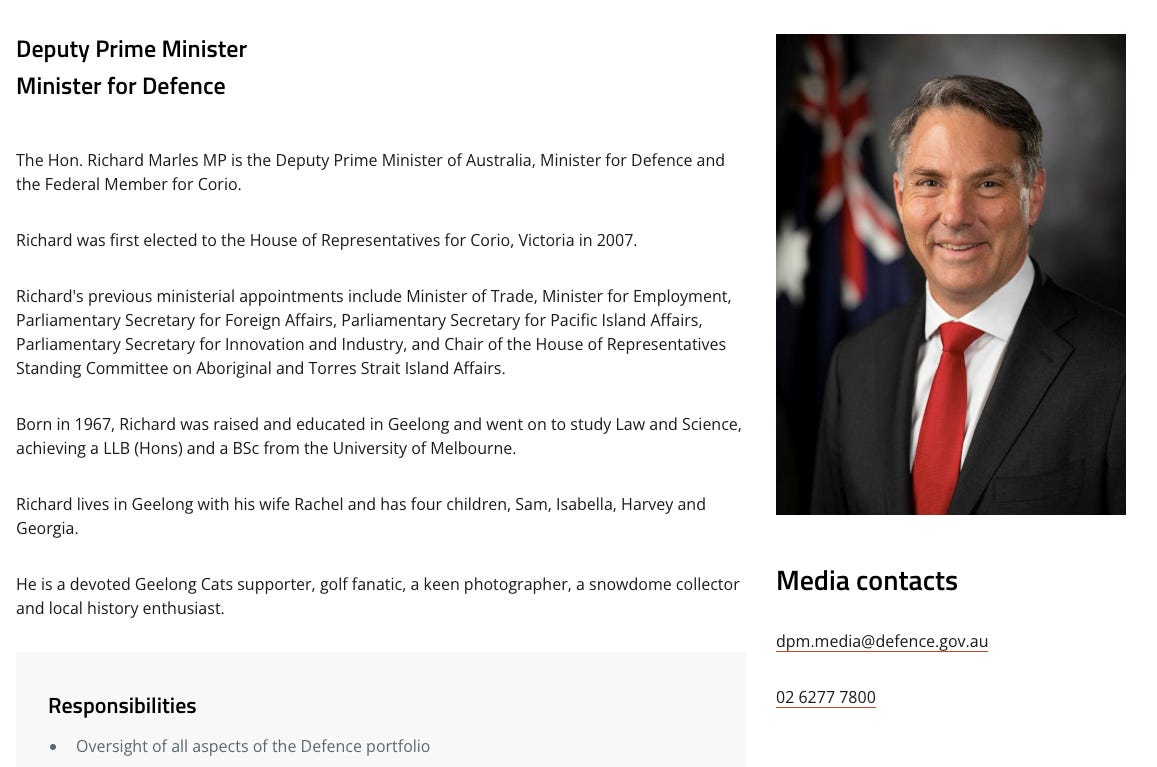
That is not creative interpretation. The Australian Financial Review reported on 3 May that Defence Minister Marles is delivering an additional $53 billion of military spending across the decade, of which roughly $15 billion will come through what the official press release describes as “alternative financing where appropriate.” The “private investors” the Government has in mind are not Goldman Sachs. They are sitting on $4.5 trillion of mandatory employee retirement contributions known as superannuation.
The Albanese government did not describe this as pension capture. They described it as “off-budget structures” and “special government investment vehicles.”
Of course they did.
One Australian defence analyst reading the same press release used the phrase “Enron-level creative financing.” We would have settled for “the lucky country has discovered the largest immobile pool of capital it has access to and is gently moving the goalposts on what that capital can be directed toward.”
In other words... the pot has a lid on it, and the hands have arrived.
This Is a Pattern, Not a Surprise
Governments do not raid pensions because they are cartoon villains. They raid pensions because the alternative is doing something politically harder. Selling more bonds at yields the market actually demands. Raising taxes to a level the electorate will not accept. Reducing public spending to match revenue. None of those are compatible with re-election cycles.
Pension capture is.
Walk over to London. From 6 April 2027, unused defined contribution pension funds and most lump-sum death benefits will be pulled into the deceased’s estate for inheritance tax purposes. Effective rate above the nil-rate band: 40 per cent. The nil-rate band is frozen at £325,000 until 2030 to 2031, which means rising property values pull more estates into the net every year. New analysis estimates 152 additional UK local authorities will cross the IHT threshold once pensions are included.
The kicker is the withholding notice. Pension scheme administrators can be instructed to withhold up to 50 per cent of pension funds for fifteen months from date of death while HMRC works out what it is owed. In other words... your spouse cannot access half your pension for over a year after you die while a tax bill is calculated on the rest.
Effective 40 per cent. Frozen threshold. Half the pot impounded for fifteen months. This is what the soggy island calls pension reform.
We covered the American version of the same playbook in No Cash, No Yield, No Exit. Trump’s executive order opening 401(k) plans to private credit and private equity, just as the largest funds in those asset classes were beginning to gate redemptions on the existing investors. Ninety million American savers and roughly $13.8 trillion of defined contribution assets are about to become a distribution channel for an asset class whose existing retail customers are currently being told to stand in line. Three jurisdictions, three flavours, the same playbook running on the same week.

And This Has Happened Five Times Already
For anyone tempted to think this is a unique feature of our particular financial moment, allow us to walk through what governments have already done when they ran out of less politically inconvenient options.
Hungary, 2010 to 2011. Orbán’s government issued an ultimatum to citizens: transfer your private pension assets to the state, or forfeit your state pension entitlement entirely. Around 97 per cent “elected” to transfer. Roughly $14 billion in private pension assets were absorbed into general government revenue and used to meet EU deficit targets.

Argentina, 2008. The Kirchner government nationalised approximately $30 billion in private AFJP pension funds, ostensibly to “protect” retirees from the Global Financial Crisis. In reality the funds plugged a fiscal hole and gave the state large equity stakes in private Argentine companies. Pensioners received government bonds in exchange. Argentina subsequently defaulted on those bonds.
Ireland, 2011. The government raided the National Pension Reserve Fund, around €5 billion, to recapitalise banks and meet the conditions of the EU and IMF bailout programme. The retirees whose money it was had no vote.
Poland, 2014. The Tusk government seized $50.4 billion in Polish Treasury bonds held in private pension funds and transferred them to the state ZUS system. The bonds were promptly cancelled. Reported national debt fell from 57 per cent of GDP to 49.9 per cent. Pensioners received a state-guaranteed pension liability in return for their privately-held assets, which is a polite way of saying they received an IOU from the same entity that just confiscated their savings.

Cyprus, 2013. Bank deposits over €100,000 were bailed in directly. Pension funds with bank exposure were wiped. The mechanism was presented as a condition of the EU bailout, which is the Brussels-approved euphemism for “we have run out of options and have decided that this money is now ours.”

Five jurisdictions. Five rationales. One pattern. The phrase changes. The mechanism does not.
The Australian model fits the Polish-Portuguese template most closely: shift defence spending off the formal balance sheet while the economic cost is borne by retirees who do not yet realise they are silent partners in a missile factory.
Why Now
The reason these moves cluster in time is not coincidence. Governments are reaching for pension assets now because the bond market is no longer giving them what they need at prices they can afford. Yields on the long end are testing multi-decade highs across the developed world simultaneously. The fiscal arithmetic does not work. The political arithmetic does not allow tax rises. The retirement assets sit there, regulated, accessible, and politically defensible because most of the people whose money it is have not yet noticed.

Pensions are the path of least resistance. They always have been.
What You Cannot “Pension-Tax”
Which brings us to the question every investor with a pension in a Western jurisdiction should be asking: what cannot easily be pension-taxed, withholding-noticed, redirected toward “productive finance” mandates, or quietly shifted off-balance-sheet?
The honest answer is: things you can hold outside the regulated retirement architecture entirely. Hard assets in jurisdictions where the enforcement reach is weaker than the seizure ambition. Physical commodity exposure that does not require a custodian to honour your claim. The dividend-paying real-asset companies we have been writing about for years. Argentina, where capital is currently smelling freedom and the regulatory environment is moving in the opposite direction to most of the developed world.
We addressed the structural risk in the retirement channel itself back in October 2025, before the pieces had quite fallen into place. The architecture has hardened since then. The Australian announcement was the next domino in a sequence we have been describing for the better part of a decade. The Brits will follow. The Americans are already there.
If you want the analytical case for what we are doing with our portfolios, the Insider Newsletter on Substack is where the analysis lives. The actual holdings, position sizing, and ongoing rotation work are not inside the Newsletter. Those sit one tier up, inside the full Insider Service at capitalistexploits.at, which is a separate product. Two different products. The Newsletter carries the why. The Insider Service carries the what.

The pension is not your savings.
The pension is a database of assets the government has not yet decided to claim.
If this resonated, you’re reading the free version.
Paid subscribers got the full picture last week…specific positions, entry points, and the reasoning behind every allocation. Not general thesis. Actual trade ideas.
The macro setup doesn’t care whether you acted on it. If you want to move from understanding it to doing something with it, that’s what the Insider Newsletter is for.

No spam. No fluff. Twice a month, when it matters.
Thanks !
If one wishes to become a paid subscriber, the question I have overhanging which Broker, is considered ideal from the Western perspective.