


![[Section Divider Image]](https://substackcdn.com/image/fetch/$s_!rbyV!,w_1456,c_limit,f_webp,q_auto:good,fl_progressive:steep/https%3A%2F%2Fsubstack-post-media.s3.amazonaws.com%2Fpublic%2Fimages%2Fba2becda-3200-4790-9429-19997b82d586_1320x50.webp "[Section Divider Image]")
On April 7, Moody’s revised its outlook on the entire US business development company sector from “stable” to “negative.” The same day, it downgraded Blue Owl Capital’s flagship private credit fund. Three months after Blue Owl first capped retail investor redemptions, the ratings agency that most institutional allocators take their cues from has formally acknowledged what the market was already pricing...this is no longer a single-firm story.
When you see one cockroach, there are probably more.

The Gates Are Spreading
Here is the Q1 2026 retail withdrawal tape that the industry was hoping you wouldn’t total up.
Blue Owl Credit Income Corp...21.9% of shares tendered for redemption. Blue Owl Technology Income Corp...40.7%. Between the two, investors tried to pull roughly $5.4 billion. BlackRock’s HPS Corporate Lending Fund...9.3% tendered, $1.2 billion requested. Apollo...11.2%. Ares Strategic Income Fund...11.6%. Blackstone’s private credit fund...8%. Morgan Stanley’s North Haven Private Income Fund...10.9%.
Every single one of those funds capped withdrawals at the 5% quarterly ceiling. In plain English, investors asked for their money back and were told they’d get a fraction and wait for the rest. Blue Owl went further, putting its OBDC II retail fund into wind-down and switching from tender offers to “return-of-capital distributions”...which is a polite way of saying the fund no longer offers redemptions at all.
Goldman Sachs Private Credit Corp, for its part, met its first-quarter redemption requests...at 4.999% of shares. One thousandth of a percentage point below the cap. The margin by which they avoided gating is itself a statement.
This is what a slow-motion bank run looks like when it hits a structure designed to suppress the visible symptoms of one. The withdrawal window is quarterly. The redemption is capped. The manager controls the valuation. The investor cannot mark the holding to a real bid. Every feature of a non-traded business development company is an engineering choice to make panic invisible. When that many funds hit the cap simultaneously, the engineering has failed.
The New Century Clock
On April 2, 2007, a subprime mortgage originator called New Century Financial filed for bankruptcy. The industry consensus at the time was that the problem was contained. An isolated blow-up in a corner of the mortgage market that serious people didn’t invest in anyway.
Four months later, on August 9, 2007, BNP Paribas froze three of its investment funds, citing an evaporation of liquidity in US mortgage-backed securities. Thirteen months after that, Lehman Brothers filed for bankruptcy. The gate at New Century to the collapse of Lehman was eighteen months.
Is every credit shock a Lehman? No. Most aren’t. But the sequence... first a niche lender has a problem, then the largest funds gate redemptions, then the ratings agencies downgrade the sector, then the containment takes proliferate, then the dominoes... that sequence rhymes across forty years of financial history. You see it because it’s there.

Step one was Blue Owl in February. Step two was BlackRock, Apollo, Ares, Blackstone, and Morgan Stanley joining the queue through March and into early April. Step three was Moody’s negative outlook on the entire BDC sector three weeks ago.
That’s not a containment sequence. That’s an escalation sequence.
The Disease Beneath the Symptom
The private credit market is roughly $1.8 trillion. When you count the shadow lending it touches... the leveraged loan market, the CLOs that package the loans, the BDCs that sell them to retail, the insurance companies that hold roughly 8% of their assets in this paper... you’re looking at something materially larger than the subprime mortgage market was in 2007.
Underneath all of it sits three structural problems.
Opacity. Private credit assets don’t trade, so the valuations are whatever the manager marks them at. BlackRock recently wrote down a private loan from 100 cents on the dollar to zero within three months. That’s not a gradual loss discovery. That’s a valuation that was fiction the day it was set, carried at par until the fiction became unsustainable, then marked to what it actually was. The CRS report that flagged it is Congressional language for “we have noticed.”
Payment-in-kind. PIK loans... where the borrower “pays” interest by issuing more debt to the lender rather than sending cash... are now 11% of BDC income across the industry. When your borrowers pay you in IOUs, “income” earns its quotation marks. The 11% is what the funds disclose. The unofficial number, including distressed borrowers who get quiet accommodations to keep the loans classified as performing, is almost certainly higher.
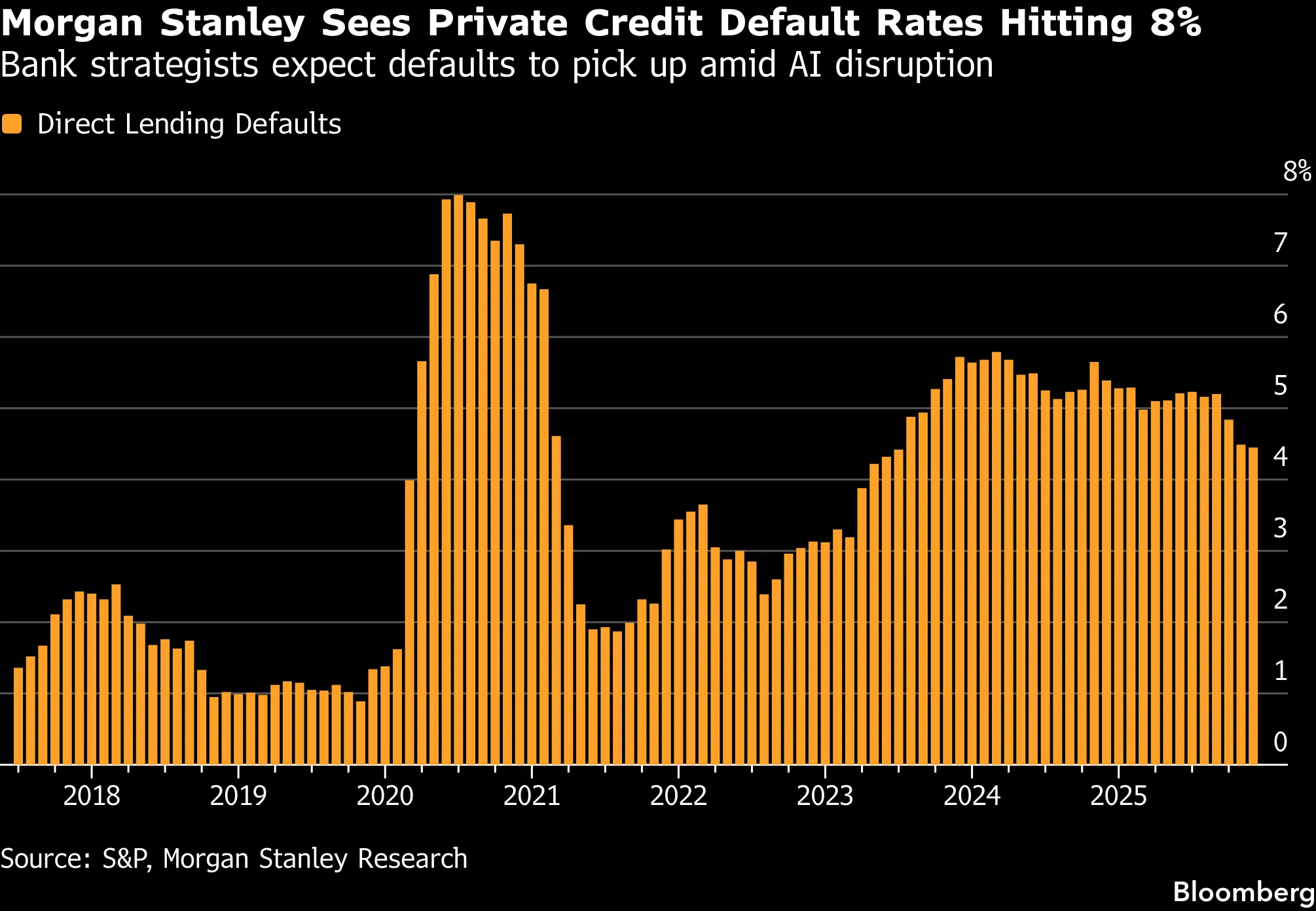
Default rates. The US private credit default rate has now reached 5.8%, up from 4% last year. The CRS paper flagged that some observers expect it to hit 8% as AI disruption continues to gut the software companies that form the single largest borrower concentration in the asset class. Private credit’s exposure to SaaS borrowers alone is roughly $500 billion. When AI is compressing the revenue of every business-software company on the list, that concentration becomes the story.
And then there’s the charming fiction that illiquid assets can offer liquid redemptions. That fiction worked for fifteen years because interest rates were at zero and risk appetite was buoyant. Now it doesn’t.
The Peasants Get the Garbage
Here is the part that should focus the mind.
In August 2025, President Trump signed Executive Order 14330... “Democratizing Access to Alternative Assets for 401(k) Investors.” The order directs the Department of Labor to reduce the regulatory barriers and litigation risk that had historically kept private credit, private equity, and related alternatives out of the average American’s retirement account. We flagged the structural risk in the retirement channel last October, and the architecture has only hardened since.

In March 2026, the Department of Labor issued the proposed rule implementing the order. Sixty-day comment period, then finalization. The comment period closes in May. The rule is expected to take effect before year-end.
Now take a step back. Private credit managers spent a decade loading the retail channel with product. Non-traded BDCs, interval funds, semi-liquid credit vehicles. The retail channel is now full. The same month the largest funds in the asset class start gating redemptions on the product they’ve already sold, the executive branch of the US government proposes a rule designed to funnel 90 million additional Americans’ retirement savings into the same asset class.

Ninety million savers. $13.8 trillion in defined-contribution plan assets. The proposed distribution channel for an asset class where the existing retail investors are currently being told to stand in line and wait for their money.
Remember Trump’s executive order to open 401(k) plans to private credit. That was because Trump is a podium donut for the ruling class, and the ruling class needed to offload their garbage onto the public before the gates finished closing. Retail investors are queuing for their own money at Blue Owl while the co-CEOs contemplate hockey trades on the side. Noblesse oblige.
Where We Sit
We don’t own private credit. The geometry of it never worked. You cannot offer daily or even quarterly liquidity on ten-year loans and expect that to survive a single downturn. The fact that the industry got away with it for fifteen years was a function of zero interest rates and buoyant risk appetite, not a function of clever structuring.

What we own instead are things with a physical identity. Oil and gas producers with free cash flow at current prices. Energy services names that were beaten to death for a decade. Gold and silver miners trading at forty-year lows relative to the S&P 500. Farmland in jurisdictions where your ownership is actually yours. Emerging markets where valuation is measured in cash flow rather than narrative.
Tidewater (TDW) sits in our portfolio as the cleanest example of the type. A pure-play offshore service vessel operator with $710 million of debt and $263 million of free cash flow, capitalised on a market cap that the private credit industry could not have underwritten because the steady-yield profile is wrong shape. Public, traded, marketable to a real bid. The opposite of opaque.

The tell is in the denominator. A barrel of oil is priced on whether somebody wants to buy it at the dock. A bar of gold is priced on whether somebody will hand you dollars for it. A hectare of farmland is priced on whether it grows food this year. The denominator in each case is physical. The denominator in private credit is a spreadsheet that has now been tested, that six major funds have simultaneously had to defend, and that a Congressional Research Service paper is now formally examining.
Spreadsheets get tested in gates. Gates get tested in bankruptcies. Bankruptcies get tested in contagion.

We’re past step one. The Moody’s sector downgrade on April 7 was step two. Nobody watching the tape should expect step three to be long coming.
When credit-fuelled equity multiples start rerating downward and capital begins looking for things that exist in the physical world, the names that get bid first are the ones the private credit industry would not touch because they did not produce enough “yield” for the pension funds on the buying side. The energy services book, the producers, the shipping names, the gold and silver miners ... that’s where the rotation lands.
If you want the long-form argument and the next idea before it gets crowded, the Insider Newsletter is on Substack at $39 a month. If you want the actual portfolio (the Asymmetric Portfolio, the Dividend Portfolio, the Skeleton, and the Big Five contrarian picks each fortnight), the full Insider Service is where the names live.
The canary hasn’t stopped singing. It’s started to fall off the perch.
Nothing here is investment advice. This is what we think and what we own. Do your own research.
Refer a friend. Get paid in research.
If you’ve found Capitalist Exploits useful, odds are you know two or three people who would too…investors who are tired of consensus finance coverage and want a thesis they can actually build a position around.
Here’s how the referral program works:
Share your personal referral link (find it in your account settings under “Refer a friend”). When someone subscribes using your link, it counts. Hit the thresholds below and we add comp months to your subscription automatically…no action required on your end.
5 referrals → 1 free month added
10 referrals → 3 free months added
15 referrals → 6 free months added
There’s also a leaderboard on the site if you want to see where you stand.
No complicated signup. No affiliate dashboard to manage. Your link is already active…you just have to use it.
The theft restsrts in earnest :-/