


![[Section Divider Image]](https://substackcdn.com/image/fetch/$s_!RxHi!,w_1456,c_limit,f_webp,q_auto:good,fl_progressive:steep/https%3A%2F%2Fsubstack-post-media.s3.amazonaws.com%2Fpublic%2Fimages%2Fe3100659-df4c-4bfa-bc24-08f8265c7769_1320x50.webp "[Section Divider Image]")
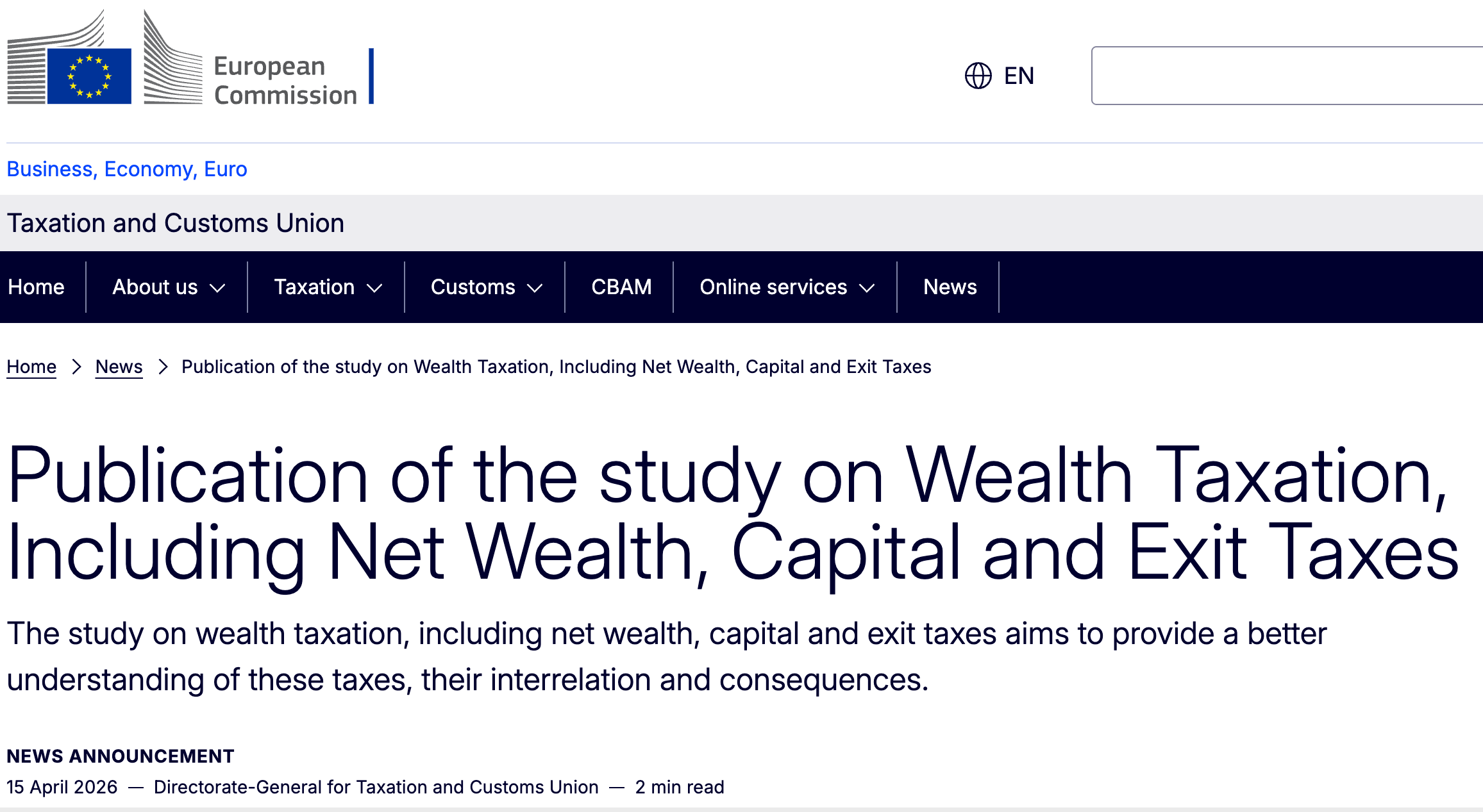
On April 15, 2026, the European Commission quietly published a study titled “Wealth Taxation, Including Net Wealth, Capital and Exit Taxes”. Two volumes. Case studies across seven jurisdictions. A methodological framework for how EU member states can design wealth taxes, capital gains taxes, exit taxes, and related instruments to extract more revenue from the holders of concentrated private wealth. Commissioned in 2024. Quietly delivered nine days ago.
The Commission’s own framing is that the study is neutral analysis, not policy advocacy. Read it anyway. What it actually represents is the shared technical manual for a set of policies that are no longer being debated one country at a time. They are being coordinated.
I have been saying capital controls were already here. That was two years ago, and at the time it sounded slightly paranoid to polite company. Polite company has updated.
The Playbook Is No Longer One Country
The Dutch 36% tax on unrealised capital gains is the loudest story, because the House of Representatives passed the bill on February 12 and the mechanism is genuinely startling...a government taxing you on paper profits you haven’t actually cashed in. If your Dutch portfolio rises by ten thousand euros on paper, you owe three thousand six hundred in tax even if you sold nothing. If it falls the following year, you carry the loss forward and hope to offset it against gains that may or may not come. The Dutch Supreme Court had ruled the prior wealth-tax regime unconstitutional in 2021. The replacement regime is worse, not better.
But that is one country. The story has moved on.
On April 3, Belgium’s Chamber of Representatives formally approved the country’s first-ever capital gains tax on financial assets. The headline is a 10% rate on realised gains with a €10,000 annual exemption. Moderate by European standards. The footnote matters more. Belgium’s new CGT includes an exit tax... when a Belgian tax resident moves abroad, the law treats all their appreciated financial assets as if they had been sold at that moment. Any unrealised gains accumulated since January 1, 2026 are taxed on departure. The deferral extends only to certain EU destinations, and only for 24 months.
In other words, the first country to introduce a CGT after Belgium now makes leaving the country a taxable event in itself.
Norway tightened its exit tax in 2024 specifically to prevent wealthy residents from realising gains elsewhere. The current charge sits at 37.8% on unrealised gains above NOK 3 million, levied at the point of departure. Norway also raised its wealth tax... individuals worth $54 billion then fled Norway, costing the treasury $594 million in foregone wealth tax revenue. Net result was a $448 million annual revenue decrease, achieved by a tax that was supposed to raise money. The Commission’s study examines Norway as a case study. It does not conclude that the lesson is to not levy the tax.
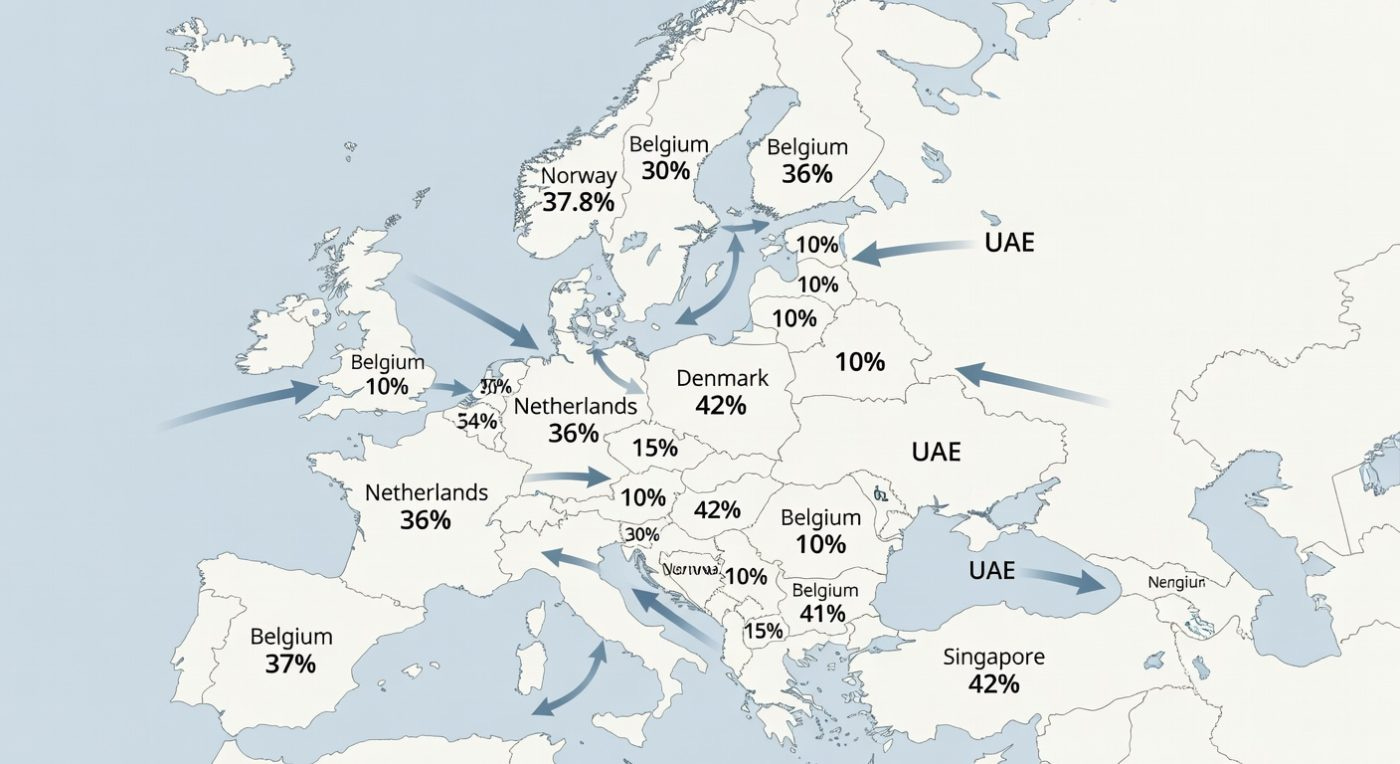
Italy raised capital gains tax on crypto from 26% to 42%. Denmark sits at 42% on realised capital gains, the highest headline rate in the EU. France levies a real estate wealth tax at €1.3 million of net real estate holdings. Spain levies a net wealth tax plus a “solidarity” wealth tax on assets above €3 million, introduced in 2022 as a temporary measure and already made permanent. The UK saw 257,000 millionaires leave last year, more than three times the number the Office for Budget Responsibility had forecast.
According to the European Central Bank, the top 5% of eurozone households own 45% of the region’s net wealth, and the top 10% own 57.4%. The Commission study cites this figure as the political motivation for the policy architecture it then describes. The political class has identified its target and formally published a manual for reaching it.
The Mechanics Matter
A capital gains tax on realised sales is a tax. You dislike it, you plan around it, you time your sales. A tax on unrealised gains, an exit tax on departure, and a wealth tax on static holdings are something else entirely. Together they form a system that makes your ownership of capital conditional on remaining within the jurisdiction that levies them, in the state your government approves, held in the assets your government is willing to recognise. Which is adjacent to another trend we’ve been tracking...the formal shift in which sovereign claim on private property is presumed, not exceptional.
Take the Dutch mechanism as the template. Your portfolio rises ten thousand on paper. You owe three thousand six hundred. You have not sold, so you have no cash to pay. You are forced to sell part of the position to cover the tax. So is every other Dutch investor holding the same stock. The most held Dutch stock is ASML. When forced selling of ASML becomes the annual April ritual, every European ETF with a material ASML weighting transmits that pressure into portfolios held in Frankfurt, Paris, Madrid, and Dublin. Balaji Srinivasan framed the cascade as an Iron Curtain of wealth. The first ones out might get to freedom, while the slowest may be stuck behind a new Iron Curtain, spending a century paying off the debts their states incurred over the last century.
The framing is not hyperbole. The mechanism is the same. What changes is who runs the fence.
The Exits Are Already Closed
The polite fiction in all of this is that taxes will be announced, citizens will have time to restructure, some will leave, life goes on. That fiction breaks down the moment you examine what is already operational.
A hedge fund called Subvertere Capital, run by respectable regulated European investors, has reported that their bank will no longer wire money on their behalf to counterparties in jurisdictions the bank has internally decided to deprioritise. Not counterparties that are sanctioned. Counterparties the bank has quietly decided it does not want its name associated with. The investor’s money, in the investor’s account, sent to a destination the investor has approved. The answer is no. Sorry, peasant. You are banned from doing that.
This is not a future risk. This is how EU retail banking works in 2026. The official story is always something about anti-money-laundering compliance. The functional reality is that your capacity to move your own capital across borders is now conditional on your bank’s internal risk committee agreeing with you.

Belgium’s new exit tax is the same mechanism applied to your entire person. If you decide Belgium has become uninvestable and you would like to leave, the Chamber of Representatives would like a conversation. That conversation will be expressed as a percentage of the net worth you are attempting to remove. The Dutch have had an emigration tax proposal pending since October 2024. Norway’s was tightened in 2024. The Commission’s April 15 study treats exit taxes as a standard policy instrument, alongside net wealth taxes and capital gains on unrealised appreciation.
The pattern is clear. The capital controls are not being drafted, debated, and announced. They are being drafted, debated, and implemented, with the debates conducted in language deliberately boring enough to ensure that most citizens do not notice what is being built around them. Unrealised gains tax. Emigration tax. Correspondent banking restrictions. Wealth tax. KYC-driven transfer refusals. Each of these, in isolation, sounds like a technical adjustment. Taken together, they are the operating manual.
The Pushback Matters Less Than You Think
On February 25, the Dutch Finance Minister announced the Dutch 36% unrealised-gains bill would be amended before Senate ratification because the backlash was real. Investors, business leaders, and the King’s brother Prince Constantijn publicly criticised the measure. Emigration inquiries from Dutch high-net-worth residents surged. Dubai, Singapore, Portugal, and Andorra were cited as the top destinations.
Good. The bill may be amended. It may be delayed beyond 2028. None of that changes the thesis. The Dutch political class proposed the mechanism in the first place because they needed the money. They will need the money tomorrow and the day after. What gets amended this round gets reintroduced next round under a different name. The Commission’s April 15 publication ensures the template circulates through every finance ministry in the union.

Where Capital Actually Goes
The honest answer is out of the system that’s built to trap it.
The UAE does not have a personal income tax. Singapore does not tax capital gains. Argentina, having endured capital controls long enough to fully discredit them, is now under Milei’s Principle of Fiscal Innocence Law, which reverses the traditional assumption that taxpayers must justify every guilder. Dubai has become the de facto finance and lifestyle capital for European and Asian high-net-worth families who no longer trust their home jurisdictions to leave them in possession of their property.

Inside the liquid portfolio, the answer is the same as it has been. Gold, silver, oil producers, energy services, farmland, emerging markets where the monetary authorities can only steal from their own population rather than from yours. The shiny stuff works in a debasement because the denominator cannot be created at will. Farmland works because the crop grows regardless of who holds the paper. Emerging markets work because when the system you live in starts taxing what you haven’t earned, the system that has already been through collapse starts looking like a reasonable place to park capital. The rotation into hard assets has been quietly underway for two years.
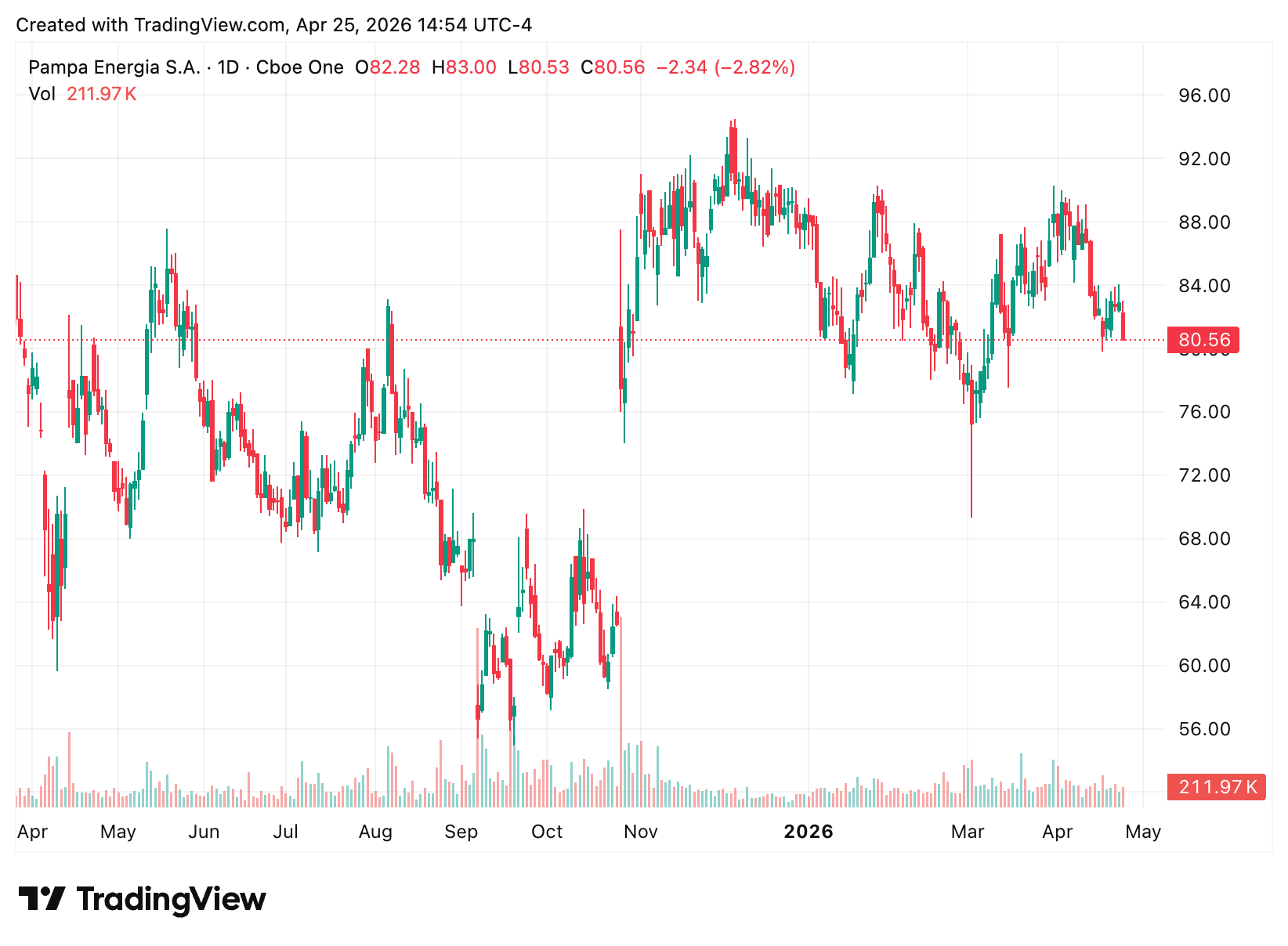
Pampa Energía (PAM) anchors our Argentina exposure for exactly this reason. An Argentine integrated energy operator with hard-asset cashflows in a jurisdiction that has already been through the wealth-confiscation cycle and come out the other side. The country that learned the lesson the hard way is now the country that does not need to learn it again.
If you want the long-form thesis and the next idea before it gets crowded, the Insider Newsletter is on Substack at $39 a month. If you want the actual portfolio (the Asymmetric Portfolio, the Dividend Portfolio, the Skeleton, and the Big Five contrarian picks each fortnight), the full Insider Service is where the names live.

Nothing here is investment advice. This is what we think and what we own. Do your own research.
If you think this stops with the Commission study, or that the mechanisms it describes do not get progressively tightened over the coming decade, you’re betting against hundreds of years of history.
If this resonated, you’re reading the free version.
Paid subscribers got the full picture last week…specific positions, entry points, and the reasoning behind every allocation. Not general thesis. Actual trades.
The macro setup doesn’t care whether you acted on it. If you want to move from understanding it to doing something with it, that’s what the Insider is for.

No spam. No fluff. Twice a month, when it matters.
The “Iron Curtain” label is sensational but useful because it forces people to ask: Which side of the fence do I want my wealth on? And once that fence becomes harder to cross, the answer is to act before the gate slams.
Tax scavenge mode as Francis Hunt would say.