
![[Section Divider Image]](https://substackcdn.com/image/fetch/$s_!A5AJ!,f_auto,q_auto:good,fl_progressive:steep/https%3A%2F%2Fsubstack-post-media.s3.amazonaws.com%2Fpublic%2Fimages%2F5ed93970-fcec-4651-97e9-66ac56cb3b6d_1320x50.webp "[Section Divider Image]")
Everyone Just Bought the Same Rocket
The richest woman in Australia, twenty-eight thousand retail punters, and an index fund you probably own... all crowded into the same trade in the same fortnight. That is not a signal you ignore.
Gina Rinehart is the 104th richest person on the planet. She built a fortune digging iron ore out of the Pilbara and selling it to India and China...a real business, real dirt, real cash flow. Last month she wrote a cheque for over a billion dollars for a slice of SpaceX. It is the single largest investment her company has ever made outside of iron ore.
Read that again. A woman who got rich owning the ground looked at a rocket company losing four billion dollars a quarter, trading near a hundred times revenue, and decided that was where the next billion should go.
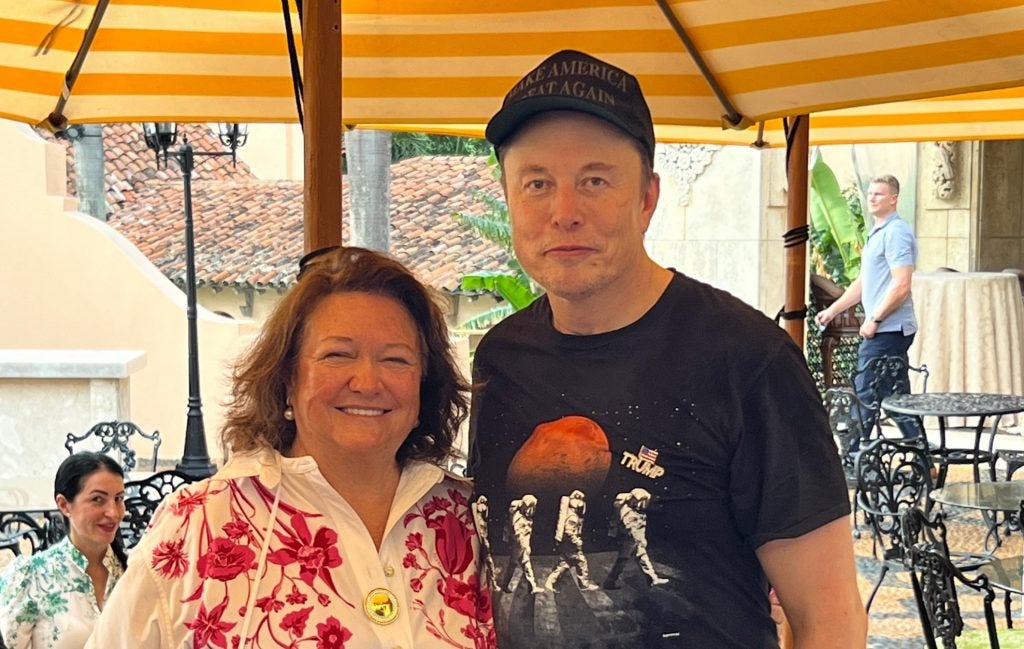
She was not alone. She was early to a stampede.
CommSec, Australia’s biggest retail broker, had four times as many customers bid for SpaceX shares as for any float in its thirty-year history. Four times. For a company with no local listing, in a foreign currency, with zero management presentations, no dividends, and, in the broker’s own words, no certainty about its future revenue or even its products. Twenty-eight thousand retail accounts piled into an offshore IPO. Thirty-seven thousand more opened accounts just to get in.
When the cleaning lady and the mining billionaire are reaching for the same red-hot stock at the same moment, you are not looking at a market. You are looking at a mood.
We have seen this mood before. We wrote about it when the giants of one era became the fossils of the next...back when Schlumberger, an oil service company, was the fourth most valuable business on earth and nobody could imagine it any other way. We wrote about it again when we pointed out that the hyperscalers had quietly stopped being software companies and become capital-hungry utilities wearing a software multiple. The market did not notice then either.
Here is the number that should stop you cold.
Fifty-one percent of the S&P 500’s entire market cap now sits in stocks trading above ten times sales. Half the index. Not half the companies...half the money.
Ten times sales is not a valuation. It is a confession. In 2002, after his own stock had already crashed ninety percent, the CEO of Sun Microsystems explained exactly what you are agreeing to when you pay it. At ten times revenue, to get your money back in a decade, the company has to pay you every single dollar of revenue as a dividend for ten straight years. Zero costs. Zero R&D. Zero taxes. Zero employees. He asked his own investors, flatly, what on earth they had been thinking.
Today half the index trades there. And the crowd thinks it is being sensible.
This is the part where somebody usually tells you to short it. Don’t. We are not going to hand you a rope to hang yourself with, and inside the issue we walk through exactly why...a story about the greatest investor you have probably never heard of, a man who saw the last mania with perfect clarity, called it precisely, and was very nearly destroyed for the crime of being right too early. His investors screamed at him. His money fled. He quit the exact month the top came in. The lesson buried in that story is the single most useful thing we can teach you about the months ahead, and it is not the lesson you are expecting.
So if you don’t short it, what breaks it?
Because something always does. Manias do not die of old age or of common sense. They die when the plumbing seizes... when the one input the whole tower is quietly resting on gets pulled out from underneath it.
We think we know what that input is. It is not earnings. It is not a scandal. It is not even the Fed.
It is a single number on a single screen, one we have circled for readers before, back when we told you why five percent was the level that mattered more than any headline coming out of Washington. That number is compressing into the tightest coil we have seen in years. A range this long, wound this tight, does not resolve gently. And when it breaks...and we are talking about when, not if...it moves further and faster than almost anyone positioned in that half-of-the-index is prepared for.
The MANGOS have a poison pill baked into them, and almost nobody buying the rocket has read the label.
Then there is the other thing about that SpaceX float. The part the twenty-eight thousand retail accounts did not see, because it was never meant to be seen from the cheap seats. Musk folded a pile of old debt from his other companies onto the rocket’s balance sheet in the months before the listing. Billions of it. Due for repayment within six months of the float.
Which means a good chunk of the money the crowd just handed over for Mars...isn’t going to Mars.
We laid it all out this week...where that money actually goes, the number that breaks the whole trade, and the one lesson from the last bubble that determines whether you come out the other side richer or wiped out.
The full Insider issue is below. It is not comfortable reading. It was never meant to be.
If you haven’t done so already, join us behind the paywall.