

![[Section Divider Image]](https://substackcdn.com/image/fetch/$s_!Iita!,w_1456,c_limit,f_webp,q_auto:good,fl_progressive:steep/https%3A%2F%2Fsubstack-post-media.s3.amazonaws.com%2Fpublic%2Fimages%2Feadecfe3-ee96-41cd-8539-4b93c7ef2df2_1320x50.webp "[Section Divider Image]")
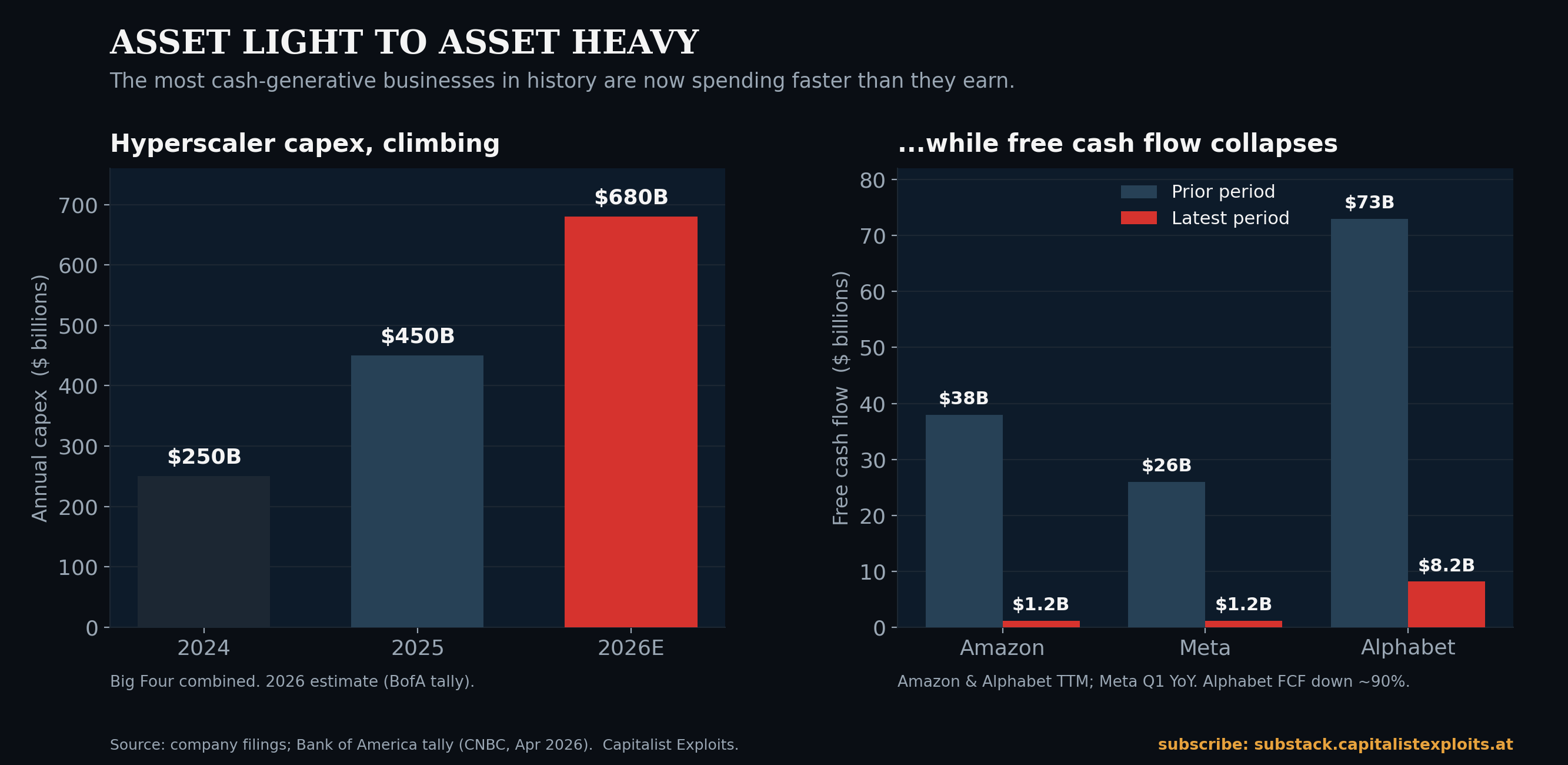
Here is a number that should stop you cold. Amazon’s free cash flow over the trailing twelve months collapsed to $1.2 billion. A year ago it was running around $38 billion. A $59 billion surge in infrastructure spending swallowed nearly all of the $148 billion in operating cash the business generated. Same company, same dominance, a fraction of the cash left over at the end.
And to bridge the gap, the hyperscalers have been queuing at the bond window. In March, Amazon raised something like $54 billion. Weeks earlier, Alphabet sold a 100-year “century bond”... the first by a tech company since Motorola in 1997... as part of a roughly $32 billion multi-currency offering.
Let that sit for a second. The most cash-generative businesses in the history of capitalism are now borrowing money on hundred-year terms to keep the lights on in their data centres. Something has changed. Most of the market hasn’t noticed yet.
The Greatest Business Model Ever Invented
For two decades, the Bag 7 ran on the best business model anyone has ever dreamed up... asset-light software.
You write the code once. Whether you then sell it to a million people or a billion, the marginal cost of the next customer is basically nothing. No factories. No raw materials. No union labour. No physical plant. Just pure operating leverage... scale the revenue, barely scale the cost. That is precisely how you end up with companies trading at 30x, 50x, 60x earnings. The market wasn’t paying for the earnings. It was paying for the compounding... the belief that returns on capital would stay sky-high indefinitely because there was no heavy physical anchor dragging them back down to earth.
It was a wonderful machine while it lasted.
Then AI blew it up.
When Software Companies Start Looking Like Utilities
The hyperscalers...Amazon, Microsoft, Google, Meta...are now projected to spend somewhere between $600 and $700 billion on capex in 2026 alone. Two years ago that figure was around $250 billion. It isn’t plateauing. It isn’t even climbing in a straight line. It’s going vertical.
And it isn’t just the chips and the buildings. It’s the energy underneath all of it. When Microsoft re-signed Three Mile Island, it locked in a 20-year forward purchase agreement at more than $100 per megawatt hour...nearly double the going rate for wind and solar in the same region. That is a long-dated liability now baked into operating cash flows for two full decades. That is not what an asset-light software company’s balance sheet is supposed to look like. That is what a utility’s balance sheet looks like.
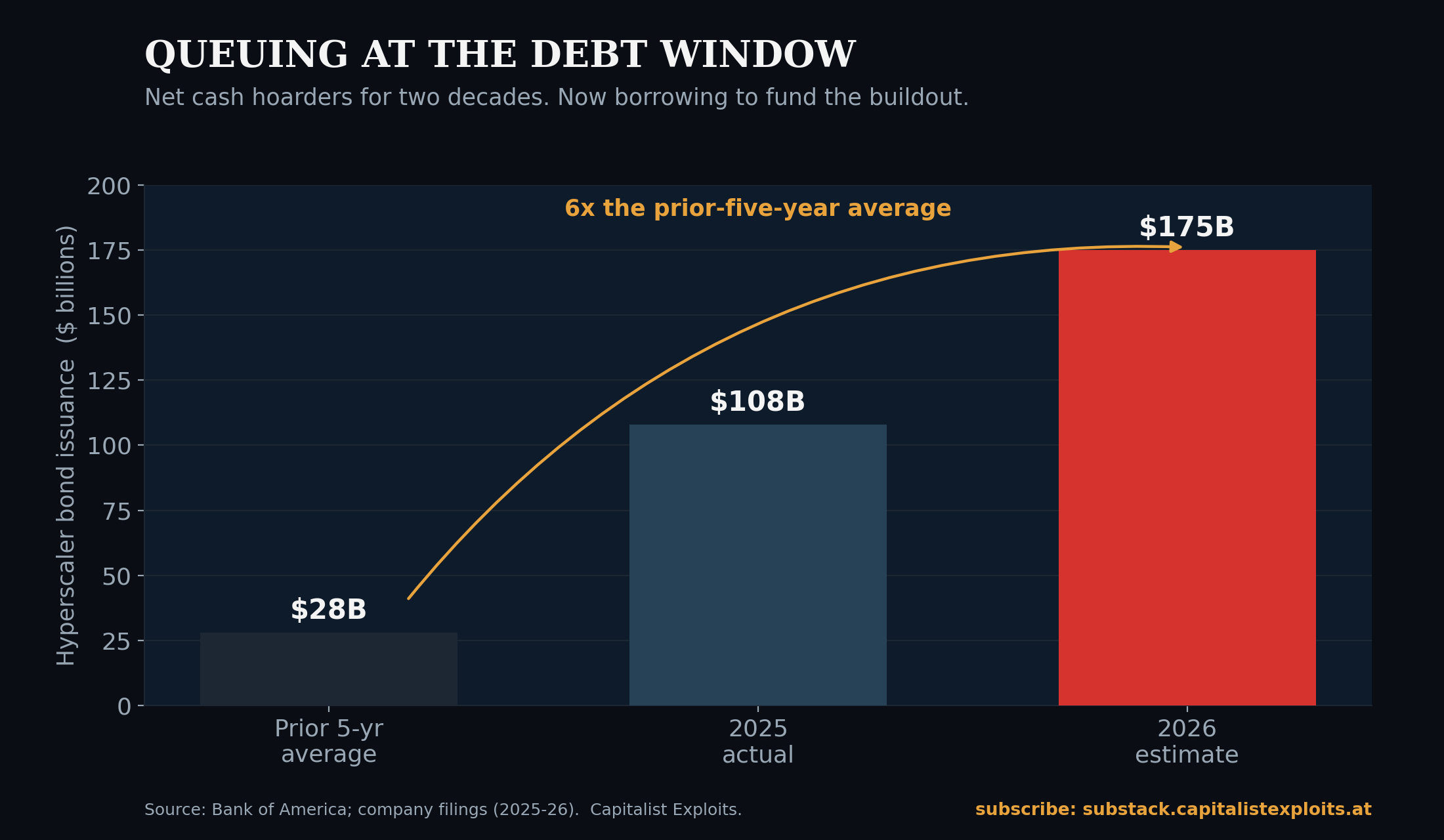
This is the part the multiple hasn’t caught up to. When a company is asset-light, investors pay a premium for the lightness... the 30x reflects a faith that capital-efficiency stays high forever. But when Google is locked into 20-year power contracts, carrying a debt load it never used to carry, and spending close to half its revenue on physical infrastructure, the rational multiple has to compress. You don’t price a utility at 30x earnings. You price it at 10x, maybe 12x. Bank of America reckons hyperscaler capex now eats roughly 94% of operating cash flow after dividends and buybacks. These businesses can no longer self-fund their own growth. That’s why the five biggest raised $108 billion in bonds in 2025, and why BofA now sees $175 billion of issuance in 2026 alone...more than six times the annual average of the prior five years.
Companies that spent twenty years as net cash hoarders are now queuing at the debt window like everyone else. Term loans, revolvers, structured facilities, century bonds. That’s fine. Businesses borrow. But a business that borrows to fund physical buildout does not deserve to trade like a business that prints cash from thin air.
We’ve Read This Page Before
History doesn’t repeat, but it does rhyme, and this particular rhyme is getting loud.
Go back to the height of the energy boom in 2013 and 2014. You couldn’t give Microsoft away. Energy could do no wrong. That was the exact moment to own tech. Then tech took a bottle of Viagra and shot the lights out for the better part of a decade while energy got decimated and left for dead. The way these things always work is that the last clutch of investors in a sector lose their shirts, swear off it for years, and miss the entire turn. Recency bias, dressed up as prudence.
Now flip it around. AI-related equities are something like 45% of the S&P 500. The energy needed to power the entire world...including all of that AI...is less than 4% of the index. The US is pouring more capital into AI data centres over six years than the inflation-adjusted cost of the Marshall Plan, the Apollo programme, the Manhattan Project, and the Interstate Highway System... combined. We’ve laid out why the energy side of that trade pays from here at length. The mirror image is the side most portfolios are still crowded into.
The market is overweight the thing that needs the power... and underweight the power.
