

![[Section Divider Image]](https://substackcdn.com/image/fetch/$s_!KYVQ!,f_auto,q_auto:good,fl_progressive:steep/https%3A%2F%2Fsubstack-post-media.s3.amazonaws.com%2Fpublic%2Fimages%2F7bfd62dd-eb17-4650-b150-5ff3c61d845b_1320x50.webp "[Section Divider Image]")
Nobody believes the giants of one era become the fossils of the next. Then it happens anyway.
There is a chart we keep coming back to. It ranks the ten biggest companies on the planet by market capitalisation, and you can drag a little slider along the years and watch the kingdoms rise and fall in real time. It is the single most humbling thing you can look at as an investor, and I would recommend everyone spend ten minutes with it before they buy another share of anything.
Let me walk you through what it shows. Because it tells you almost everything you need to know about where the next decade of returns is hiding.
The Companies Everyone Knew Would Last Forever
Run the slider back to 1972. The biggest company in the world was IBM. The second biggest was Eastman Kodak. Then AT&T, then Exxon, then General Motors, Sears Roebuck, General Electric, Procter and Gamble, Coca-Cola, Texaco.
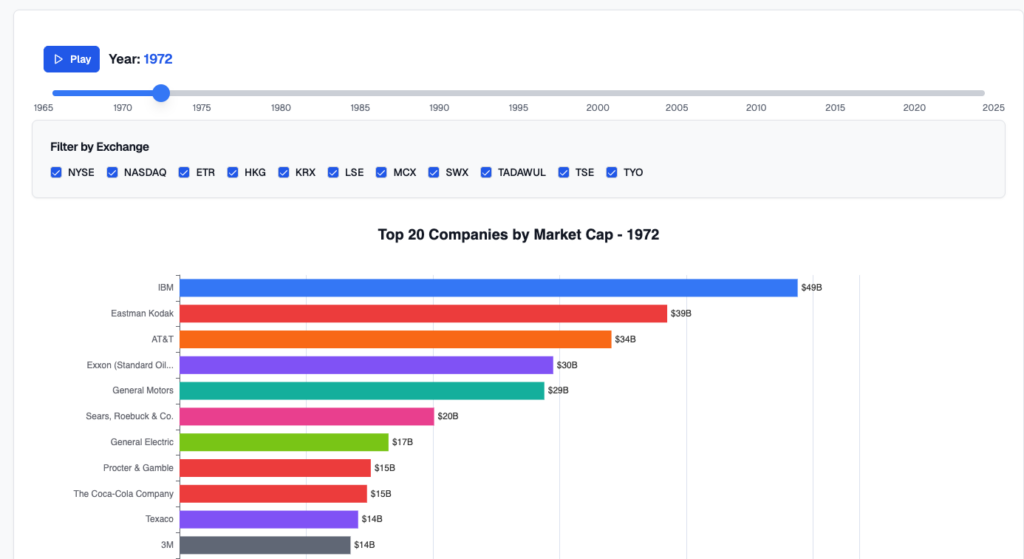
Now. At the time, the idea that Kodak might one day be a punchline...that it could file for bankruptcy and have its name turned into a business-school cautionary tale...was simply unthinkable. Kodak was film. Film was photography. Photography was forever. You may as well have told someone in 1972 that water was about to go out of fashion.
IBM was the bluest of blue chips. The phrase “nobody ever got fired for buying IBM” was not a joke, it was corporate religion. These were not companies. They were institutions. They were the furniture of the modern world, and the modern world does not throw out its furniture.
And yet here we are. One of them went bankrupt. The other spent two decades as a slow-motion cautionary tale about missing every technology wave that mattered. Few ever thought they would fall from their greatness. They fell anyway.
In other words...the things everyone agrees are permanent are usually the things about to be repriced.
Now Drag It Forward to 1980
This is the part that stops people in their tracks.
By 1980 the top of the table looked like this. AT&T at the top, around 49 billion dollars. IBM second, around 43. Exxon third, around 37. And in fourth place, at roughly 25 billion dollars...Schlumberger.
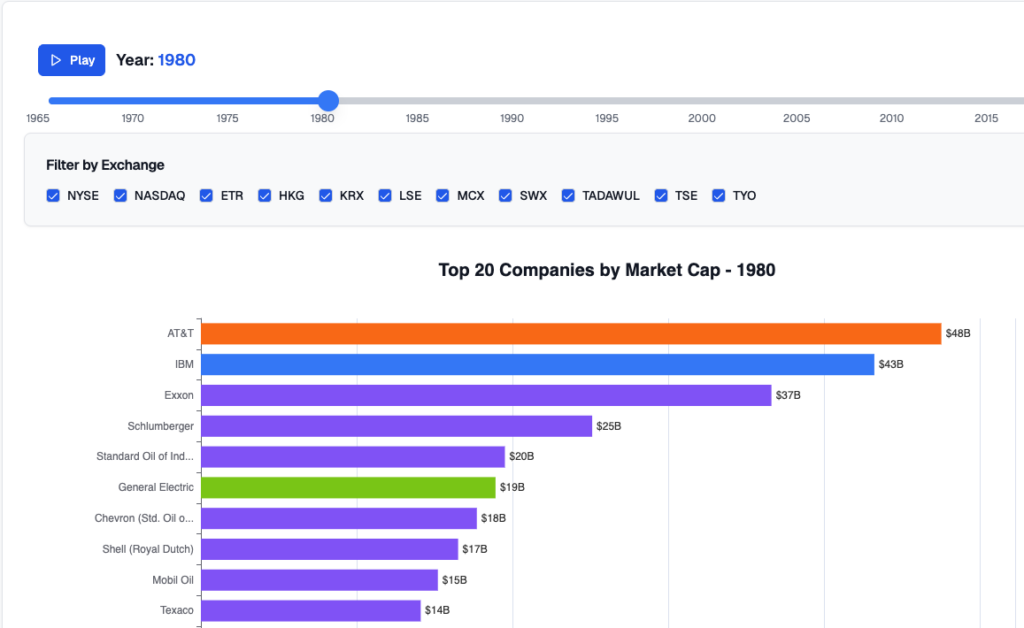
Read that again. The fourth biggest company in the entire world was an oil service stock. Not an oil major. Not a household name. An oilfield services company...the outfit that shows up to log your well and measure what is down there in the dark. The plumbing of the plumbing of the oil business.
And it gets better. Look down the rest of that 1980 list. Standard Oil of Indiana. Chevron. Royal Dutch Shell. Mobil. Texaco. Of the ten most valuable companies on earth, seven were energy. The shiny stuff and the black stuff between them owned the entire podium.
What makes the Schlumberger story so delicious is the asset base it pulled this off with. The company sat fourth in the world on something like 5 billion dollars of invested capital. Its market-cap rivals were carrying six to thirty times more capital on their books to justify roughly the same valuation. Schlumberger was, in the scheme of these titans, almost tiny. It was a generational valuation stretched over a sliver of hard assets, because the market had decided that finding and producing hydrocarbons was the most important thing a company could possibly do.
This was 1980. The second oil crisis had just torn through the decade. Oil and gas exploration and development was not a backwater, it was the main event. Capital flooded in. The best engineers in the world wanted in. And the market did what the market always does at the end of a long, powerful trend...it extrapolated. It looked at a decade of rising prices and exploding demand for energy services and said, this is the future, pay any price.
Can you imagine? An oil service stock, the fourth most valuable enterprise on the planet. Today that sentence reads like a typo.
And Today
Drag the slider all the way to the right.
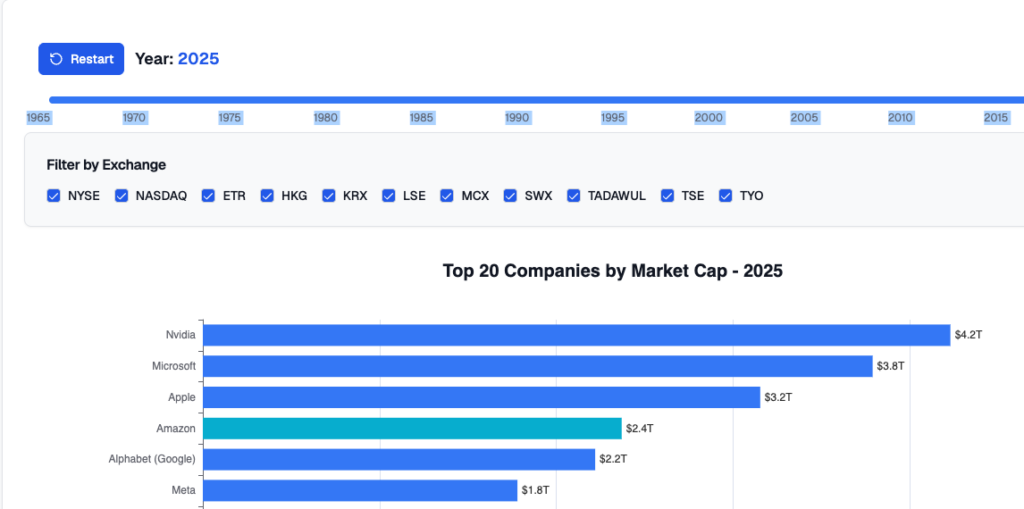
When the chart was captured, the table read: Nvidia, around 4.2 trillion. Microsoft, 3.8. Apple, 3.2. Amazon, 2.4. Alphabet, 2.2. Meta, 1.8. The exact figures have only stretched further since...Nvidia has since punched through 5 trillion and the order at the top reshuffles by the week. But the figures are not the point. The composition is. Six names, every one of them technology, every one of them riding the same single story. There is not one energy company anywhere near the top. The sector that owned seven of the top ten slots in 1980 has been so thoroughly forgotten that the average investor genuinely struggles to name a single oil service company. Do they not know they exist?
And the valuations being paid for the new royalty are not modest. They are 1972 IBM. They are 1980 Schlumberger. They are the furniture of the modern world, priced as though the world will never rearrange its living room again.
We have written before about why we think energy is the most hated, most ignored, most uninvestable-looking sector on the board, and why that is precisely the setup that pays. This chart is the long-memory version of that same argument. You do not need a forecast. You just need to know that the table has been turned over before, and that it was turned over hardest precisely when one story had become so dominant that paying any price for it felt like common sense.
The Quiet Part
Here is the thing nobody wants to say out loud. There is nothing...nothing...stopping this from happening again.
Well, almost nothing. All it would take is higher-than-expected oil and gas prices for the next decade, and an exploration and development boom to go with them. That is the entire list of preconditions. And if you have been reading us for any length of time, you will know exactly how probable we think both of those are.
We are not going to give you a price target. We never do. The denominator is fiat, and fiat can be conjured at will, so the number is meaningless and the direction is everything. What we will tell you is that the cheapest, most loathed, most structurally starved sector on the board is the one that has form for marching straight to the top of this very table. It did it in 1980. It did it on a tiny asset base, against a backdrop of a tight oil market and a capital-starved industry that could not bring on supply fast enough.
Squint at the present and tell me what is different.
We romance the idea of dragging this slider forward ten years and finding an energy name back in the top five. Stranger things have happened. In fact, the entire history of this chart is nothing but stranger things happening to people who were certain they would not.
Where We Go From Here
What you are reading is the surface argument. The full analysis...the energy supply math that has us this confident, the sector mechanics walked end to end...runs in the latest Insider Newsletter, Issue 331, where we also lay out the Big Five for the month. The actual names being held to play this, with the sizing and the rotation discipline... the offshore service companies trading at a fraction of where the last cycle took them, the producers sitting on reserves the market is pricing at close to zero...sit one tier further up, in the full Insider Service at capitalistexploits.at.
If you have been circling the energy trade and want to see how we are actually positioned for the decade this chart keeps hinting at, the Insider Service is where to go.
The giants of every era looked permanent right up until the slider moved.