


![[Section Divider Image]](https://substackcdn.com/image/fetch/$s_!jl9B!,f_auto,q_auto:good,fl_progressive:steep/https%3A%2F%2Fsubstack-post-media.s3.amazonaws.com%2Fpublic%2Fimages%2F69e6350f-ae7c-41af-a588-15120d2cd51f_1320x50.webp "[Section Divider Image]")
Let me tell you about the most frustrating conversation in my professional life. I have it constantly. It goes like this.
Someone comes to us. They’ve read the research. They’ve attended the conferences. They understand the thesis cold... they can describe the coming crisis with a precision that would embarrass most economists. Deficits, debasement, capital controls, pension raids... they’ve got it. Chapter and verse.
Then they want to do something about it.
They want to move capital offshore. So they consult their domestic bank. They want to restructure their pension exposure. So they call their pension administrator. They want to diversify into real assets outside their home jurisdiction. So they check with their local financial regulator.
The tsunami is visible on the horizon. The water is already pulling back from the shore. And they are standing there, looking for a lifeguard who works for the ocean.
The gap between knowing and doing
Here’s what I’ve learned running money for people who, by definition, have enough of it that these risks aren’t hypothetical. They’re existential.
The gap between what sophisticated investors intellectually understand and what they’re actually willing to do about it is astonishing.
People nod. They find it alarming. They share the piece with friends. Some write to say it changed how they think. And then... in ninety percent of cases...they do precisely nothing. The article gets filed under “important” in some mental folder that never once triggers an action, and the thumb goes firmly back where it was.
This isn’t stupidity. I want to be precise about that, because it would be lazy and wrong to call it that. These are intelligent people. Many of them are accomplished, formidable in their own fields.
What they’re suffering from is paralysis. The particular paralysis that comes from decades of being conditioned to outsource every consequential decision to an institutional intermediary. They know, intellectually, that the intermediaries are compromised. They simply cannot bring themselves to act as though it’s true. The dissonance is too large. The implications too unsettling. The steps required sit too far outside the established routines of a life built around quiet compliance.
Seeing clearly and acting on what you see are different skills. The second one is much, much rarer.
History doesn’t grade on effort
And history, unfortunately, does not hand out participation medals for understanding the crisis correctly.
Consider the Portuguese who left their retirement savings in state-managed pension funds after 2011. They didn’t lack information. They lacked the activation energy to move.
Consider the Cypriots who left deposits above €100,000 sitting in Bank of Cyprus in 2013, right up until the morning those deposits were “bailed in” and nearly half of the balance above the guarantee was simply converted to equity in a broken bank. They had read the same reports everyone else had read.
Consider the Argentines who kept dollar savings in domestic banks in 2001, when the corralito froze the accounts and converted dollar deposits into devalued pesos by decree. Many of them had lived through previous cycles. They knew the pattern. They stayed anyway.
In each case, the price of compliance was paid in full. In cash. Without recourse.
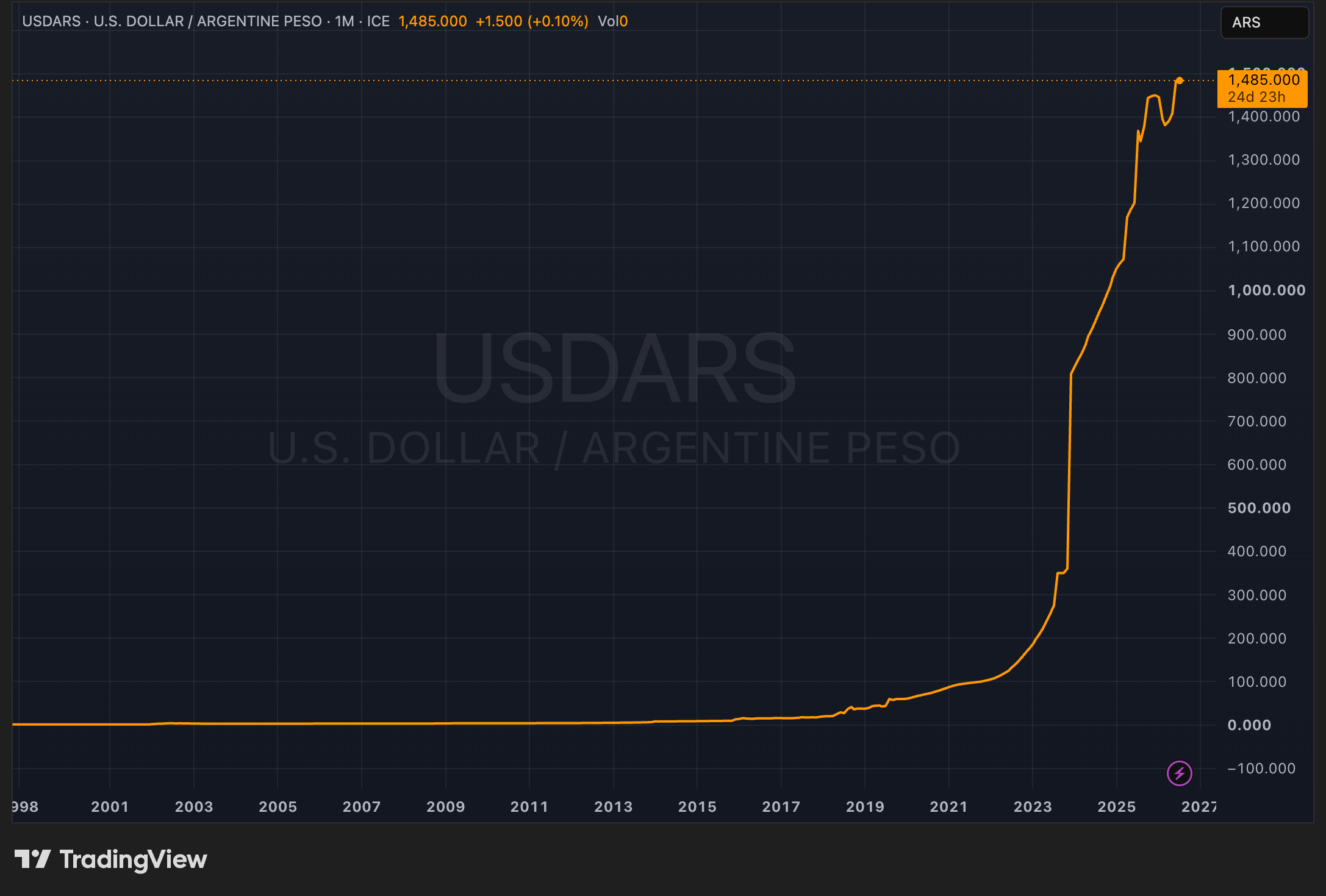
Notice the through-line. In none of these episodes was the fatal error a failure of analysis. The information was public. It was on the record, with dates and mechanisms and precedent. The fatal error was behavioural. It was the decision to wait for someone in authority to grant permission to act... permission that, by the very nature of the situation, was never going to come.
You do not get advance notice from the institution that is about to gate you. The institution is the ocean. It does not employ lifeguards for your benefit.
What diversification actually is
So let me reframe something that gets dismissed as a rich man’s indulgence.
Diversification across jurisdictions is not a luxury for the ultra-wealthy. It’s the absolute minimum rational response to the demonstrated willingness of Western states to freeze assets, suspend civil liberties, and enforce compliance with policies ranging from the merely misguided to the actively destructive.
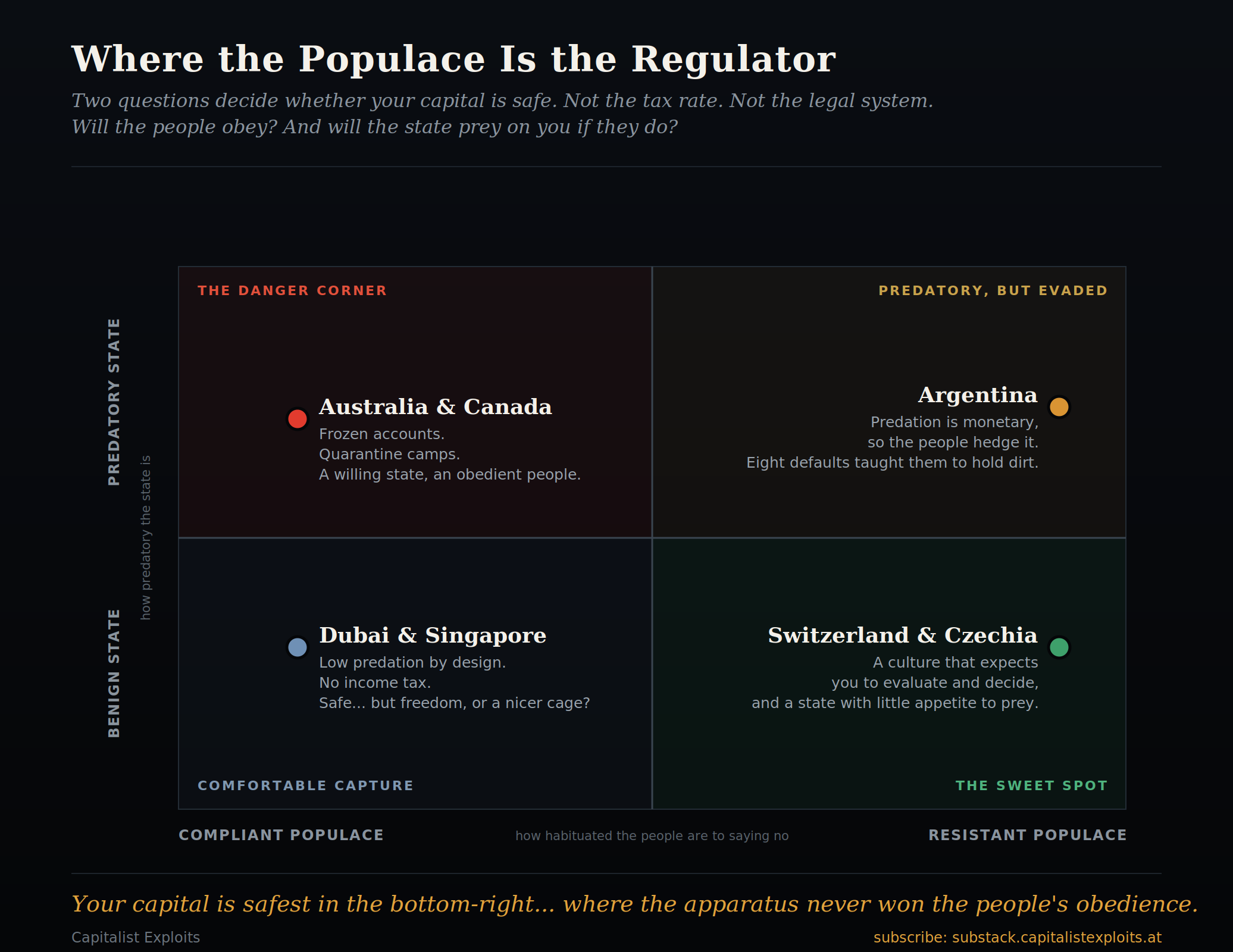
And I do mean demonstrated. These aren’t hypothetical risks I’m conjuring to frighten you. In the last handful of years we watched Canadian banks freeze the accounts of protestors and the people who donated to them. We watched an Australian government build quarantine camps and put citizens in them. We watched financial transactions surveilled without warrant. None of that was a tail risk on a slide. It happened. It’s on the record.
Once you accept that, the second principle follows naturally. The optimal jurisdiction isn’t the one with the lowest advertised tax rate. It’s the one with the most predictable actual treatment.
A 20% rate under genuine rule of law and low political risk beats a 10% rate somewhere the rules can be rewritten retroactively, where confiscation is a live possibility, and where the regulatory apparatus can be turned into a weapon against you the moment it becomes politically convenient. A low number on a brochure means nothing if the brochure can be reprinted overnight. We wrote about this the day the contrast became impossible to ignore, in When Capital Smells Freedom... one set of countries moving to presume your innocence, another set moving in exactly the opposite direction.
Which brings us to what we actually own, and why.
Real assets, held in politically stable but regulation-sceptic jurisdictions, are the most robust store of value available in a world of monetary debasement and expanding state claims. Farmland priced in distressed-country terms but producing globally priced commodities isn’t merely a commodity play. It’s a position in a jurisdiction where the apparatus has historically lacked the capacity... or the inclination... to enforce the full menu of claims that Western states now make on their productive class as a matter of routine. Argentina is the one we keep coming back to, and we laid out the size of that opportunity in The $40 Billion Bid for a sub $100 Billion Market.
I won’t name individual positions here. That’s what the Insider Service is for, and you can do your own research on the category. But the shape of the thing is not complicated. Own what a government cannot conjure at will, in a place where the government is either friendly to you or too disorganised to be effectively predatory.
Agency is the rarest asset
Here’s the part almost nobody wants to hear.
The people who navigate these episodes intact are not distinguished by superior prediction. The future is genuinely unknowable in its specifics, and anyone who tells you otherwise is selling something. What distinguishes them is superior optionality.
They hold assets in multiple forms and multiple jurisdictions. They keep relationships across more than one network. They’ve retained the cognitive independence to update their models when the evidence demands it. And they have not surrendered the one asset that underwrites all the others... the capacity to act on their own judgement.
That capacity is precisely what the whole apparatus is designed to extinguish. The captured universities, the curated feeds, the credit-financed comfort... all of it engineers a population that doesn’t exercise independent judgement because it has been trained not to trust its own.
The most valuable people I know, from a purely practical standpoint, are united by a single unglamorous attribute. It isn’t wealth and it isn’t cleverness. It’s that they never forgot how to say no.
So I’ll leave you where I always seem to land. The comfortable will manage their risk by surrendering to the system and calling it prudence. The independent will manage their risk by retaining the ability to walk out of it.
The tsunami is on the horizon either way.
The only question is whether you’re still waiting for the lifeguard.
Everything above is the free version. The part where we tell you what we actually own, and what we’re doing about it, sits on the other side.
This week’s Insider, Issue #332, is where the argument turns into positions. Inside it:
Why the richest woman in Australia just quietly took a billion-dollar stake in something the peasants are now stampeding into... and what that stampede always signals.
The poison pill hiding inside a new class of ETF that could force buying by law, and the developed-market bond chart that explains why the whole thing is primed to detonate.
The pre-IPO junk-debt reveal that tells you exactly how the smart money is funding the mania while pretence holds.
The Big Five. The names, the sizing, the reasoning. Not the category... but good positions to consider.
Plus much more…
You’ve read the map. The subscription is where you get to move on it.
Upgrade here. Take it or leave it. But the water is already pulling back, and the lifeguard still works for the ocean.
Not so sure about Canadians being such docile Go alongs... Predatory Government, Yes...Docile? Trump and the Senators who thought They could Lecture Canadians about how to be Americans were met with a rather Eye opening response... a Collective Giant middle Finger to the "Wanna-be Acquirers"... Canadians are too busy trying to Survive to think much about what the Feds are doing, but I can assure You that, should something untowards transpire from Ottawa, the Year 1789 will be created once again and in a manner that the Elites weren't prepared for...
Also, A Lifeguard in a Coming Tsunami is about as useful as a Dinghy in the same Event...... Hope Everyone has a Fantastic Week...stay safe!