


![[Section Divider Image]](https://substackcdn.com/image/fetch/$s_!fqAh!,w_1456,c_limit,f_webp,q_auto:good,fl_progressive:steep/https%3A%2F%2Fsubstack-post-media.s3.amazonaws.com%2Fpublic%2Fimages%2F211a3012-e4d7-4def-a95c-dc6732b8f268_1320x50.webp "[Section Divider Image]")
On the fourteenth of August the US Treasury sold thirty-year bonds at 5.216%. The highest yield at auction since 2001.
Five days later, the same Treasury announced it was doubling how much long-dated debt it buys back.
Sit with that a moment, because the whole story is in it.
A government does not step up purchases of its own debt because it has spotted a bargain. It does so because the price has started saying out loud what it would much rather keep quiet. Here’s the bit that actually hurts.
The Bit That Actually Hurts
Why is the thirty-year the problem child rather than the ten?
Because if I lend you money and you repay me tomorrow, I am barely taking a risk. Lend it for thirty years and an awful lot can happen to you, to me, and to what the money is worth by the time it comes home. More time, more risk, more cost. That is the whole of duration, and every finance professional who dresses it up in a longer word is doing it to sound clever at dinner.
So when confidence goes, it goes at the far end of the curve first. Which is precisely what has been happening. That $25 billion sale did not clear well. For every dollar of bonds on offer, buyers put in just $2.39 of bids, below the twelve-month average, and the primary dealers were left holding 11.5% of the issue, well above their usual share. Dealers are the buyers of last resort, the ones who mop up whatever nobody else wanted. When they are eating a bigger slice than usual, somebody else did not turn up.
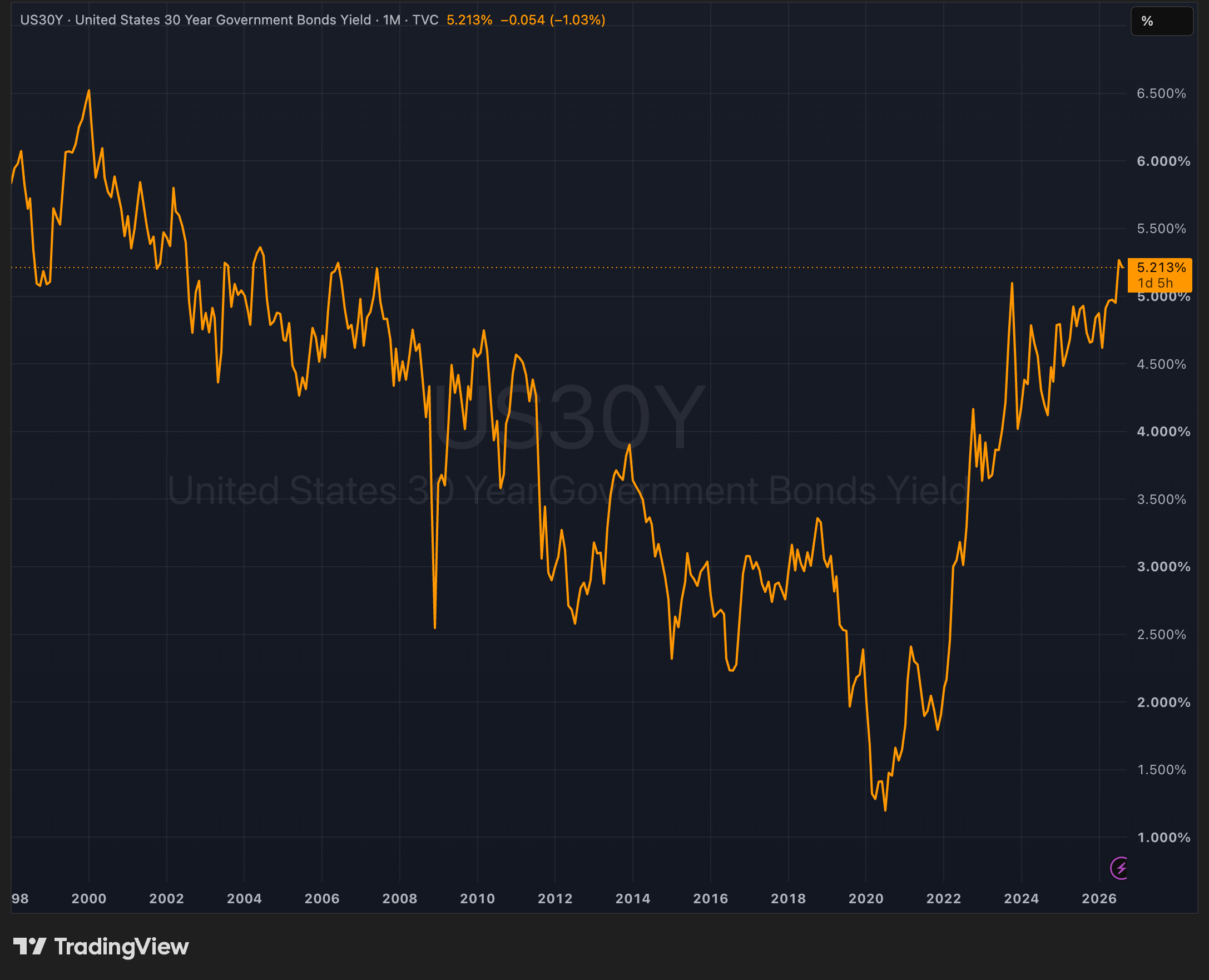
The thirty-year yield, monthly, since 1998. Twenty-odd years of falling, then 2020, then the part where it stopped falling. The dotted line is where we are now, and you have to go back a very long way to find it.
In other words, the queue is thinning. Which raises the obvious question of what you do when you are the one who still has to sell.
So What Is Being Done About It
If you are the US Treasury, you have a problem you cannot fix and a bill you have to pay. So you do what any borrower does when the expensive part of the loan gets more expensive. You stop borrowing at the expensive end.
Scott Bessent has been less coy about this than his predecessors, and he even gave it a name. The Treasury twist: buy back the long-dated bonds to take pressure off the long end, and lean harder on shorter-dated paper to fund it. Deutsche Bank, Morgan Stanley and Citigroup are all war-gaming how far it goes, up to and including cutting long-bond sales outright. The decision lands at the quarterly refunding announcement on the fourth of November. Put it in the diary.
The buyback half is already running. On the nineteenth of August the Treasury raised its long-end operations from a $2 billion maximum to at least $4 billion apiece, covering everything from ten years out to thirty. Its stated reason for doubling up, and I am quoting the press release, is that it wants to support liquidity in a part of the market with “consistent strong sponsorship from market participants.”
Sponsorship so strong it needs twice the help. Righto.
On the face of it, the twist is free money. The thirty-year costs you a bit over 5%. Short-dated paper costs you somewhere in the mid-threes. Retire the expensive stuff, issue the cheap stuff, and your interest bill falls this year. Do that all day long!
Ah. But.
The Mortgage You Already Understand
Here is what is actually happening, without the terminal.
Joe Sixpack has a $500,000 mortgage on a thirty-year fixed rate. He never thinks about it. That is rather the point of one.
Money is tight this year, so Joe decides to tap his equity and refinances into an adjustable. Today’s adjustable rate is lower, his payment drops, and he feels clever.
Joe is not unusual in this, by the way. Adjustables were close to 21% of American mortgage originations last year, the highest share in three years, and by December nearly half of everything written above a million dollars. Most of the people doing it intend to refinance again, or sell, before the rate resets.
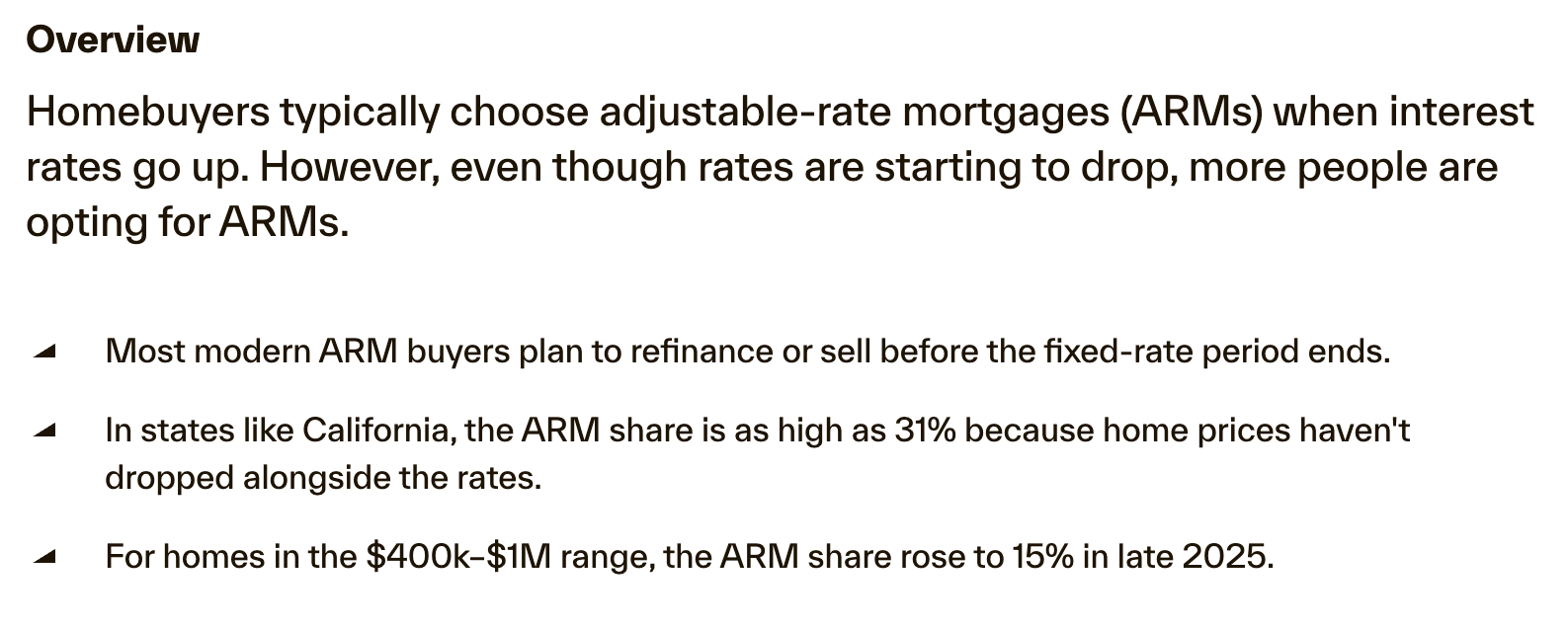
Which is the whole trick, so let us say it plainly. Joe has not made his debt smaller. He has not really made it cheaper either. He has taken a cost that was fixed and knowable for thirty years and handed it to whoever happens to be setting rates in five. He will find out how that went on a date somebody else chose.
That is what is being done to the balance sheet of the United States government, and Joe has one advantage over it. His interest bill is not the third-biggest line in the household budget. Washington’s is. Interest on the national debt came to $931 billion in the first ten months of this fiscal year, up 11%. The only things the federal government spends more on are Social Security and Medicare.
Not defence. Interest.
Where It Has Got To
This is not some emergency measure dreamed up last week. It has been running a decade, and it shows up in the plumbing.
Treasury bills, the paper that matures inside a year, were 13% of marketable debt in October 2015. By last October they were 22%. Notes went the other way, 66% down to 52%. The weighted average maturity of the whole pile peaked at 75 months in May 2023 and has been sliding since, down to 71.
Undramatic numbers, and that is the point. Nobody runs a headline on the weighted average maturity of US marketable debt, and the pointy shoes will tell you four months is neither here nor there. But the direction has been one way for ten years, and every month it continues, a little more of that mountain has to be refinanced sooner at whatever the world feels like charging by then.
You are not removing the risk. You are moving it closer.
None of which is new, by the way. They have run this exact play before, and we know how that one finished.
They Have Done This Before
The name is not even original. Operation Twist ran in 1961, when the Fed and the Treasury bought long-dated bonds and sold short ones to bend the curve into a more agreeable shape. Bernanke dusted it off in 2011.
The 1961 version is worth knowing because of why they did it. Under Bretton Woods the dollar was still convertible into gold, and America was bleeding the stuff: investors swapped dollars for gold and put the proceeds into higher-yielding European assets, at a rate the San Francisco Fed later put at several billion dollars a year walking out of the country. Washington needed lower long rates to help the economy at home, and short rates high enough to stop capital fleeing to Europe. Twisting the curve promised both at once.
Ten years later Nixon closed the gold window.
I am not claiming one caused the other. I am saying that when a government engineers the shape of its own borrowing costs to dodge an uncomfortable piece of arithmetic, the arithmetic does not go anywhere. It waits. And it collects.
And Then What?
So where does this one end? Not a mystery, sadly. Every country that has walked this road comes out at the same place.
When the debt cannot be rolled at a price the government can afford, the government prints the money and buys its own paper. That is monetisation, and it is where the exercise stops being a swap and starts being inflation.
Note the distinction, because it gets muddled by people who should know better. Shifting maturities is not itself inflationary. It swaps like for like, flatters this year’s expense line, and creates no new money. It turns inflationary at the step after, when there is nobody left to swap with.
They will not call it that, of course. It will arrive with a friendly name, the way quantitative easing did. Something committee-approved and faintly heroic, and the peasants will hear it on the news and not have the faintest idea what has just been done to their savings. That is rather the function of the name.
Who Has Already Worked It Out
You could dismiss all of that as the usual doom merchandise, so let us not rely on my opinion. What are the people who actually have to hold this paper doing with their afternoons?
At the start of August the yen slid towards 160 to the dollar and Japan stepped in to prop it up, roughly $75 billion of it, with the US chipping in another five to ten billion. Go back over that. The United States spent to hold up somebody else's currency.
But the mechanism is the tell, not the money. Notice what neither side would touch. Our sake-drinking friends hold more US Treasuries than any country on earth, and they arranged to fund any further intervention through a Federal Reserve facility rather than sell a single one of them. The US, when it bought yen, paid in euros rather than dollars, so that it too parted with nothing tied to the dollar. Two governments moving heaven and earth to prop up a currency, and the one thing both refused to touch was American paper.
Sheesh.
That is not a market. That is a market being held up by the elbows.
And the reserve managers are perfectly candid about where this goes, if you bother asking them, which the World Gold Council did. Seventy-six central banks, surveyed February to May. Seventy-four percent expect the dollar’s share of global reserves to be lower in five years. Eighty-three percent expect gold’s share to be higher. A record 45% intend to buy more of the shiny stuff inside twelve months.
Not YouTube dollar-collapse merchants. The institutions that own the thing, telling a surveyor, in writing, that they intend to own less of it.
So what do you do with that?
What It Means for You
Let me head off the obvious misreading, because everybody makes it.
None of this says the dollar is about to collapse. It is still the king currency, it sits on one side of the overwhelming majority of world trade, and it is going nowhere. It is the cleanest shirt in a dirty pile. If you are bearish the dollar then you are, by arithmetic, bullish the euro, and good luck writing that down with a straight face. The soggy island has its own troubles. Japan rather more.
So stop thinking about currencies. That is the trap, and it has cost a great many otherwise sensible people years of their lives and a decent chunk of their capital.
The comparison that matters is not one fiat against another. It is the whole financialised paper world against the world of things that have to be dug up, grown, refined or shipped. Gold, oil, copper, farmland, fertiliser. The boring stuff that hurts when you drop it on your foot. In an increasingly inflationary environment real things beat claims on other people’s promises, and they beat all the currencies at once rather than some of them.
That is not a trade you put on in November because of a refunding announcement. It is a decade-long positioning call, we have been making it for years, and we intend to go on being boring about it for a good while yet. None of this is a recommendation and none of it is advice. Do your own research.
The rest of this argument runs in Issue #334, and it is the half that would not fit here. What China has been quietly doing to its Treasury holdings for fifteen years, and how much faster it is doing it now. Why Japan’s debt problem and America’s are the same problem wearing different hats. What Goldman’s own modelling says happens to the gold price when the average American portfolio shifts its allocation even fractionally. And the Big Five, five deep-value contrarian ideas offered as ideas to explore rather than recommendations.
That is the Insider Newsletter. It lands monthly, it runs $39 a month or $420 for the year, and the link below is the entire ask. If it is not for you, no hard feelings, and the free pieces keep coming regardless.
Upgrade to the Insider Newsletter
Governments do not announce the day they stop being able to afford themselves. They change the terms quietly, give it a name nobody understands, and count on you measuring your net worth in a unit they control.
Bearer of Bad News

I don’t want to be the bearer of bad news. Well, yes I do...that’s what the job pays me for. So here it is: if the fertilizer doesn’t move, we have a famine.
Nothing in this article constitutes investment advice. Do your own research. All investments carry risk. This is what we think...it may not be suitable for you.
And the Grindstone continues It's relentless turn...