

![[Section Divider Image]](https://substackcdn.com/image/fetch/$s_!U0O9!,f_auto,q_auto:good,fl_progressive:steep/https%3A%2F%2Fsubstack-post-media.s3.amazonaws.com%2Fpublic%2Fimages%2F88831cd3-09e0-4a96-bbb8-068385e6d303_1320x50.webp "[Section Divider Image]")
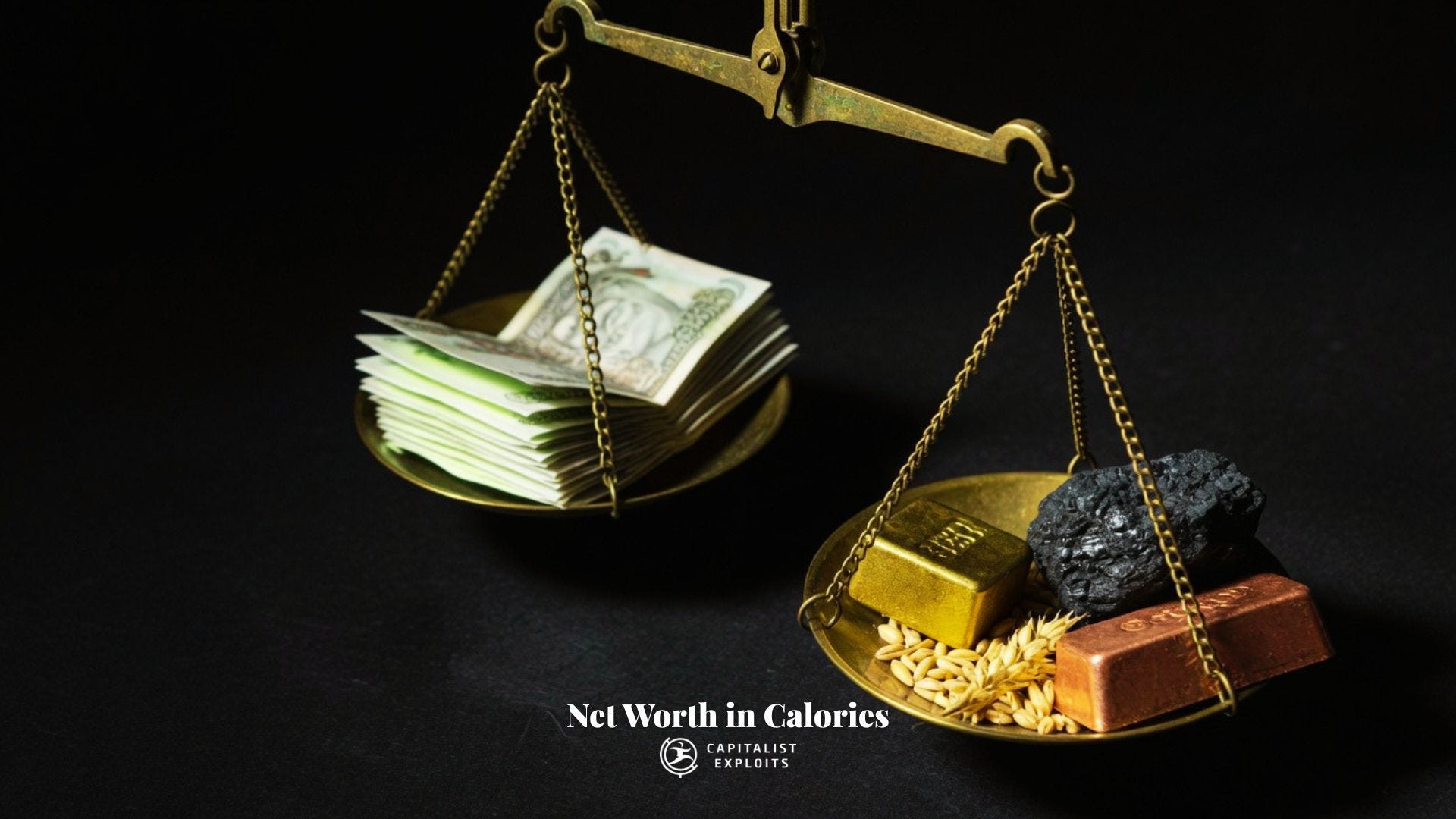
I had a conversation recently where I said something out loud that I have been chewing on for a while, and it landed harder than I expected. I said that within five years we are going to be calculating net worth in kilojoules and calories.
People laugh when I say that. Then they stop laughing, because they start to think about it.
Here is the uncomfortable little exercise. Pull up your brokerage account. Look at the number. Now ask yourself a question that almost nobody asks, because the system is designed so that you never have to. What is that number actually denominated in? It is denominated in a liability. A unit of account that a central bank can create at the press of a key, in any quantity, at any time, answerable to no one. You are measuring your life’s work with a rubber ruler...and the people who own the ruler can stretch it whenever it suits them.
So let me walk you through how I have come to think about this. Because once you see it, you cannot unsee it, and it changes what you choose to own.
The Rubber Ruler
Most investors think entirely in fiat terms. What is the IRR in dollars. What is the EBITDA multiple. What did the portfolio return this year, in dollars. And those are not stupid questions. But they all share a hidden assumption, which is that the dollar is a fixed thing you can measure against. It is not. It is the thing being measured, and it is shrinking.
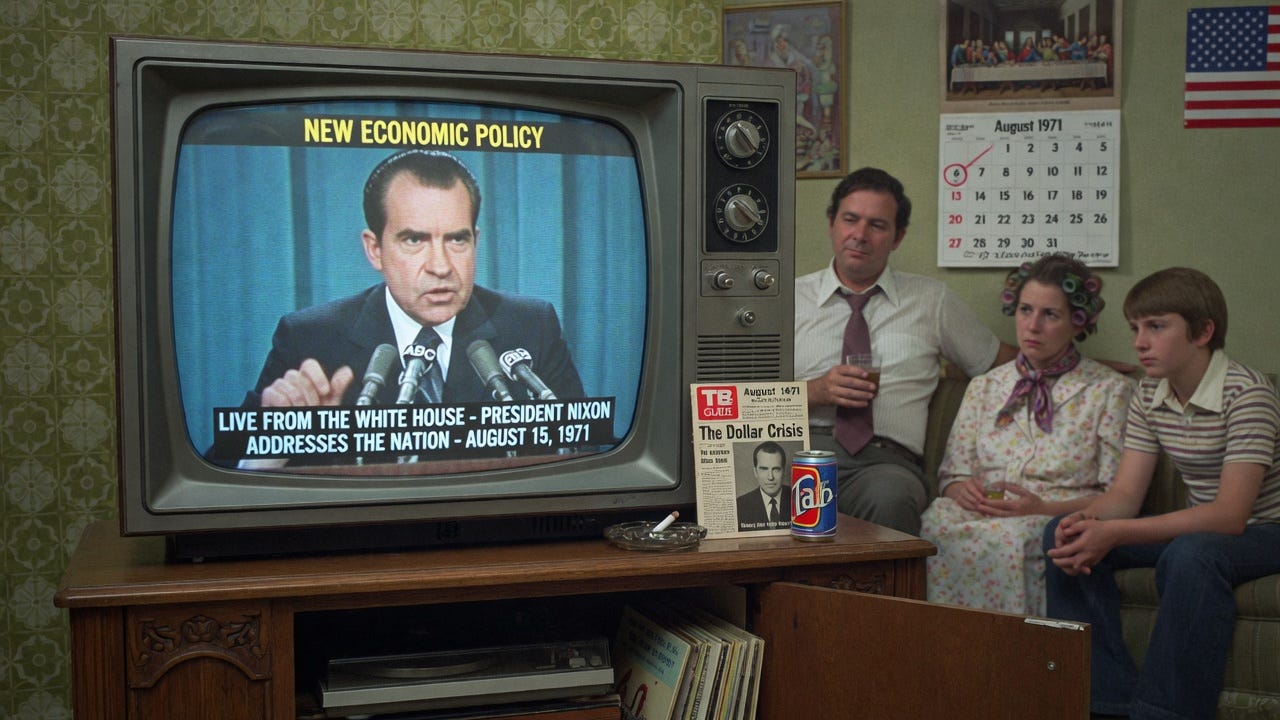
Go back to August of 1971. On a Sunday evening, Richard Nixon went on television and closed the gold window. Foreign governments could no longer hand the United States dollars and receive gold in return. Up to that moment, every dollar was a claim on something real. After that moment, every dollar was a claim on...another dollar. A promise backed by a promise.
The history books file this under monetary policy. I file it under the largest unilateral default in human history. Overnight, the world’s savings were quietly redenominated from hard-asset claims into sovereign promises, and almost nobody noticed, because the number on the statement did not change. The digit stayed the same. Only the meaning of the digit changed.
And then the ruler started stretching. Since that night, the broad money supply has expanded something like fifty times over. Gold has gone from thirty-five dollars an ounce to north of four thousand. That is not gold becoming more valuable. That is the ruler getting longer. Same bar of metal. Same weight, same shine, same atoms. Just measured against a unit that means less every single year.
In other words...the thing you are using to keep score has been losing the game the whole time.
What You Own Versus What You Control
Here is where it gets personal, and here is the distinction that matters more than any chart I could show you.
There is what you own. And there is what you control. We have been trained to treat these as the same thing. They are not.
Think about the pension. Most people look at the statement, see a number with a comfortable amount of zeros, and feel wealthy. They will tell you, with total confidence, that they have a million dollars. Do they? Go and read the fine print on what you are actually permitted to do with “your” money. There is a great deal you cannot do. You cannot, in many cases, take it out without penalty. You cannot move it where you like. And increasingly, governments around the world are deciding what it must be invested in...mandating allocations into government securities, into “national priorities,” into whatever the parasite class has decided is patriotic this quarter.
The moment a politician tells you what you should be doing with your assets is the moment you should be wide awake. Because what they are describing is not your asset. It is their asset, with your name on the spreadsheet.
Contrast that with something you genuinely control. A farm. Cattle in a paddock. A store of grain. Energy you physically hold. Nobody can press a key and dilute the herd. Nobody can mandate that your wheat be reallocated into government bonds. You can walk outside, put your hand on it, and if it comes to it, you can eat it. That is ownership in the oldest and only unbreakable sense of the word.
I am not telling you to go and buy a farm tomorrow. I am telling you that the gap between “the screen says I have it” and “I actually control it” is the single most underpriced risk in modern finance...and it is about to get repriced for a lot of people who never knew the gap existed.
The Hierarchy That Actually Matters
So if the dollar is the wrong unit, what is the right one?
This is where the calories line stops being a provocation and becomes a framework. When you strip away the fiat layer and ask what actually sustains a society, you arrive at a hierarchy of real things, and they rank in a very particular order.
At the base sits energy. It is the master resource, the one that prices all the others, because nothing moves, grows, smelts, or ships without it. A barrel of oil contains roughly four and a half years’ worth of human manual labour, compressed into a form you can pour. You cannot print that. You cannot legislate it into existence. You can only find it, lift it, and burn it...and right now the world is doing far too little of the first two while complacently assuming the third will always be cheap.
Above energy in monetary terms, but woven through the whole structure, sit the monetary metals. Gold and silver. Not as inflation hedges, which is the lazy framing, but as the thing capital flees to when faith in the paper version finally cracks. Then agriculture, the most underappreciated tier of all, because it is the literal base of social stability...hungry people do not stay calm, and you cannot restate a failed harvest with a press release. And finally the industrial metals, copper above all, which functions as a real-time vote on whether the world is actually building anything.
Energy. Metals. Food. The materials. That is the hierarchy. And here is the part that should make you sit up...every single tier of it is, in both absolute and relative terms, about as cheap as it has been in a generation, precisely because the entire investing world has spent fifteen years measuring value with the rubber ruler and concluding that the unprintable things were boring.
The unprintable things are never boring for long.
Systems, Not Stories
Let me take this one level higher, because the same logic that reframes your portfolio also reframes the map.
I try very hard not to think in ideologies, because ideologies make you tribal, and tribal makes you stupid with your money. I try to think in systems. A system is just a set of rules that produces outcomes, and you can assess it coldly...what does it produce, at what price, and what is it priced at right now.
Run that lens across the world and you get an answer that offends a great many people’s instincts, which is usually a sign it is worth listening to. You can compare two systems, and one of them might genuinely be more productive than the other. But productivity is only half the trade. The other half is what you are paying for it. If the more celebrated system trades at a hundred times earnings and the less celebrated one trades at six, the cheaper system can grow more slowly and still hand you the better return, because you did not overpay for the privilege of owning it.
I cannot afford to be ideological about that. My job is to make money for clients and for myself, which means I have to be realistic rather than righteous. And realism keeps pointing at the same uncomfortable conclusion. The unloved, the cheap, the structurally starved, the things sitting at six times earnings while the crowd piles into the hundred-times story...that is where the asymmetry lives. It always has.
We have written before about why the most hated sectors on the board are the ones set up to pay. This is the same argument, told from the top down. When the next monetary architecture emerges...and it is when, not if...it will be anchored to something real, and the entities holding the physical nodes of that system will be standing on the right side of the reset. Everyone else will be holding digits, insisting the screen still says they are rich.
So What Do You Actually Do
You do not need to move to a farm and start churning your own butter. This is not a survivalist sermon. It is a portfolio instruction, and it is a fairly simple one.
You tilt the denominator. You move weight, at the margin, out of the things that are priced in fiat and into the things that price the fiat. And you can do it with the most boring instruments imaginable. If you want a single one-stop way to own the upstream producers of the real economy, a fund like GUNR holds the lot in one line. If you want energy specifically, the producers sit in XOP and the beaten-down services end sits in XES. The gold miners live in GDX. And for the sector the whole world keeps trying to bury and cannot, the coal names...we have said it before and we will say it again, own coal...with something like Yancoal as the example everyone loves to hate. None of that is exotic. None of it requires a passport or a numbered account. It just requires you to decide that you would rather own a claim on something real than a claim on a central bank’s good intentions.
Now, I am naming those as illustrations of the categories, not as a shopping list...do your own research, because what suits our positioning may not suit yours, and every one of them carries its own risk and its own timing. But the principle underneath them does not change with the ticker. Own the unprintable. Underweight the conjurable. Measure your wealth, increasingly, in the units that cannot be summoned from nothing.
Because the casino does not stay open forever. And the question that matters when the doors finally close is not what your chips were worth on the screen. It is what you walked out holding.
Where This Goes Next
What you have just read is the philosophy. The positioning is a separate thing, and it is where the real work lives.
The full breakdown...which tiers of the hierarchy we are weighting most heavily right now, the specific energy and metals and agricultural names we hold and why, the sizing and the rotation discipline that turns a good idea into an actual return...runs in the latest Insider Newsletter, where we lay out the Big Five for the month. The individual holdings, with entry logic and position sizing, sit one tier further up, in the full Insider Service at capitalistexploits.at. Three products, three jobs. The article gives you the frame. The Newsletter gives you the analysis. The Service gives you the names.
If you have spent this whole piece quietly recalculating what you actually own versus what you merely have a number for, that is the right instinct. The next step is deciding to do something about it.
The screen tells you what you are worth today. The dirt tells you what you will be worth when the screen stops working.
Sincerely,
Chris MacIntosh Founder & Editor In Chief, Capitalist Exploits Independent Investment Research
Nothing in this article constitutes investment advice. Do your own research. All investments carry risk. This is what we think...it may not be suitable for you.
Soon, Sir. I've been reading Your Work since You called Yourselves Hedgies Uncut. Excellent Analysis, Great Picks and Wisdom brought of many Years as a Hedge-fund Manager shows in the Writing. Soon, Sir, I WILL Be a Paid Subscriber...
Awesome post!
This is the part that floors me: every AI data center, every chip fab, every 'asset-light' darling (or so they were, until the capex bills forced many of them to quietly drop the label) is downstream of the energy tier you describe. We've somehow priced the foundation below the building sitting on top of it. The megawatts and the copper trade at six times earnings, while the abstraction layer that can't run a single GPU without them trades at a hundred. That isn't optimism about technology. It's a category error, and the rubber ruler is one of the biggest reasons nobody sees it. Which is good news for anyone paying attention, because there's no shortage of dreamers out there to keep the foundation cheap.
The one thing I can't settle, though: how long does the dream actually last? It's far from clear now that governments are lining up to subsidize AI development directly, treating it as some kind of arms race in the name of 'national security.' Doesn't state money risk keeping the ruler stretched, and the foundation cheap, well past the point fundamentals alone would justify? Curious how you're thinking about this.