

![[Section Divider Image]](https://substackcdn.com/image/fetch/$s_!DBRV!,f_auto,q_auto:good,fl_progressive:steep/https%3A%2F%2Fsubstack-post-media.s3.amazonaws.com%2Fpublic%2Fimages%2F86799ce1-b6fb-410c-9899-d4c16dacfaf3_1320x50.webp "[Section Divider Image]")
At the time of this writing (Friday May 8th) Brent crude had closed at $114.4 on Monday. And by Thursday it had fallen to $96.9.
Same week, same war, same blocked strait.
The market spent four days trading a one-page memorandum supposedly threading through Pakistani intermediaries to get Iran back to the table. In that same session, the 6-month forward Brent contract jumped to $91.99... its largest single-day move since March 2022.
Spot oil oscillated wildly on the prospect of peace. Six-month oil traded the prospect of structural pain regardless of peace. The market is two markets right now. One trades the headline. The other trades the maths. Today’s piece is about the second one.
The wave is now hitting shore
Here is the structural fact that nothing in the headline cycle changes.
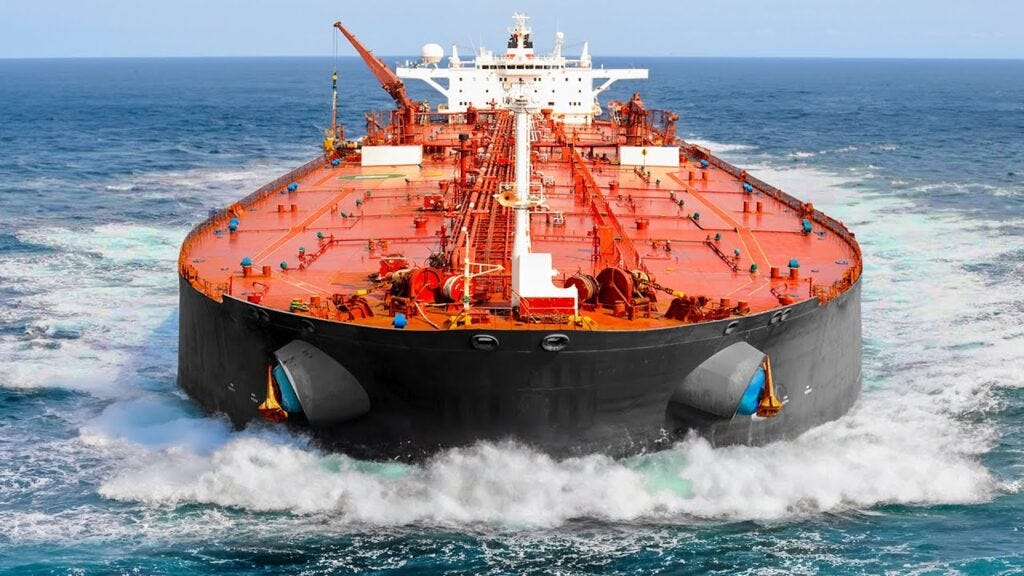
When the Strait of Hormuz went effectively dark on February 28 following the US-Israel strikes on Iran, an enormous quantity of crude was already on the water. Tankers that had loaded out of Ras Tanura in early February were sitting somewhere in the South Atlantic with three or four weeks of voyage still ahead. Cargoes that had cleared Jubail two weeks before the strike were already most of the way to Singapore. The Asian sour blends that traded at $153 in early March did so partly because the inventory machine looked normal at the receiving end. The water in the pipe was already there.
The water in the pipe is no longer there. We are now arriving at the moment when what gets unloaded at LOOP, at Fujairah, at Ulsan, is what was loaded after the shutdown. Which is a much smaller number.
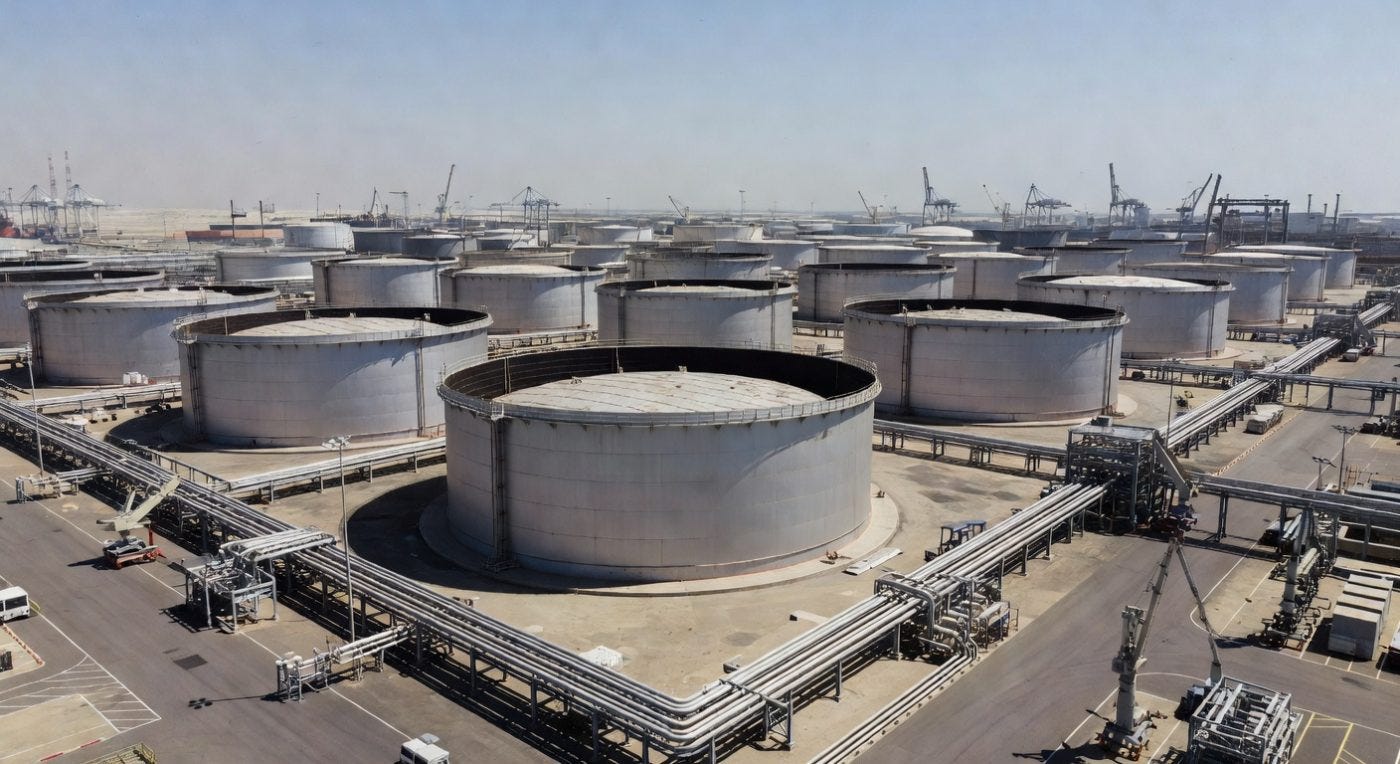
This is what Goldman Sachs is talking about when it warns of easily-accessible refined-product buffers depleting rapidly. Global commercial refined-product stocks have fallen from about 50 days of demand pre-war to about 45 days now. Total global oil stocks sit near an eight-year low. Naphtha storage in UAE Fujairah has dropped 72% since late February. The Amsterdam-Rotterdam-Antwerp hub is down 37%.
That’s the wave. It is hitting the shore now.
Why this is just math
Let’s do the math.
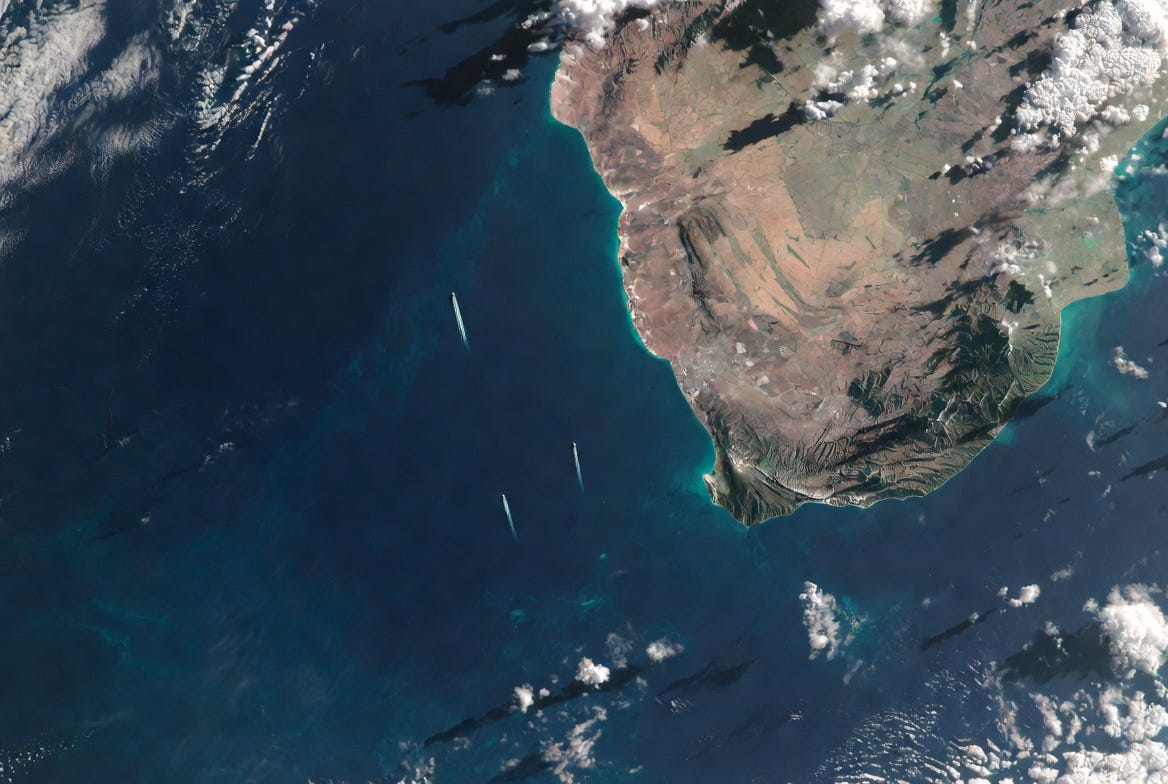
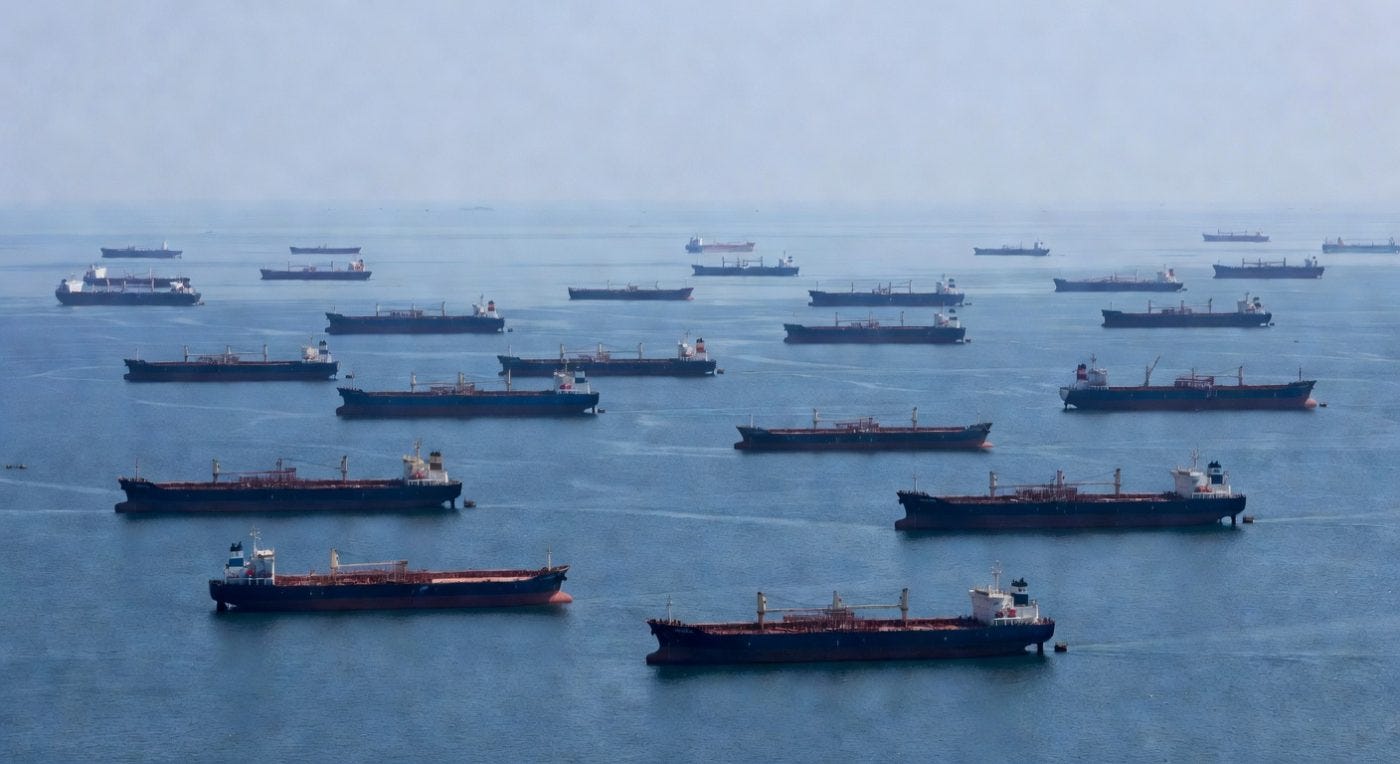
A VLCC moves at roughly 11.5 mph. Slower than Usain Bolt jogging. These beasts of the seas are four soccer fields long and carry around two million barrels of crude. The standard Saudi-export route to the US Gulf Coast for a laden VLCC, with Suez avoided because most VLCCs cannot transit it laden anyway, runs around the Cape of Good Hope. Call it 28 to 35 days at sea, plus port handling. Traders model 30 days as the working assumption. The Singapore run from Saudi is shorter but still the better part of two to three weeks.
Now stack the costs. With Brent above $100, a single VLCC is carrying roughly $200 million of floating inventory. At $112 you get the $224 million figure from last weeks Insider Newsletter math. Financing cost on $224 million held for 30 days is several million dollars per voyage before freight... and freight has moved. VLCC day-rates hit an all-time record of $423,736 on March 3 and have stayed in the $400,000 to $800,000 per day band since.
Then add the insurance. Within 48 hours of the February 28 strikes, Lloyd’s Joint War Committee redesignated the entire Arabian Gulf as a conflict zone. War-risk premiums went from 0.15-0.25% of hull value to 1-7.5% and higher. On a $250 million VLCC that is between $2.5 million and $15 million of additional premium per transit before you have moved a barrel. Major P&I clubs cancelled cover outright. Tanker traffic through the strait collapsed by more than 80%.

We covered the insurance mechanism at length in The Toll Booth...the point worth repeating here is that the Hormuz closure is not enforced by a missile. It is enforced by an underwriter in London who declined to renew. That decision is not reversed by a memorandum of understanding from the White House.
Stack all of that into the cost of a barrel at the receiving terminal and the cost layer is structural. This is just math. The math says it is going much higher. And the math would still say that if everyone laid down their arms, decommissioned their drones, and sang kumbaya together tomorrow.
Even if peace breaks out
Suppose the memorandum gets signed. Suppose Tehran agrees, the strait formally reopens, and the headlines tomorrow read “deal ends the war.” What changes? A few things. None of them fast.
The IMO is reporting roughly 20,000 seafarers stranded on around 2,000 vessels in and around the strait. Iranian mines reportedly need clearing. Insurers need to retrocede new cover. Crews need to consent to sailing...and many simply will not, until they see other ships make the run unscathed for longer than a few weeks. Iraq, Saudi Arabia, and the UAE shut in oil production after the February strikes; restart sequences are themselves slow and dangerous, and damaged refineries take months to recertify. And even if barrels start moving on day one of an armistice, those barrels still take 30 days at 11.5 mph to reach the US Gulf Coast around the Cape. Five to six weeks before they hit a refinery. Eight weeks before refined product hits a tank you can fill from.
The “deal” headline buys you nothing on the calendar. Goldman has pencilled in its assumption that Gulf exports normalise by the end of June, not mid-May, and has the global oil market shifting from a 1.8 million barrel-a-day surplus in 2025 to a 9.6 million barrel-a-day deficit in the second quarter of 2026. That is a 12 million barrel-a-day swing. There is no way to wash that out in a quarter.
The thing the headline traders haven’t priced is that the math doesn’t care about the headline. It cares about how many fully-loaded VLCCs are within ten days of a refinery and how much refined product sits in tank at the receiving end. Both numbers are going down. They go on going down for several months even on the most optimistic deal scenario. This is not an end-of-the-world piece. It is a pacing piece. The inflection has happened, not been theorised. We are inside the window now.
The cascade we already wrote
The reason we are not walking the cascade in detail again here is that we already walked it. The fertilizer leg...why a closed Hormuz cuts global ammonia, sulphur and urea flows, why planting seasons in import-dependent regions get materially compromised, why food shortages follow on a calendar lag of months not years... runs in Bearer of Bad News and You Can’t Print Fertilizer. If you have not read them, do that first. The piece you are reading is the upstream of those two cascades. It is what makes them a calendar problem rather than a price problem.
What is fresh here is the timing. The cascade has shifted from “incoming” to “arriving.” Goldman’s petrochemical-feedstock numbers...naphtha and LPG acutely tight in Asia, jet fuel cushions thin enough that Wirth at Chevron is publicly saying the question is whether you can get the fuel, not what you pay for it...those are the first wave. Diesel and heating oil follow. Refining margins follow. Refined-product price spikes follow. Final-demand destruction follows. We are at step one of that sequence right now.
What rotates into what
For a portfolio, this is a rotation question, not a forecast question.
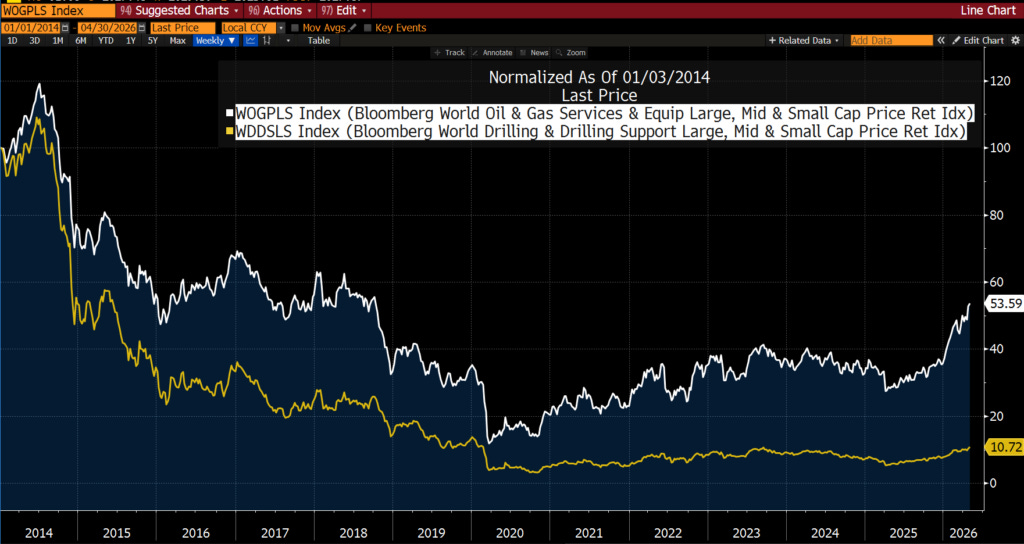
The rotation is from things priced on narrative...AI multiples, growth-stock optionality, anything trading on a discount-rate assumption that no longer holds at $112 oil... toward things priced on physical throughput. Producers with free cash flow at current prices. Energy-services names whose order books finally fill after a decade of capital starvation. Deepwater drillers with multi-year contracted day-rates. Refiners with complex configurations that can capture distillate cracks. Pipeline and terminal owners who collect a toll on every molecule that moves through the system.
The denominator helps too. When oil holds above $100 for a sustained stretch, energy producers earn that revenue in a currency the central banks are still actively debasing to fund the deficits the war has accelerated. The income is real. The denominator is variable. The asymmetry sits in the gap between the two.
“We have written extensively on the energy-services thesis...why a decade of underinvestment, idle rig capacity at 80-90%, and a structural shift from just-in-time to just-in-case inventories combine to produce demand for vessels, rigs, and oilfield equipment that is not in the published forecasts.
If you want the long-form thesis and the next idea before it gets crowded, the Insider Newsletter is on Substack at $39 a month. If you want the actual portfolio (the Asymmetric Portfolio, the Dividend Portfolio, the Skeleton, and the Big Five contrarian picks each fortnight), the full Insider Service is where the names live.

Nothing here is investment advice. This is what we think and what we own. Do your own research.
If this resonated, you’re reading the free version.
Paid subscribers got the full picture last week…specific position ideas, entry points, and the reasoning behind every allocation. Not general thesis. Actual allocation setups that make sense.
The macro setup doesn’t care whether you acted on it. If you want to move from understanding it to doing something with it, that’s what the Insider Newsletter is for.

No spam. No fluff. Twice a month, when it matters.
The window on these setups doesn’t stay open forever.
another great writing, only missing part is responsibility for current situation, deep state ? zelensky ? for sure not trump and his mate from 12 tribes country .....