

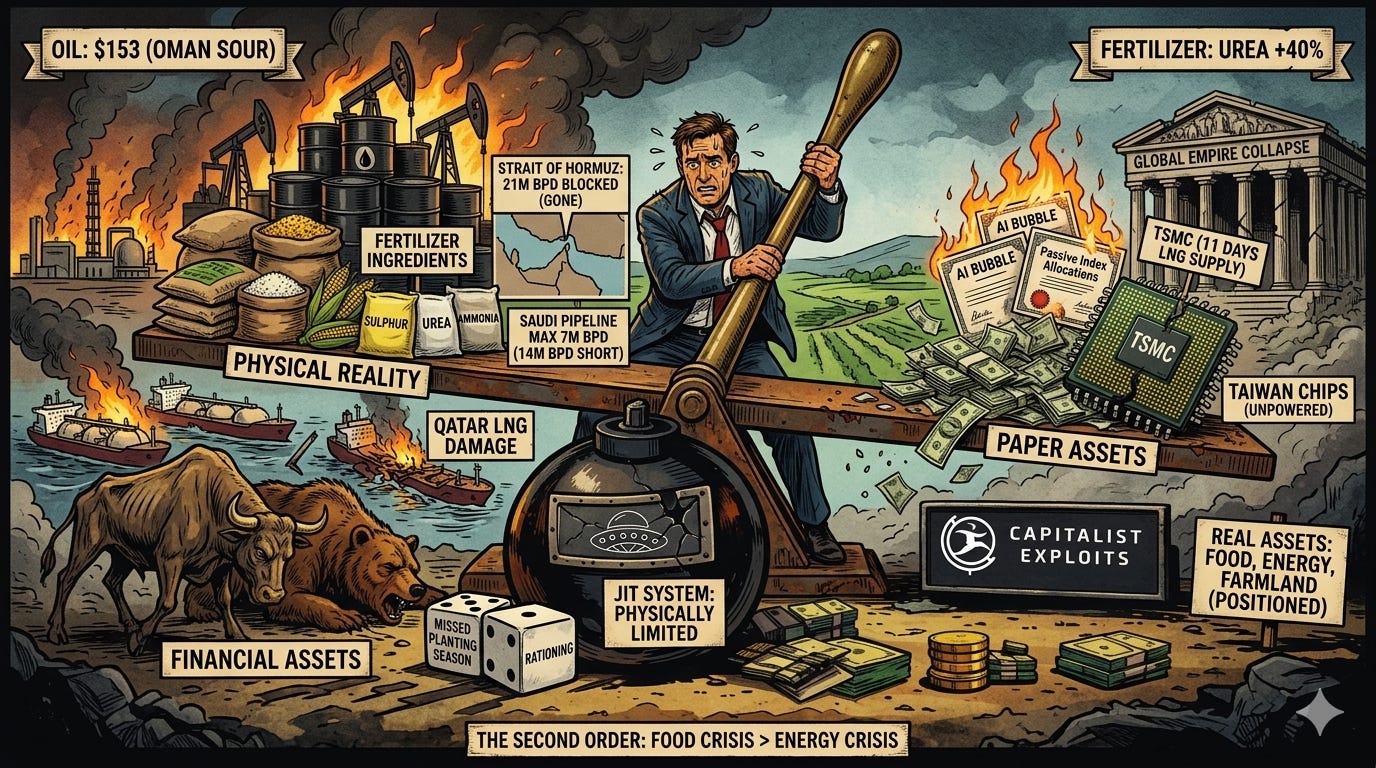
Greetings, friends!
Everyone is glued to oil prices right now. Lines at the pump. Flights grounded. Dubai in chaos. And the financial media is doing what financial media does...obsessing over the thing everyone can already see.
What they’re missing is the second order.
And the second order is where empires actually fall.

The Strait Is Shut. This Is Not a Diplomatic Problem.
On February 28, the US/Israel project in Iran began. Within days, tanker transits through the Strait of Hormuz...the world’s most critical energy artery...had effectively flatlined to zero.
![Bianco Research — “Hormuz Strait Tanker Daily Crossings (Bidirectional)” chart — showing collapse from ~60-70 crossings/day to zero by mid-March 2026]](https://substackcdn.com/image/fetch/$s_!UyhO!,f_auto,q_auto:good,fl_progressive:steep/https%3A%2F%2Fsubstack-post-media.s3.amazonaws.com%2Fpublic%2Fimages%2Fdcacb71f-852b-4a46-900a-8872d886216c_800x600.png "Bianco Research — “Hormuz Strait Tanker Daily Crossings (Bidirectional)” chart — showing collapse from ~60-70 crossings/day to zero by mid-March 2026]")
Let that sink in.
The Strait of Hormuz carries roughly 21 million barrels per day. That’s 20% of global crude consumption. 31% of all seaborne crude. Gone.
The pointy shoes in Washington have a solution, of course. Drain the SPR. Blame the Ayatollah. Beg NATO allies. None of that moves one barrel through a closed strait.
And here’s the math everyone is ignoring on the Saudi workaround: the East-West pipeline from Jubail to Yanbu can ramp to a maximum capacity of 7 million barrels per day.
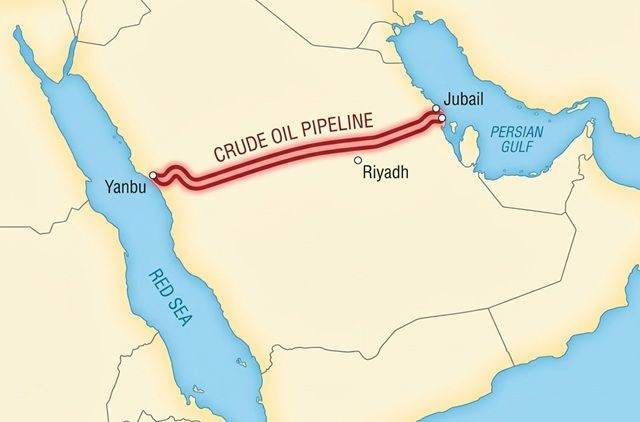
Seven million into twenty-one million doesn’t go. Even if it ramped tomorrow...which it hasn’t...you’re still 14 million barrels per day short. Ships are in the wrong places. Infrastructure is damaged. We’re looking at a minimum of two months just to restore physical flow, assuming the Strait reopened tonight.
It won’t reopen tonight.
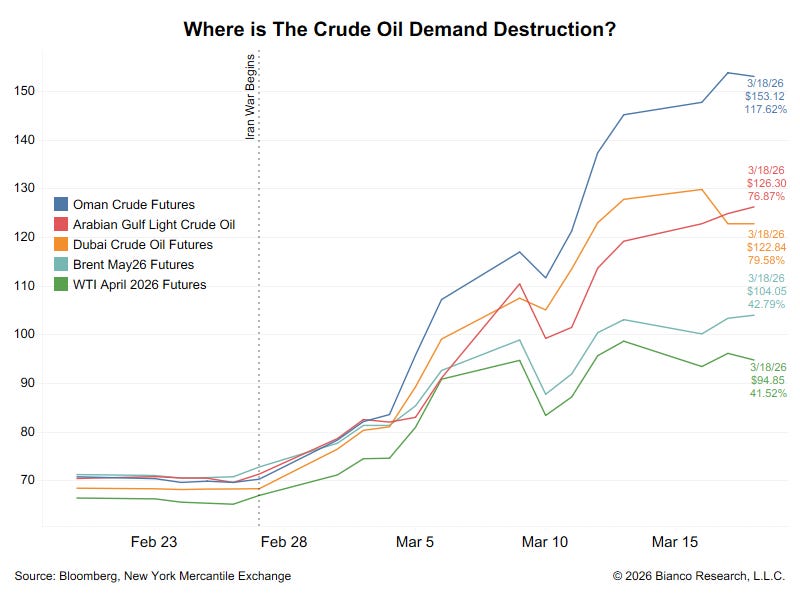
The price data tells you everything. Asian crude grades...Oman futures, Arabian Gulf Light, Dubai...have decoupled violently from Western benchmarks. Oman crude hit $153 on March 18. WTI sits at $94. That spread exists because Asian refineries are chemically tuned to specific sour grades. They cannot simply switch. So they bid astronomical premiums for any barrel that makes it through...and Asia has become the world’s shock absorber.
For now.
But That’s Not the Real Problem.
Oil prices getting your attention? Good. Now forget about them for a moment.
The real problem is food. And food runs on exactly two things: diesel and fertilizer.
Diesel you understand. Trucks. Tractors. Supply chains. Every barrel of diesel that doesn’t flow through the Strait is a truck that doesn’t run, a tractor that doesn’t plant.
Fertilizer is the one nobody’s talking about.
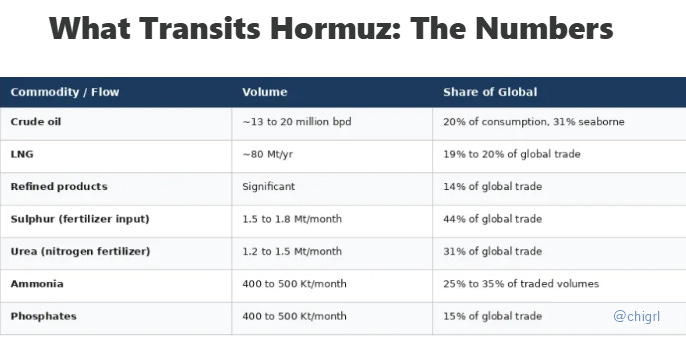
Look at those numbers. 44% of global sulphur trade...a primary fertilizer input...flows through the Strait. 31% of global urea. 25-35% of traded ammonia. These aren’t rounding errors. These are the inputs that make crops grow.
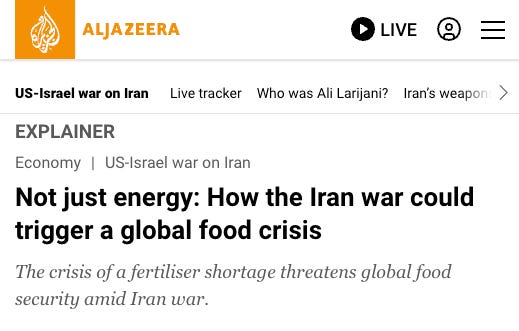
One third of global seaborne fertilizer now moves through waters effectively controlled by Iran. Plants are halting. Nearly a million tons is stranded. Urea is already up 30-40%.
India gets 40% of its urea and phosphates from this region. Same for Southeast Asia. Rationing has already started.
And then there’s Qatar.
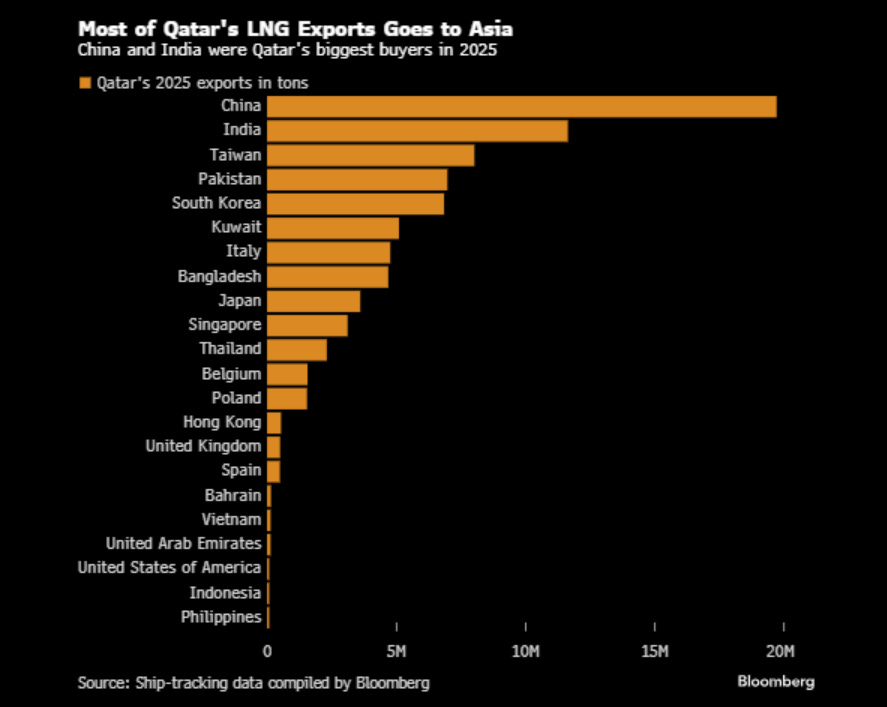
The Ras Laffan facility...responsible for roughly 20% of the world’s LNG supply...took Iranian missile strikes. Fires. Extensive damage.
Europe spent four years and hundreds of billions of dollars building its post-Russia energy strategy around Qatari LNG. They congratulated themselves endlessly on the pivot. Energy independence. Crisis averted. Grownups in charge.
That entire strategy is now on fire...literally...because Iran decided to punish Qatar for hosting a US air base Qatar.
No Policy Response Fixes a Physical Supply Problem. None.
This is the part Washington doesn’t understand. And it’s the part that matters most to anyone with capital at stake.
Trump can tweet. Doesn’t grow one ton of urea. Doesn’t move one barrel of diesel. Doesn’t buy back a missed planting season.
Print more money? Doesn’t rebuild a blown refinery. Doesn’t replace incinerated LNG infrastructure that will take a decade to repair. Doesn’t feed anyone.
Here’s what makes food different from every other supply shock: you cannot restate the harvest. Miss the planting window and you wait until next year. That’s not a quarter you revise. That’s a season gone. Bangladesh, Pakistan, India...roughly two billion people, a quarter of the planet...are already facing fertilizer shortfalls going into planting season.
Physics and geography eventually trump central bank prayers. We are watching it happen in real time.
Taiwan. Chips. The Thing Under the Thing.
While we’re at it...
Taiwan imports 98% of its energy. It currently has approximately eleven days of LNG supply on hand.
TSMC is Taiwan.
The Bag 7 and the 33% of the S&P 500 that depends on them...is TSMC. The AI superstory...the chips, the fabs, the power requirements, the entire narrative holding up twenty-three times price-to-cashflow...sits on physical infrastructure that just discovered it has an energy supply problem no earnings call can explain away.
We Didn’t Need to Predict the War. The Setup Was Obvious.
Here’s the thing. We didn’t need to see this exact conflict coming to be positioned for it.
We’ve been long energy. Long farmland. Long hard assets. The thesis was never “there will be a US-Israel strike on Iran on February 28.” The thesis was simpler than that: the global system was running on just-in-time assumptions that had never been stress-tested at scale, and the price of that fragility would eventually be paid in real goods...not financial abstractions.
Paper promises are meeting their physical limits in real time.
The Americas bloc is relatively insulated. North and South American feedstock chains are shorter, less exposed to Gulf disruption. That matters enormously for agricultural output. Latin American farmland...already cheap, already unloved...looks considerably more interesting with each passing day.
The trades that follow from here are not complicated. Real assets. Energy. Agricultural commodities. Hard infrastructure in geographies that aren’t downstream of a closed strait.
Think Maslow’s hierarchy: food sits at the bottom. Everything else stacks on top of it. When people start worrying about eating, they stop worrying about their passive index allocations.
The crowd is already furious about petrol prices and cancelled flights.
Wait until it’s food prices.
That’s how empires collapse. Return of capital matters more than return on capital...right now, more than at any point I can remember.
We’re positioned. If you’re not, that’s worth thinking very seriously about. Do your own research. But don’t wait for CNN to tell you it’s a crisis. By then, you’ll be paying for it at the checkout.
Sincerely,
Chris MacIntosh Founder & Editor In Chief, Capitalist Exploits Independent Investment Research
I came to the conclusion that being here in New Zealand is not a good idea anymore.
An abundance of sunshine and rain. Diesel and fertiliser? Not so much!
Costa Rica here I come!
Qatar never asked to be dragged into a war over."
Not sure what this can mean?