

![[Section Divider Image]](https://substackcdn.com/image/fetch/$s_!zmDD!,w_1456,c_limit,f_webp,q_auto:good,fl_progressive:steep/https%3A%2F%2Fsubstack-post-media.s3.amazonaws.com%2Fpublic%2Fimages%2F581adbc3-b79d-4f08-a815-2e32268448f2_1320x50.webp "[Section Divider Image]")
Brazil’s stock market ran to multi-year highs this spring before pulling back over the past few weeks. The iShares MSCI Brazil ETF (EWZ) is still up on the year even after that slide, the real has been one of the better-behaved currencies on the board, and Brazil is sitting on some of the highest real interest rates of any major economy on earth. So naturally, with the tape softening, the pointy shoes have decided this is the moment to start worrying about Lula.
Let me offer a different frame.
The Two Lists
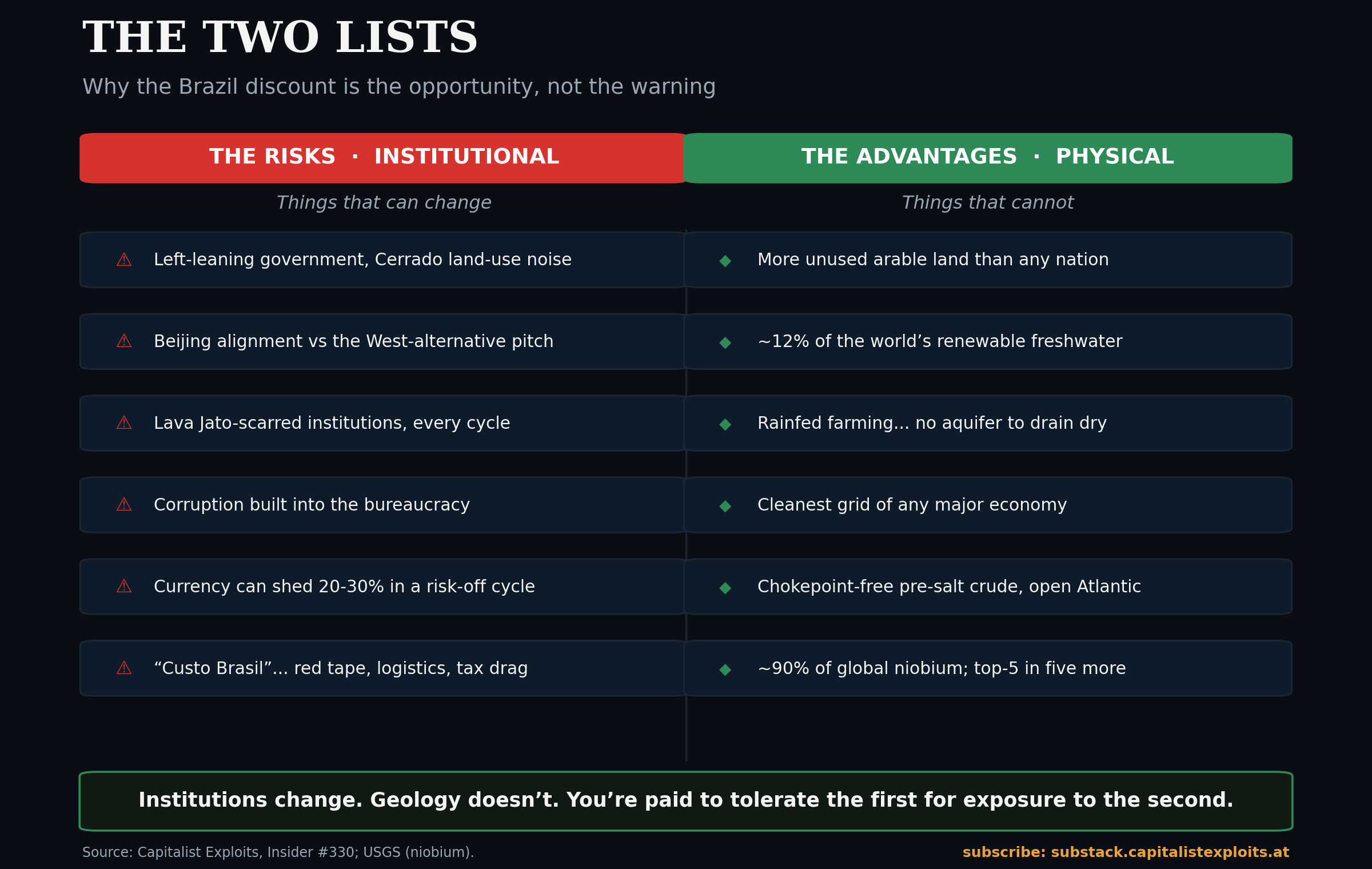
Sit down and write out everything that is wrong with Brazil. It’s not a short list. Lula’s administration leans left and has rattled the cage on agricultural land use in the Cerrado. He’s cosy with Beijing, which is awkward if your whole pitch is “Brazil is the West’s way around China.” Every election cycle stress-tests institutions that never fully healed from the Lava Jato years. Corruption isn’t a bug you can patch...it’s woven into the bureaucracy, top to bottom, under every administration anyone can remember. The currency can shed 20 to 30% in a single risk-off cycle no matter how well the underlying business is run. And then there’s the famous “custo Brasil”...the aggregate drag of red tape, logistics, and tax complexity so severe that it can cost more to move soybeans from Mato Grosso to the coast than to ship them from the coast to Shanghai.
Now write out the second list. The things that are right about Brazil.
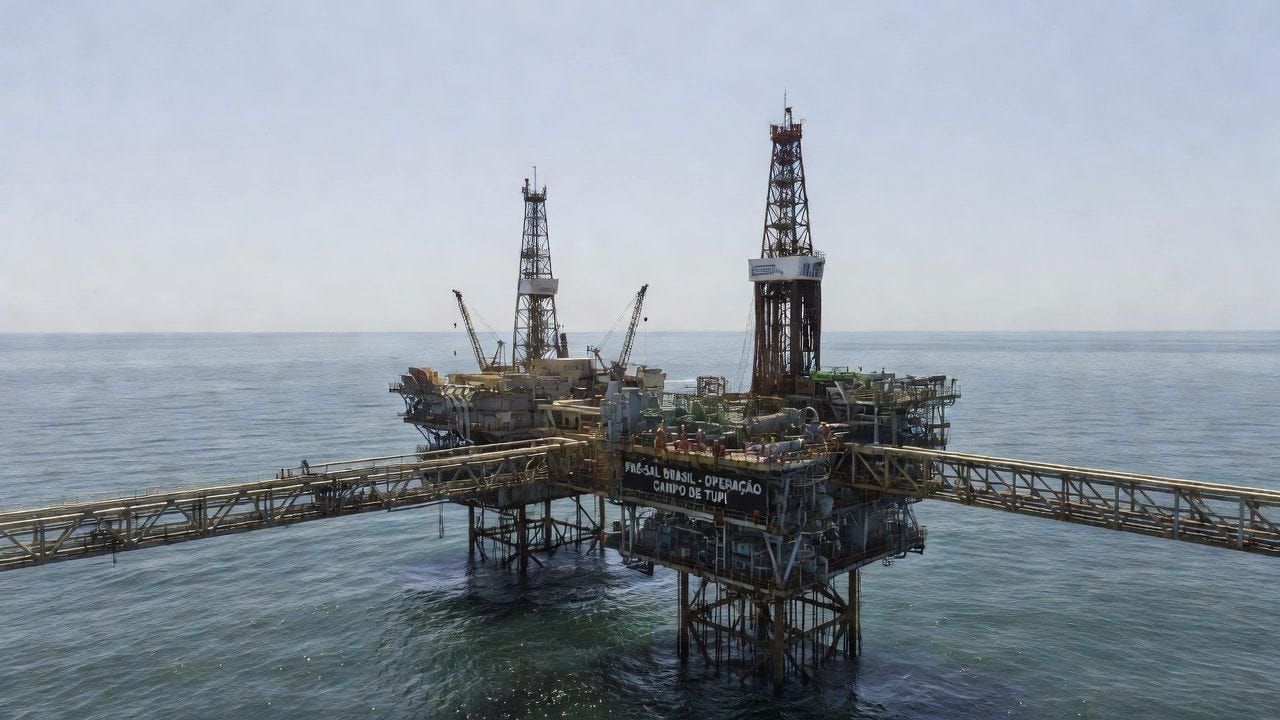
It holds more unused arable land than any country on the planet, and it can roughly double the area it farms without touching the Amazon, using technology that already exists, on pasture that’s already degraded. It controls something like 12% of the world’s renewable freshwater. Unlike California, unlike Punjab, unlike the North China Plain, its agriculture is mostly rainfed...it isn’t quietly draining an aquifer that will never recharge inside any timeframe you’d care to invest across. Its electricity is the cleanest of any large industrial economy, the bulk of it hydro, fed by rivers that aren’t running dry. It’s a serious oil producer whose pre-salt crude sails out across the open Atlantic, touching no strait controlled by anyone hostile or unstable. And on the minerals the entire Western world is currently scrambling to source from anywhere that isn’t China...Brazil controls roughly 90% of global niobium, sits in the global top five for nickel, graphite, lithium, manganese, and rare earths, and has surveyed less than half its own ground.
Two lists. Look at them side by side, because the relationship between them is the entire trade.
Institutions Change. Geology Doesn’t.
Here’s the thing nobody on the worried side of the table seems to notice.
Every item on the first list is institutional. Political cycles, governance quality, fiscal management, currency policy, bureaucratic friction. Every item on the second list is physical. Soil, water, sunlight, geology, geography.
Institutions change. They can rot further, or they can heal. Physical endowments do not change. The Amazon basin will carry the same volume of freshwater in 2075 regardless of which podium donut is sitting in Brasília. The pre-salt fields will hold the same barrels. The niobium will still be sitting in Araxá. You are being asked to accept institutional volatility...which is real, which will hand you drawdowns, which deserves genuine respect... in exchange for physical advantages that compound in exactly the world now arriving.
In other words, the risks are the reason the assets are cheap. If Brazil had Singapore’s governance, its farmland would trade at Iowa multiples. It doesn’t, so it doesn’t. The discount exists precisely because tolerating the dysfunction takes conviction, local knowledge, and patient capital. Those are the barriers to entry. Those barriers are what create the return.
This is our shtick, really. Buy what’s cheap and unloved, and the reason it’s cheap is usually something uncomfortable that everyone else has decided not to stomach.
A Country That Could Close the Door and Survive
Put the pieces together...food surplus, water abundance, clean and secure energy, chokepoint-free oil, mineral dominance, and a domestic market big enough to sustain its own demand...and you get something rare. Brazil is one of the only economies of meaningful size that could function in near-autarky if it were ever forced to.
That’s not an argument for autarky. It’s an argument about pricing. In a world that is increasingly paying a premium for supply security... food security, energy security, mineral security... Brazil’s bargaining position appreciates continuously, and it doesn’t have to lift a finger to make it happen. Every Red Sea disruption, every Hormuz anxiety, every Bab el-Mandeb incident reprices Brazilian energy and Brazilian food upward without Brazil doing a damn thing. We’ve been hammering on the supply-security repricing theme for a while now, and Brazil is the cleanest expression of it we’ve found.
Compare that to the alternative. Look at the absolute clustafuk that is Europe right now... or the United States, for that matter, if you fancy a serious conversation about institutional corruption. Suddenly the discount you’re getting on Brazil looks rather generous.
How You’d Actually Play It
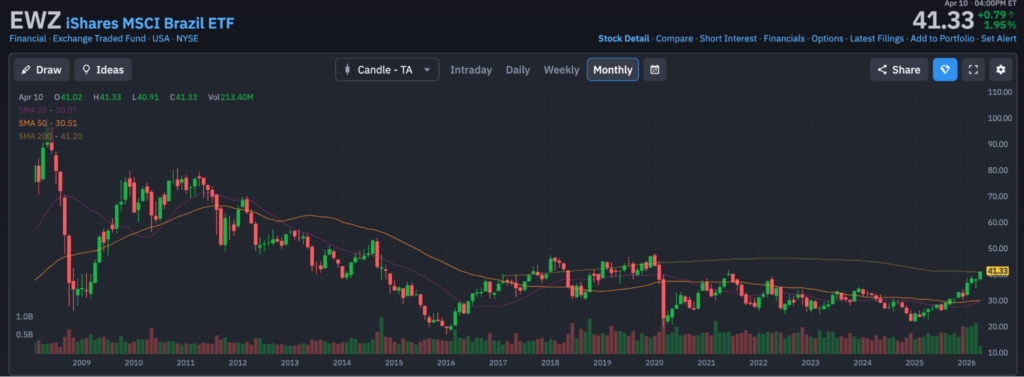
We are long EWZ and have been for a while. It’s been better than a poke in the eye with a sharp stick. But pull up a longer-term chart and the more important point lands...even after the run to the spring highs, we are still nowhere near the old peaks. This is a market getting off the mat, not one that’s run away from you. And the recent pullback hands you a better entry than chasing the high would have.
Now, the standard caveats apply, and they matter. The currency risk is the most immediate threat to dollar returns...Brazil’s fiscal trajectory means the basis for periodic real weakness simply persists. But you’re buying an export economy. Your costs sit in real, your revenue arrives in dollars. Not a bad shape for profitability. And currency risk is global now anyway...the whole point of owning hard assets is that they hold value while the paper doesn’t.
So if you were going to structure this properly, you wouldn’t treat it as a binary in-or-out call. You’d size for the currency. You’d favour export-oriented assets...agribusiness, oil-linked names, mineral royalties priced in dollars. Think soybeans sold to China, crude sold to Europe, niobium sold to the carmakers. And you’d treat the whole thing as a long-duration position, because the thesis plays out over decades, not quarters. Political cycles will turn against you at times. The currency will punish you at times. The investor who sizes correctly and holds through those episodes is the one who captures the compounding.
Do your own research, obviously. None of this is advice. It’s how we’d think about it.
The Discomfort Is the Point
Brazil is not a comfortable trade. It isn’t meant to be. Honestly, think about most of the things we buy when we buy them...the average Joe Sixpack would look at the lot and call it reckless. That’s how it’s supposed to feel. The political noise, the currency swings, the institutional friction... none of that is incidental to the opportunity. It is the opportunity. Strip the discomfort out and the discount goes with it.
The full Brazil case study runs in the most recent Insider Newsletter, Issue #330...the complete endowment breakdown, the risk framework walked end to end, and where it sits alongside the rest of the commodity-supercycle positioning. Go read it. What you’re reading here is the surface argument. The named companies behind the themes, with the sizing and the rotation discipline, sit one tier further up in the full Insider Service at capitalistexploits.at. Three different things...this article, the Newsletter, the Service. Don’t confuse them.
Everyone’s busy counting the votes. The dirt doesn’t vote.
Nothing here is investment advice. This is what we think and what we own. Do your own research.
A sharp piece, and the institutional-versus-physical frame is the right one. One amendment, from a different desk.
The dirt doesn't vote — but it doesn't collect a toll, either. Soil, water, and ore are price-takers; you capture them only through price, and price is exactly where the fat tail lives, as the author concedes the moment the currency sheds a third in a risk-off week. Buying the endowment is buying the beta.
The cleaner expression of this same thesis is to own what the endowment is forced to cross. Supply-security repricing doesn't just lift the commodity — it raises the volume and the strategic rent of the chokepoints: the exchange the capital routes through, the single rail that drags the soybeans to the coast. The "custo Brasil" the piece laments isn't the bug. For whoever owns the bottleneck, the friction is the toll.
Same continent, different node. The compulsion was never the commodity — it's the gate it has to pass through.
Dirt doesn’t Vote and It doesn’t steal Your Money, either…