


![[Section Divider Image]](https://substackcdn.com/image/fetch/$s_!EsK2!,w_1456,c_limit,f_webp,q_auto:good,fl_progressive:steep/https%3A%2F%2Fsubstack-post-media.s3.amazonaws.com%2Fpublic%2Fimages%2F335d5572-1993-40be-a6c9-df08cd072dcf_1320x50.webp "[Section Divider Image]")
Somebody built the biggest short position in gold miners in roughly a decade.
They were betting against a sector generating record free cash flow, carrying half the debt it had five years ago, and priced at its cheapest relative to the S&P 500 in twenty years.
Then, across five trading days in the first half of August, GDX rose 21.09%. GDXJ 22.42%. Newmont 20.55%. Barrick 19.22%. Agnico Eagle 22.92%.
You can probably guess how that went for them.
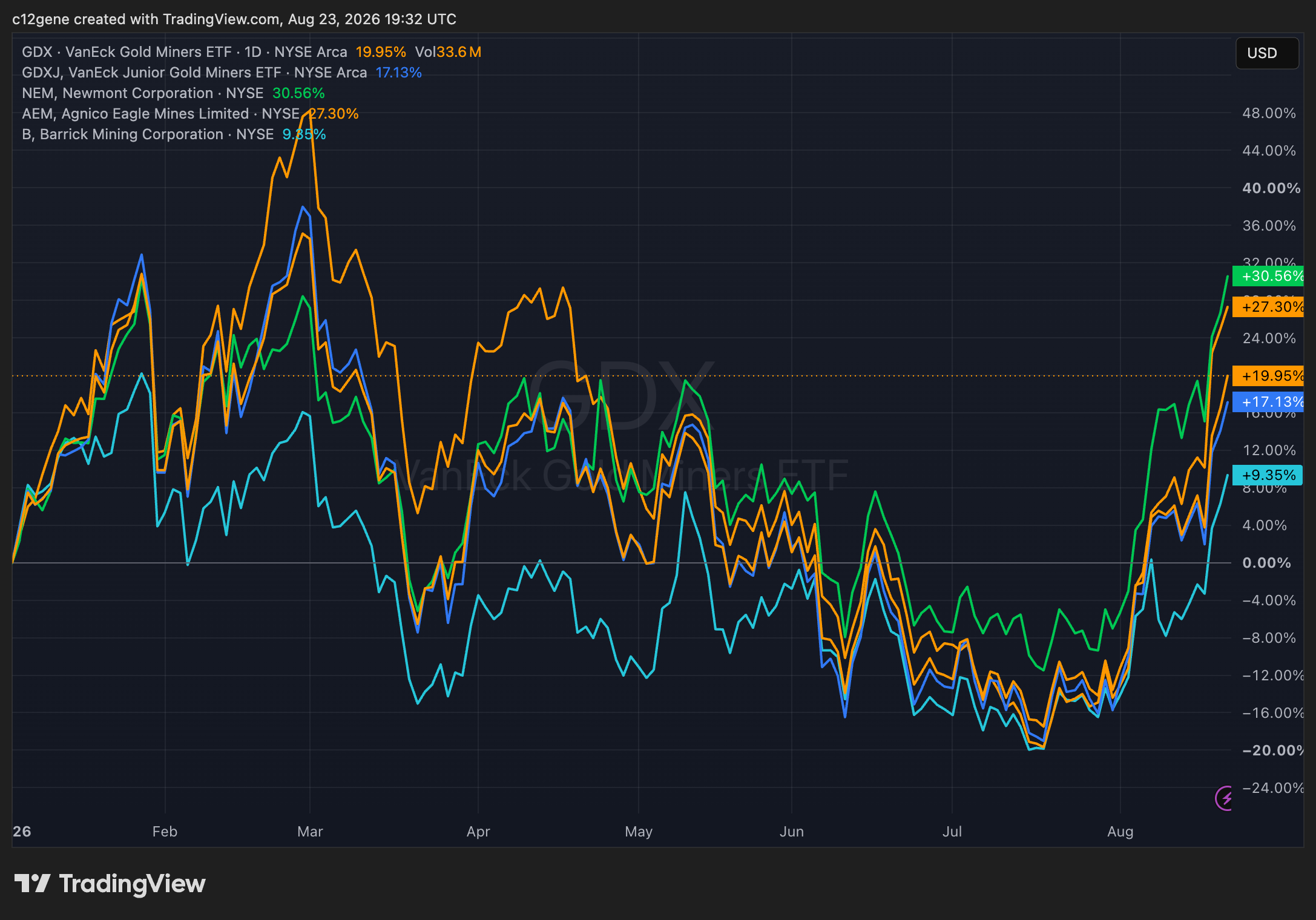
The financial press filed the week under the obvious heading. Gold ran, miners dig up gold, therefore miners went up. True as far as it goes, which is not far, because gold has gone up plenty of times over the last decade without the miners doing anything of the sort. That was rather the whole complaint about them.
And look at the sizes. Gold reached a two-month high that week. It did not go up twenty-one percent. Whatever accounts for that gap, it is not the price of the metal.
The more useful explanation runs through a chart we ran in Issue #334.
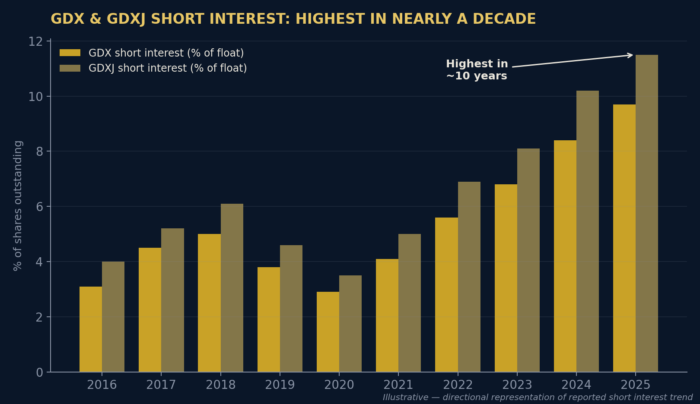
Short interest in the two big gold-miner ETFs, sitting at its highest level in nearly a decade. In a thin, structurally short market, as we put it in the issue, that is not a trade you would want on if, or rather when, the sentiment turns even slightly.
The sentiment turned.
What the Shorts Were Actually Short
Start with the thing that makes the position strange.
Free cash flow across the senior gold miners is roughly 10x what it was in 2020, and over the same stretch their net debt has halved.
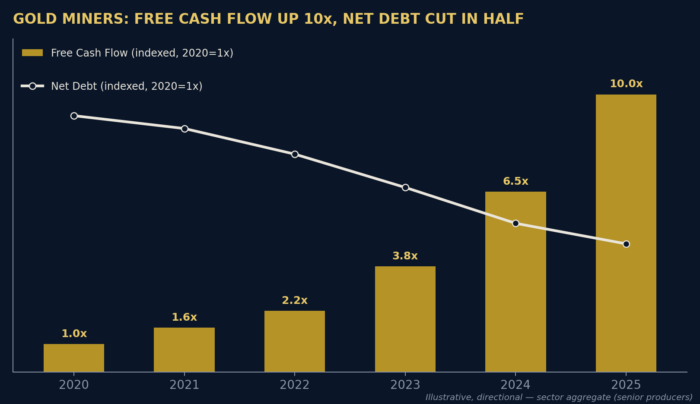
This is not a forecast about what happens once the new mine comes online. Newmont posted a record $2.2 billion of free cash flow in the second quarter. Agnico did $1.3 billion. Cash that has already arrived, sitting in filings anybody could have read.
And yet the market has priced these companies as though the whole sector were closing down. Against the S&P 500 they have not been this cheap in twenty years.
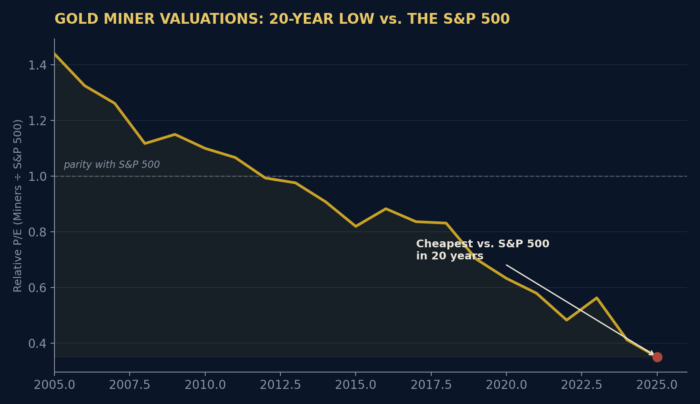
So the short position was never a bet that the miners would fail to make money. They were already making it, visibly. It was a bet that nobody would care.
For about twelve years, that was an outstanding bet. Which is worth understanding before you write off the people on the other side of it.
Why Being Short Was Not Insane
I am not going to pretend that side of the trade was staffed entirely by muppets, because it wasn’t.
Gold miners spent two decades earning a reputation as some of the worst capital allocators in public markets. They bought assets at the top, diluted shareholders at the bottom, blew out cost guidance with a straight face, and turned every gold bull market into a fresh lesson about why owning the metal was easier than owning the people who dig it up. Anyone who lived through that learned an expensive rule. When gold goes up, do not reach for the miners.
Add the price action. The sector that just moved 20% in a week spent the run-up to it going backwards, with several of the large caps down more than 40% from their highs.
So the short case was never stupid. It was stale. A rule learned from a version of the industry that no longer exists, applied to balance sheets that look nothing like the ones that taught the lesson. Which is usually what the far side of a decent asymmetry looks like...not idiocy, but a perfectly correct observation about a world that has quietly stopped being there.
Which leaves the question of what actually broke it.
The Trigger Was Not the Cause
What lit it was ordinary enough. The US economy unexpectedly shed 23,000 jobs in July against expectations for a gain of around 80,000, and the shiny stuff did what it tends to do whenever confidence in the people running the machine takes another small knock.
Fine. But a soft payroll print does not move a sector 21% in five days. Payroll prints happen constantly and mostly nothing occurs. So why this time?
Because of who was standing on the other side.
If you have never shorted anything, the mechanic is worth thirty seconds. A short seller borrows stock he does not own, sells it, and plans to buy it back cheaper later. The buying back is not optional, and that is the part people forget. Every tick higher enlarges his loss, and eventually his broker stops asking politely. He has to buy. If the people who wanted out got out long ago, the only way to find stock is to bid until somebody parts with it...which enlarges the loss of every other short still in the trade. Who then also has to buy.
That is why the catalyst gets the headlines and the positioning does the work.
Notice, too, how uniform it was. Every large name went up roughly the same amount inside the same week. That tells you little about the shorts, but a great deal about how to own this stuff: the week belonged to the sector, not to any one management team having a clever quarter. Roughly 80% of what moves any individual position here is the macro and the sector cycle. Get the sector right and you are spared having to also pick the hero.
All of which brings us to the only question you actually care about.
So Is It Over?
Here is where I would rather disappoint you than flatter you.
We put this exact question to you back in December, in a piece titled Gold Miners: Time to Scale Out? The answer then was no. The miners were nowhere near overbought, the pointy shoes were ignoring them in favour of the same handful of mega-caps as everybody else, and the sensible move was to sit still and be boring about it.
Eight months and one violent fortnight later I would give you broadly the same answer. But one part of it has weakened, and you should know which part.
The easy money in the squeeze itself is gone. Retail has noticed. GDX pulled in $419 million in August, on track for its strongest monthly intake since February, including its largest single day of retail buying in at least a year. When the punters turn up after a 20% week, that is a fact to respect rather than celebrate.
But look at what the fortnight actually repaired, and what it left alone.
Go back to the first chart and read it again. On the twentieth of July, GDX was down 17% on the year. It is now up 20%. That is the entire contribution of the fortnight, and it is worth being precise about what it was. Not a launch. A repair. The sector spent five months handing back everything it made in the first two, and August took most of that back again. Even now, after all the excitement, GDX sits below where it was trading in early March.
The gaps that made this interesting in the first place are multi-year gaps, and a fortnight does not close them. Measured against gold itself, the miners have been sitting at historic lows. To crawl back to the previous cycle’s peak, the ratio of miners to metal would have to roughly quadruple. Not because gold has to fall. Because they have that much ground to make up.
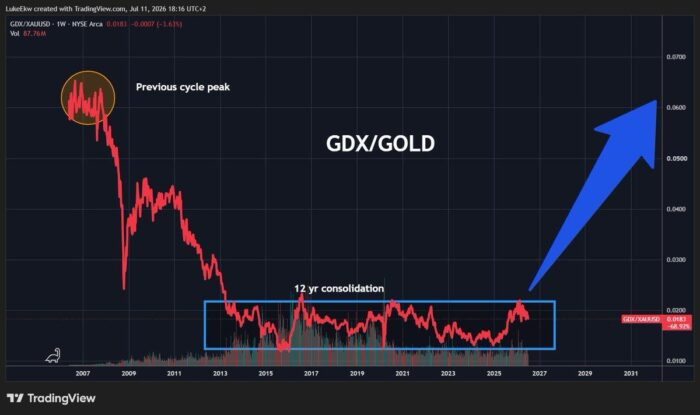
Twelve years of accumulated indifference does not get resolved by three good weeks.
Nor does anybody own any of it yet. According to Goldman Sachs the average American portfolio carries a 0.18% allocation to gold. Eighteen basis points. Gold miners are about 0.16% of the S&P 500, and gold’s share of global financial assets was roughly four times higher in 1980 than it is today. None of that has shifted at all. A short squeeze reprices a float over a few sessions. Moving a country’s savings takes years.
What We Actually Do About It
We have owned GDX for years, through the stretch where it did nothing and through the stretch where it went backwards, which is the only way anybody was ever going to be holding it in a week like this one. Nobody times the turn. You size a position so that being early is survivable, and then you get on with your life.
None of this is a recommendation and none of it is advice. Do your own research. For what it is worth, we size so that a bad outcome is an inconvenience rather than an event, and we are not chasing a 21% week into a weighting we already carry.
The rest of the gold work sits in Issue #334, and it is the half that would not fit here. A record outflow from the biggest US gold ETF, $14.4 billion out since March, running against physical metal moving east into hands that never much wanted a paper claim in the first place. China’s central bank buying gold every single month for twenty straight months, at a pace the World Gold Council flagged as accelerating through the spring, while its Treasury holdings have collapsed from 29% of reserves to 7.3%. What Goldman’s own modelling says happens to the gold price when that 0.18% allocation shifts even fractionally. And the Big Five, five deep-value contrarian ideas offered as ideas to explore rather than recommendations.
That is the Insider Newsletter. It lands roughly every two to three weeks, it is where the rest of this argument lives, and it runs $39 a month or $420 for the year. If that sounds useful, the link below is the whole of the ask. If it doesn’t, no hard feelings, and the free pieces keep coming either way.
Upgrade to the Insider Newsletter
Twelve years of nobody caring is what built that short position. It took five days to find out how few people were standing on the other side of it.
Nothing in this article constitutes investment advice. Do your own research. All investments carry risk. This is what we think...it may not be suitable for you.
Hello Opus 5!
First commentators to reveal the Miners short... Paper Gold yes, but not the Miners 👍