

![[Section Divider Image]](https://substackcdn.com/image/fetch/$s_!-VuH!,f_auto,q_auto:good,fl_progressive:steep/https%3A%2F%2Fsubstack-post-media.s3.amazonaws.com%2Fpublic%2Fimages%2F41873d80-32e5-4620-ba04-983a2b118566_1320x50.webp "[Section Divider Image]")
Years ago I took a course in neurolinguistic programming. NLP, for those unfamiliar. At the time I was simply curious about how the brain works...how language shapes perception, how trust is built, how people get led from one state of mind to another without quite knowing it happened.
What I didn’t appreciate at the time was how useful that course would turn out to be. Not for selling products or winning negotiations, which was the stated purpose. But for understanding exactly how power operates against ordinary people.
This isn’t an article about neuroscience. But what’s playing out right now in American politics...and by extension, in your portfolio...runs directly through these mechanisms. So bear with me.

The Trust War Governments Are Losing
Traditional media is collapsing. Not just in viewership numbers, but in something more fundamental: authority. The age when a network anchor could deliver a verdict and the public would update their priors accordingly is over. The pointy shoes running legacy institutions haven’t accepted this yet, but the data is not subtle.
Into that void stepped the influencer. And governments, being governments, noticed.
Here’s what NLP makes explicit that most people understand only intuitively. An influencer doesn’t just have an audience. They have a relationship with an audience. Years of consistent content, personality, perceived vulnerability...all of it adds up to something that in NLP terms is called pacing. The influencer has done the long, slow work of matching the audience’s worldview, their language, their emotional register. That work creates rapport. Deep, genuine, felt rapport.
Governments can’t manufacture that. They’ve tried for decades and failed. The press conference, the newspaper of record, the nightly news...all of it reads as institutional now, which is another word for suspect.
But here’s the insight: you don’t need to build rapport. You can rent it.
The Netanyahu Operation
Benjamin Netanyahu has been, arguably, the most explicit world leader about this strategy.
During the Gaza conflict he actively recruited social media influencers...flying them to Israel, briefing them, feeding them the narrative, and deploying them to counter a ground-level information war that traditional media channels were losing on platforms like TikTok and Instagram. A war being fought by twenty-two year olds with phones, not press offices.
He put it plainly during a meeting with US influencers in New York: “Weapons change over time. We have to fight with the weapons that apply to the battlefield in which we’re engaged...and the most important ones are on social media.”
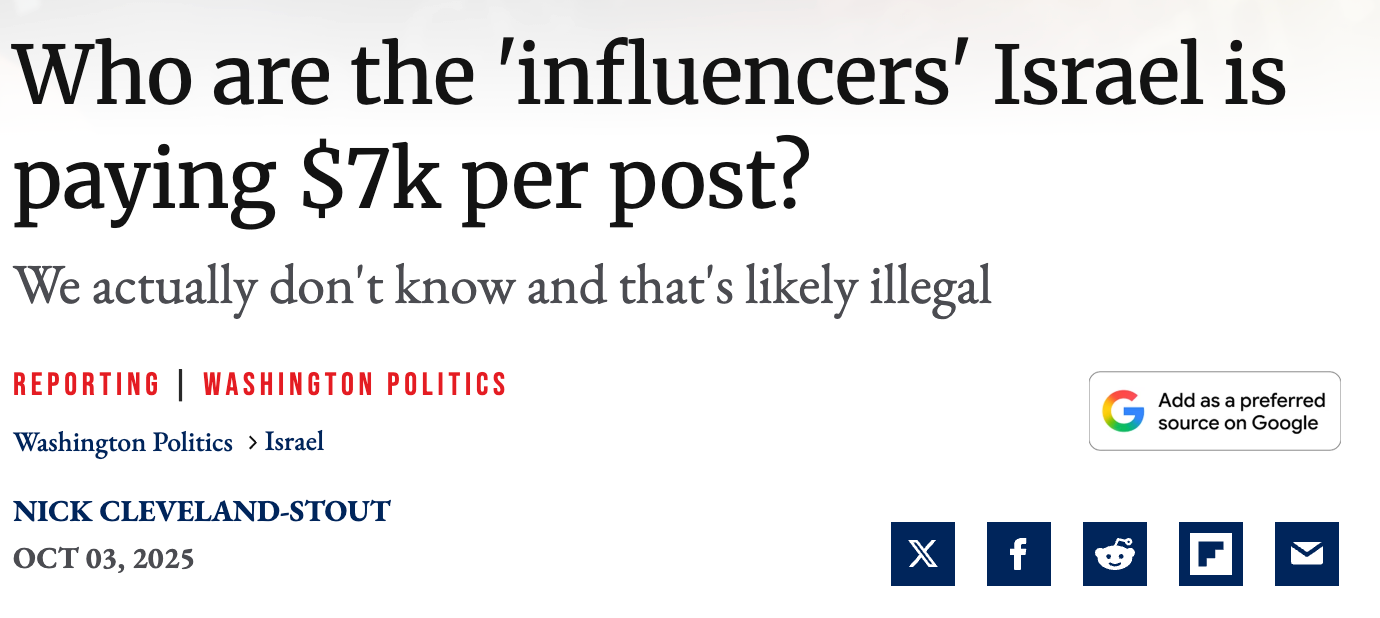
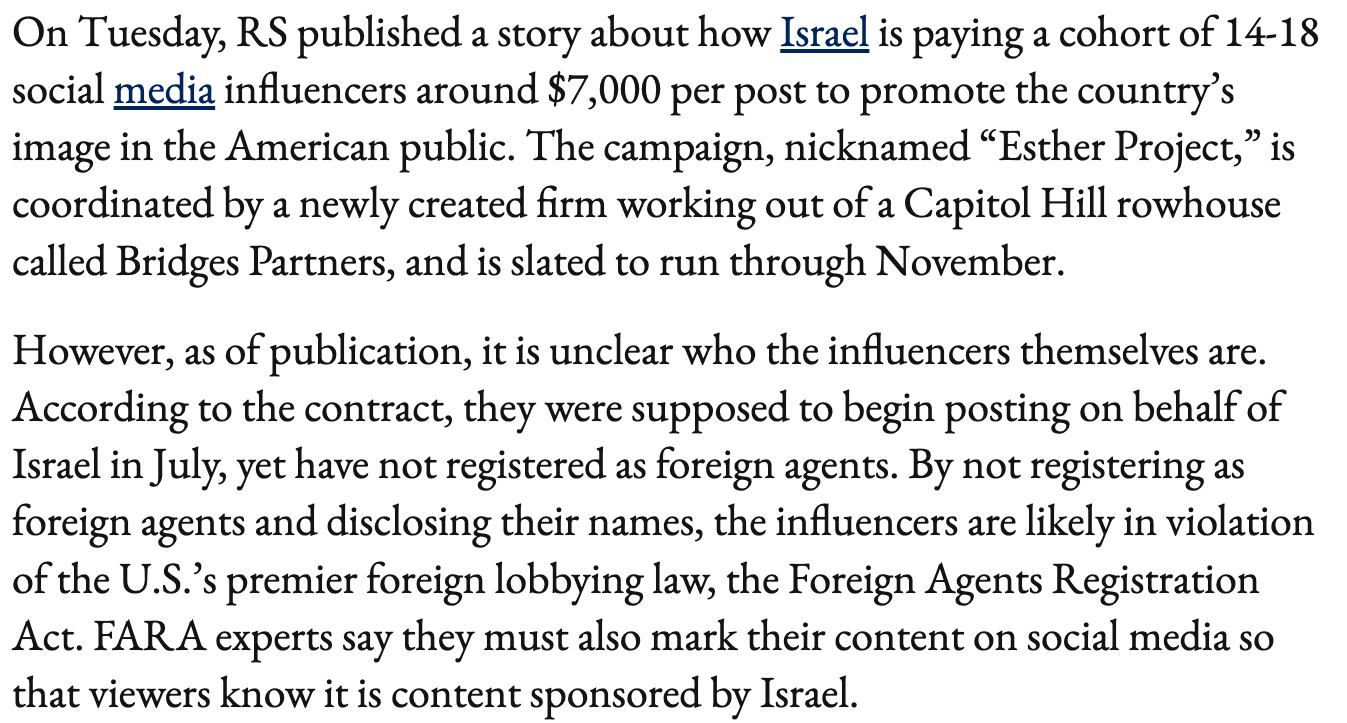
That’s not a metaphor. The Israeli Foreign Ministry allocated a budget of $900,000 through a firm called Bridges Partners, paying 14 to 18 social media influencers up to $7,000 per post under a campaign code-named the Esther Project. Registered under FARA...the Foreign Agents Registration Act...which means it’s all documented. You just have to bother looking.
The NLP mechanics running underneath this are worth naming clearly.
First: borrowed rapport. The Israeli government cannot build a genuine relationship with a nineteen-year-old in Ohio. But an influencer that nineteen-year-old has followed for three years absolutely can. The government doesn’t need to persuade the audience directly. It just needs access to the delivery vehicle.
Second: reframing at scale. A geopolitical conflict is a complex thing with contested facts, a long history, legitimate grievances on multiple sides. None of that complexity survives a sixty-second video delivered by someone the viewer trusts. The influencer simplifies and redelivers the narrative...and crucially, the audience receives it as authentic because the messenger is authentic.
Third: anchoring. The government gets associated with the emotional states the influencer already triggers. Excitement, inspiration, belonging...whatever that influencer has built over years of content. The message arrives pre-loaded with positive emotional charge.
Was it effective? In certain demographics, absolutely. Which is why every government with resources is now running some version of this.
Trump, Jake Paul, and the Textbook
Enter Donald Trump and Jake Paul.
Jake Paul’s audience is young, predominantly male, drawn to dominance, competition, and anti-establishment energy. It is, in other words, a demographic that conventional Republican outreach had essentially zero access to.
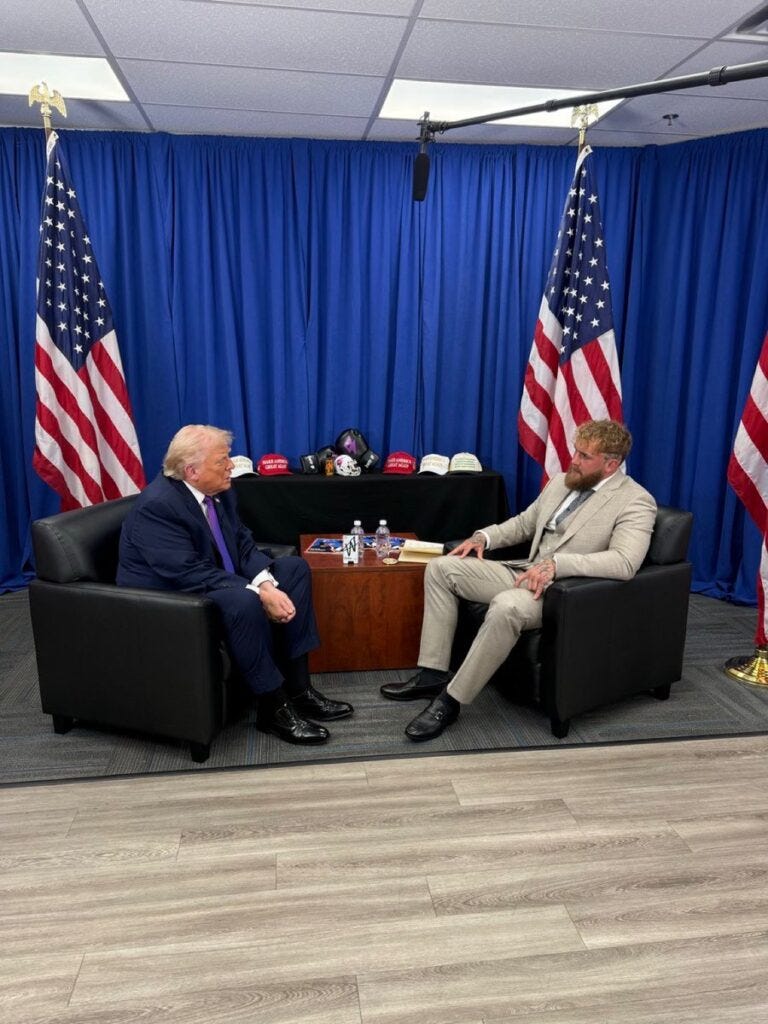
The NLP mechanics on display during Trump’s endorsement relationship with Paul are almost academic in their clarity. Rapport transfer...Paul’s audience trusts him, and that trust extends, at least partially, to whoever he endorses. Identity reframing...voting Trump becomes consistent with the Jake Paul identity: masculine, winning, anti-establishment. Anchoring...Trump gets associated with the emotional states Paul already generates in his audience.
Trump’s team understood instinctively what NLP makes explicit: you don’t persuade people by arguing with their identity. You find a messenger who already lives inside it.
There is something genuinely impressive about this, from a purely strategic standpoint. And something that should make you deeply uncomfortable.
Because it doesn’t matter what the content is. The mechanism works regardless. The same playbook that moves protein powder moves a war.
Where This Gets Dangerous
Consider what’s quietly sitting inside the FY2026 National Defense Authorization Act...language embedded in Section 535 that automatically and involuntarily registers young men for the Selective Service using federal databases. No opt-in. No consent. The system goes fully operational December 18, 2026.

And consider the context in which this sits. Operation Epic Fury...the US-Israel campaign against Iran, launched February 28, 2026...is already deeply unpopular with younger Americans. A generation that watched twenty years of Middle Eastern military adventure produce nothing except debt, dead soldiers, and regional instability. A generation that is not going to comply quietly with the machinery now being set up around them.
This is not a hypothetical. Mass resistance to involuntary draft registration, combined with a politically fragmented country that is already splitting along ideological lines, is a recipe for the kind of domestic conflict the US hasn’t seen in living memory. Protests at a scale that makes recent years look like a warmup. States taking opposing positions. Federal National Guard deployments. Internal migration accelerating, concentrating populations further into ideological monocultures.
And here’s the thing about resource allocation in a fragmented nation: it doesn’t stay neutral.
The US is already operating in a resource-constrained environment. Energy costs, housing costs, healthcare, food...none of it is getting cheaper. When states fragment along ideological lines, those resources become political weapons. Who gets federal infrastructure funding. Who gets regulatory forbearance. Who gets protected and who gets made an example of.
That path is not certain. But it’s a good deal more probable than the consensus currently prices in.
What This Means for the Portfolio
From a portfolio management perspective, the US equity market was already sitting at valuations near their second-highest level in recorded history before any of this entered the equation. The Shiller CAPE at 39x...approaching the 44x reached at the dot-com peak in December 1999. Passive flows still crowded into the same twelve names. The AI narrative carrying a valuation that requires a future which must be essentially perfect in order to justify current prices.

Throw a domestic political crisis on top of that...genuine, sustained, intergenerational resistance to military conscription, state bifurcation, federal overreach, civil unrest...and there is no scenario under which the S&P holds together at those levels. The 401(k) generation...Americans who have been systematically funnelled into passive equity exposure for three decades...are sitting in a vehicle that has never faced a stress test of this kind.
They don’t know that yet. The influencers they follow aren’t talking about it. The anchors they’ve trusted for thirty years are still running the “soft landing” script.
Which means the gap between what the market is priced for and what is actually unfolding is still fully exploitable.
We’ve been clear about our positioning. Hard assets, real things, assets that don’t require a functioning US equity narrative to hold their value. Gold, energy, farmland, select emerging markets trading at a fraction of what equivalent US assets command. These are not trades. They are a structural repositioning away from the assumption that American political stability is a permanent condition.
It has not been a permanent condition. Not historically. And the machinery now being assembled...the influencer operations, the involuntary registration databases, the narrative manufacturing running at industrial scale...suggests the people in charge understand that better than you might expect.
The rapport merchants are doing their job. The question is whether you’re in the audience or outside it.
Nothing in this article constitutes investment advice. Do your own research. All investments carry risk. This is what we think...it may not be suitable for you.
A word on what Capitalist Exploits actually is.
This post is free. Most of what gets published here is free…the thesis, the macro picture, the arguments. That’s by design. If the thinking is wrong, you should know before you pay for it.
The Insider Newsletter is for readers who’ve decided the thinking is right and want to know where to put money. Specific positions. Asymmetric setups. The full research, not the summary.
If you’re still deciding, keep reading the free posts. If you’ve already decided, the link is below.
Spot on
The IRGC and Qatar were not filing under FARA?!