

You probably think we are a couple of miserable old buggers. Statler and Waldorf, heckling the show from the balcony while everyone below is having the time of their lives.
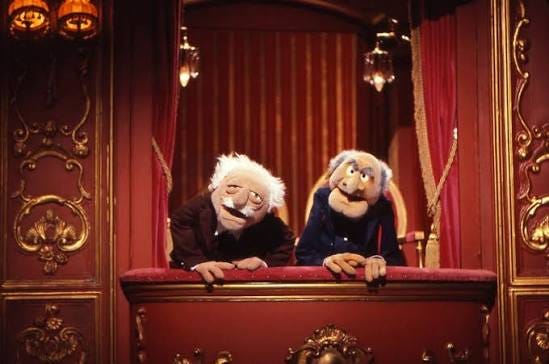
Fair enough. Although when we look back on those two and their skits, they remind us less of grumpy old men and more of Warren and Charlie trading barbs across the stage at the Berkshire meeting. The pair up in the cheap seats, laughing at the performance, are usually the two who have seen it all before. They know how the act ends. That is the whole joke.
So let us tell you what has us smirking up in the balcony this time.
We are not surprised by the elation. And once you have seen what has been driving it, you won’t be either.
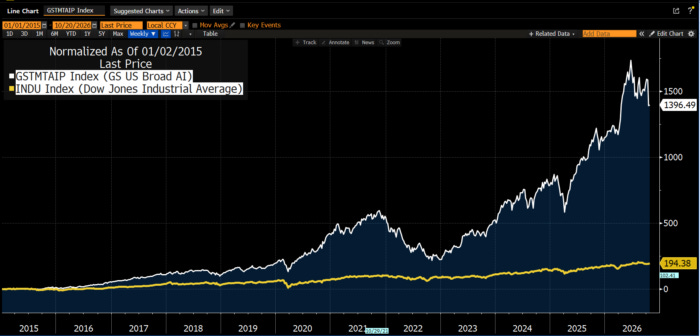
That is Goldman Sachs’ basket of US artificial-intelligence stocks run against the Dow, both set to 100 and let loose. One line behaves like a serious, grown-up stock market. The other behaves like a rocket with the safety briefing skipped. When a slice of the market goes vertical like that, it does something to people. It rewires them. Every green day confirms the genius. Every dip becomes “a gift.” Risk stops feeling like risk and starts feeling like the only thing standing between you and the good life.
And where euphoria goes, a conference follows.
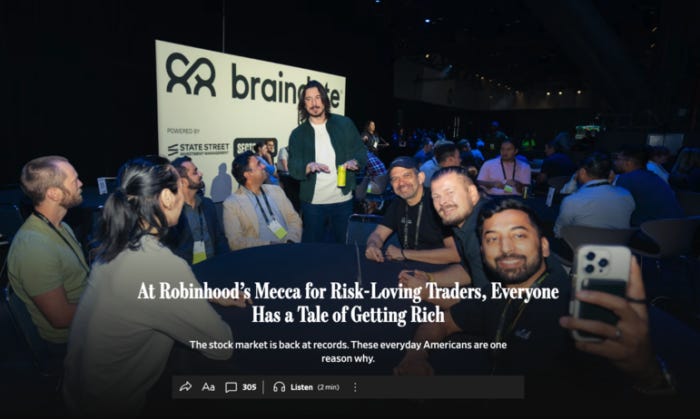
In late September, fifteen hundred of them packed a convention hall in Houston for Robinhood’s Hood Summit, the brokerage’s flagship gathering for active traders. The Wall Street Journal sent a reporter. Here is the scene.
Thirty minutes before Robinhood Markets, Chief Executive Vlad Tenev took the stage, the crowd was already buzzing.
Some 1,500 individual investors were packed into the seats of a Houston convention hall, snapping pictures and fiddling with their neon-green nametags. They came from different walks of life...plumbers and small-business owners, mingling with corporate middle managers and stay-at-home parents. But many had something in common: investment portfolios that had grown so large in recent years they had quit their jobs to play the market full time.
Back on Wall Street, investors have been sweating higher oil prices and a global bond selloff that pushed Treasury yields to fresh two-decade highs. But at Robinhood’s Hood Summit, the party was still raging.
Robinhood’s conference for active traders is the largest of the brokerage’s annual events. For two days in September, hundreds of everyday investors descend on a conference center in cities like Miami, Las Vegas and Houston to attend training sessions, swap trading tips and swarm the open bar.
The conference also offers an up-close view of a generational shift in financial markets: The do-it-yourself investor is playing a bigger role on Wall Street than ever before.
Read it again, slowly, because every line is a tell.
“Portfolios that had grown so large...they had quit their jobs to play the market full time.” People are not topping up their income. They are replacing it. They have looked at a trade, a skill, a career built over years, and concluded that clicking buy is the better use of their time. That is not a side hustle. That is a wager that the last three years are the new permanent weather.
“Investors have been sweating higher oil prices and a global bond selloff...but the party was still raging.” Hold on to that one. The serious money, the people who move trillions, were busy worrying about the cost of money climbing to levels not seen in two decades. And the open bar carried on regardless. When the professionals are nervous and the amateurs are dancing, you do not need a weatherman to tell you which way the wind is blowing.
Then the line that gives the whole thing away. “A generational shift in financial markets.”
Ah. Now we are home. Because we have heard that exact phrase before, in those exact words, delivered with the very same breathless certainty.
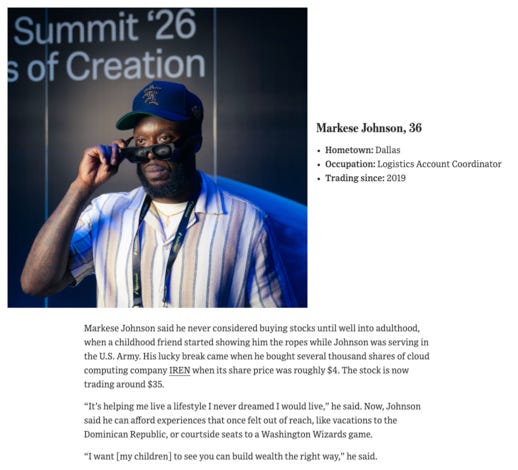
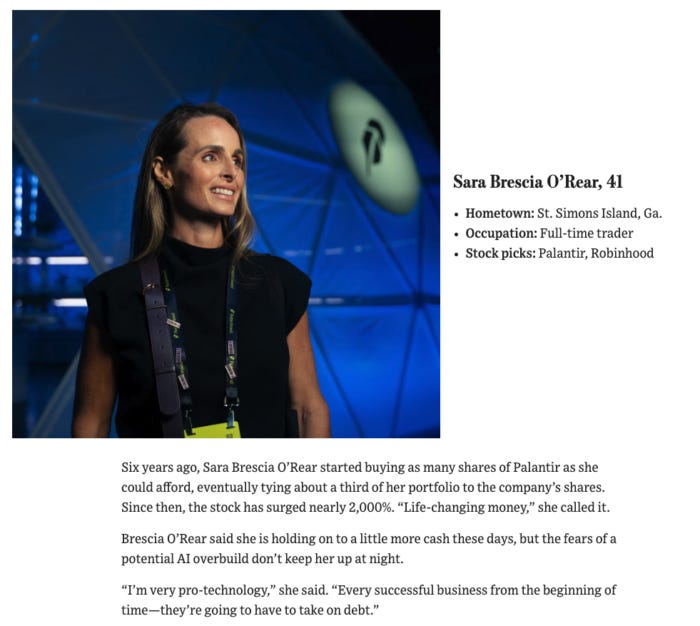
Meet the faces of the revolution. A logistics coordinator in his good sunglasses. A full-time trader with an easy smile. Good people, both, and we are not sneering at them...every one of us started somewhere, and most of us started out confusing a bull market for a brain.
Because from years of watching this, Mr Market never fails to turn up to the parties of exuberance. He does not come to spoil the fun. He comes to teach. And the lesson is always the same one. It was never that easy.
We were around for the last “generational shift.” In the late 1990s, day trading was the thing. Ordinary people quit their jobs, bought a second monitor, and traded tech stocks from the spare room. Books were written about it. Storefront firms sprang up to rent you a desk and a live data feed by the hour. It too was hailed as a democratisation of markets, a permanent change in who got to play the game. Sound familiar?
By late 2002 they had all gone. The Nasdaq had peaked at 5,048 in March 2000 and then fell 77%, bottoming near 1,139 in October 2002, and it would not see that old high again for fifteen years. The day traders did not retire to islands. They quietly went back to work and, for the most part, never spoke of it again.
Now, we are not going to insult you with a date. Nobody rings a bell at the top. Manias run further and longer than anyone sane believes they can, which is exactly what makes them so dangerous...the fellow who calls the top too early gets carried out of the building right alongside the true believers. So this is not “sell everything on Tuesday.”
But the signals are not subtle, either. Retail trading is running at record levels. Margin debt, which is simply borrowed money bet on stocks, is sitting near a record of its own, within a whisker of one and a half trillion dollars. So the crowd is not merely all-in. It is all-in with the broker’s money, on the one trade that has already gone vertical. When the plumber has quit to trade, when the summit needs an open bar and a go-kart track to draw a crowd, when leverage is stretched to the hilt and the thing everyone owns is the thing that has run the furthest...the easy money is behind you, not in front of you. You are not early to the party. You are the one being served the drinks.
Which brings us back up to the balcony. The reason the two old hecklers are laughing is not that they are clever. It is that they are bored. While fifteen hundred people crowd into one trade, there are whole wings of the market that nobody wants to touch. The unloved, the unfashionable, the stuff that has made nobody any money in a decade and so turns up on no neon-green nametag. The boring assets, priced as though the future has been cancelled. That is where we have been quietly putting our chips. Not because it is thrilling. Precisely because it isn’t.
Mr Market is already in the room at the Hood Summit. He is standing at the back, near the open bar, waiting patiently for the keynote to wrap up. The neon nametags just haven’t been introduced to him yet.
The crowd always believes it is different this time. It never is. That is about the only thing in markets you can set your watch to.
If you are reading this one for free, here is the honest pitch.
We are not going to tell you we can time the top, because we can’t, and anyone who says they can is selling you something worse than a newsletter. What the Insider Newsletter gives you is not a hot tip. It is an input...a steady, every-issue feed of the research we use to build our own picture of the world, so you can argue with it, keep the sixty percent you agree with, bin the rest, and come out with a sharper model than you went in with.
While the Hood Summit crowd piles into the one trade everyone already owns, the Insider is where we lay out the opposite: what is cheap, what is hated, what is quietly setting up while nobody is watching. We are often early. We have sat through gut-churning drawdowns in positions we were ultimately right about. We publish no price targets, because the denominator can be conjured out of thin air by men in suits. If you want someone to tell you exactly when to click buy and exactly when to click sell, we are the wrong shop, and we would rather say so now.
It is thirty-nine dollars a month, or four hundred and twenty for the year. Here is how we would think about it. If one issue changes how you size a single position, or talks you out of one trade you had no business being anywhere near, the arithmetic has already paid for itself many times over. And if it turns out not to be for you, Substack will refund any subscription inside seven days of payment. No retention call. No exit survey.
The budding traders in Houston are about to get their lesson for free. You can get the other side of the trade for the price of a couple of coffees a month.
The Insider Newsletter is where we lay out what the crowd is ignoring…what is cheap, hated, and quietly setting up while everyone piles into the one thing they already own.