


Greetings, friends!
As I write this, the US and Israel have struck Iran. Brent crude closed on Friday around $72. Markets don’t open until Sunday evening.
I suspect Monday morning will be interesting.
But here’s the thing. The Iran strike isn’t the story I want to tell today...not primarily, anyway. It’s the punchline to a story that’s been building for two years. A story about the most aggressively misrepresented market in modern finance. A story about how the world convinced itself that oil was drowning in supply...while the data said something else entirely.
Let’s start there. Then we’ll come back to Iran.
The Surplus That Wasn’t
For the better part of eighteen months, the consensus view on oil has been simple: glut. The IEA said it. Goldman Sachs said it. Bloomberg ran the headlines. Oil is oversupplied. Prices must fall. Producers are toast.
Except the surplus doesn’t actually exist. And I don’t mean that in a vague, contrarian-for-the-sake-of-it way. I mean it in a very specific, accountable, show-your-work way.
Dr. Anas Alhajji...former chief economist at NGP Energy Capital Management, a man who’s been navigating these markets for decades...has been almost alone in pointing this out. And he’s been right. Here’s what the consensus got wrong, specifically.
Error one: the Strategic Petroleum Reserve. US crude production has been rising since early 2025. That part is true. But the US government purchased and locked away more oil in the SPR than all of those production increases combined. That oil is not available to the market. It doesn’t flow to refineries. It doesn’t show up at the pump. It’s locked in salt caverns in Louisiana. When you count it as a surplus, you’re counting something that functionally does not exist in the commercial supply chain. In other words, someone built their bearish model on a spreadsheet error.
Error two: China. Since mid-2025, Chinese inventories built by over 100 million barrels, reaching record highs. The IEA and others counted this as a global surplus. But ask a different question: why is China simultaneously stockpiling oil, natural gas, coal, and building out battery storage at enormous expense? None of those things make sense as commercial decisions. The economics don’t support it. What makes sense...and what the evidence points to clearly...is that China is preparing for either sanctions or war. Every energy item is being treated as a strategic reserve. When you understand that, you stop counting Chinese strategic petroleum stockpiles as commercial supply, just as you wouldn’t count America’s SPR in your balance sheet of available crude. Strip China out, and what remains is largely inventory replenishment from genuinely low levels, not a surplus at all.
Error three: demand forecasting. At the start of 2025, the IEA projected US oil demand would grow by 60,000 barrels per day. The actual number, when revised late in the year, came in at 170,000 barrels per day...and even that was below the actual figure. So the agency that publishes the bearish outlook, and which the financial press treats as gospel, was off on US demand alone by a factor of nearly three. That manufactured demand shortfall fed directly into the manufactured surplus. Shulbit in, shulbit out.
And then, just to top it all off: Kazakhstan. In late 2024 and into 2025, roughly 700,000 to 800,000 barrels per day went offline from the CPC terminal when it was attacked...supposedly by Ukrainian drones, which makes absolutely no sense if you think about it for thirty seconds. Kazakhstan is not Ukraine’s enemy. The primary loser was Chevron. The sequence of events mirrors what happened in Venezuela, where Chevron was also the main target. Someone was playing hardball. The oil disappeared from the market anyway. Add Brazil’s export declines, and Iraq burning oil domestically after Iranian gas supplies were cut. At peak, the world lost over two million barrels per day in a matter of weeks.
A surplus with no legs. That’s the phrase. And yet the narrative has dominated the tape.

The Post-Shale World
In early February, an energy symposium gathered in Riyadh...the IEA, the EIA, OPEC, and the world’s major energy thought leaders all in one room. The mood was, as one participant put it, characterized by “profound energy realism and pragmatism.”
The central theme wasn’t peak demand. That debate, apparently, is over. The central theme was the looming supply crisis.
OPEC’s view: global oil demand will grow by 19 million barrels per day between now and 2050. And...this is the one that landed hardest in that room...shale oil production has peaked. This year. The non-OPEC countries are peaking in the next several years. The shale revolution that saved the world from an energy crisis in 2008-2010, that extraordinary feat of American engineering and capital deployment, appears to have run its course in terms of net growth. One month into 2026, global inventories had fallen by 14 million barrels against the IEA’s forecast of a 4.25 million barrel build. That’s a gap of 146 million barrels. In one month.
The question hanging over that Riyadh conference was simple: where does the 19 million barrels per day come from?
Nobody had a clean answer.
The Math Nobody Wants to Do
Let’s go to the IEA’s own research...a September 2025 report analyzing approximately 15,000 oil and gas fields worldwide. The findings weren’t buried. They were stark.
Global conventional oil fields decline at an average annual rate of 5.6% after peak. Without new upstream investment, global oil supply drops by 5.5 million barrels per day every single year...a volume equivalent to the combined production of Brazil and Norway, vanishing annually. Roughly 80% of global oil production in 2024 came from fields that had already passed their peak. And here’s the kicker: approximately 90% of the $540 billion in annual upstream investment is required just to maintain current production levels. Not grow it. Maintain it.
US shale fields decline at over 35% per year. Not a typo. Thirty-five percent of output, gone in twelve months, before a single new well is drilled to replace it. European mature offshore fields average over 15%. Even the great Middle Eastern supergiants...the pillars of global supply...decline at under 2%. Every year, the treadmill runs faster.
Three years from now, even in a moderate growth scenario, the world will need somewhere in the neighbourhood of 15 million barrels per day of fresh oil production. Venezuela, if everything goes perfectly and foreign capital floods in, might add one million. Welcome addition. Not a market-mover.
In other words: the supply problem is structural, not cyclical. It doesn’t go away when sentiment shifts. It gets worse.
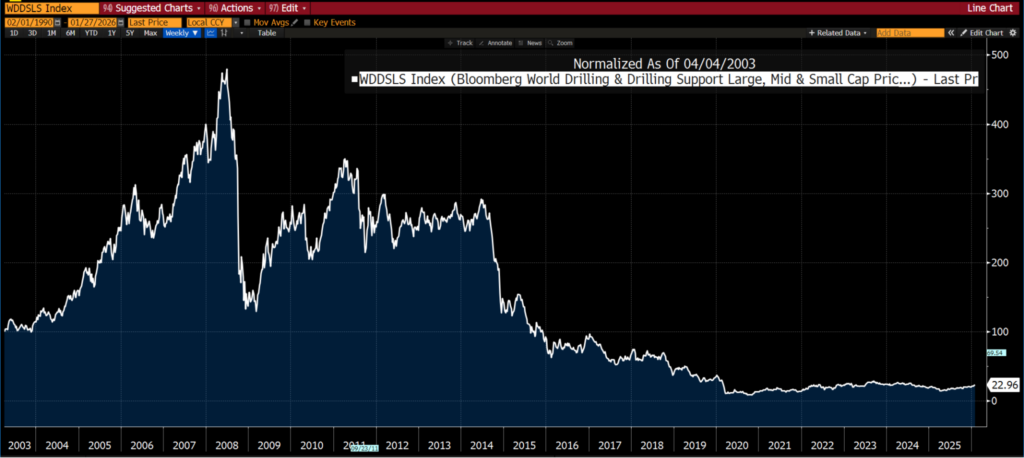
That chart shows the Bloomberg World Drilling and Drilling Support index. Peaked around 2007-2008 at roughly 500, normalized from the 2003 base. Today it sits at 22.96. Down approximately 95% from peak.
Whowouldathunkit. The sector that needs to drill its way out of a structural supply deficit is sitting at prices not seen since the early 2000s.
There is no new offshore rig capacity coming for at least seven years. Not because nobody wants to build them...because the lead times, the capital commitments, and the contracting frameworks required simply don’t allow it. Day rates could double and it wouldn’t produce a rig in the next three years. This is the same structural constraint we saw in tankers, in bulk carriers, in every capital-intensive commodity sector that spent a decade being starved of investment before the cycle turned.
We own names across this space. Do your own research...these are not recommendations, and they carry real risk. But when a sector is at generational lows precisely as the fundamental case for its services reaches a generational peak, that’s the kind of asymmetry that tends to reward patience.
Subscribe to our Insider Newsletter - 5 investment plays in every newsletter.
Subscribe to our Insider Service - Get access to our Glenorchy Capital portfolios.
Iran, Hormuz, and the Asymmetry of This Moment
Back to today.
The reflexive fear on a US-Israel strike on Iran is always the Strait of Hormuz. Twenty million barrels per day...roughly 20% of global seaborne oil...passes through that chokepoint. The headlines write themselves.
Here’s what doesn’t fit the narrative: Iran cannot block the Strait of Hormuz for too long. Not sustainably. Not without destroying itself in the process. Most of Iran’s own imports and exports flow through it. Blocking the Strait hurts India and China enormously...Iran’s actual friends and primary oil customers...while leaving Israel essentially unaffected and the US only marginally impacted. Iranian leadership understands this arithmetic. Proxies can cause disruption. A rogue militia can light something on fire. But a sustained, deliberate blockade by the Iranian state would be an act of economic self-immolation.
What this strike does do is remove from the market whatever comfort the bears derived from “Iran will just keep exporting.” Iran produces roughly 3.5 to 4 million barrels per day. Exports run 1.5 to 2 million, mostly to China. Those Chinese strategic stockpiles...the ones the IEA was counting as a surplus...start to look rather less like irrational hoarding and rather more like preparation for exactly the scenario we’re now entering.
The pre-strike consensus was a manufactured surplus and sub-$75 Brent. We now have a structural supply deficit, a declining services sector incapable of rapid response, a post-shale world confirmed by OPEC itself, and a direct military strike on the world’s fourth-largest oil producer. OPEC spare capacity...and the audit later this year is likely to confirm this...is meaningfully below consensus. Our own working estimate is around 1.5 million barrels per day, not the 3-4 million the market assumes.
The bear case relied on everything going right simultaneously: shale keeps growing, Iranian exports keep flowing, Chinese inventories keep rising, OPEC compliance keeps cracking, and demand stays weak. Every single one of those pillars has been kicked out from under the thesis, one by one, over the past eighteen months.
Sometimes the market needs a dramatic event to accept what the data has been saying all along. Perhaps that’s what today is.
Gravity isn’t a risk. It’s a schedule.
Sitting on the UAE coast overlooking the straits of Hormuz typing this .... Driven up the coast out of from our home in central Dubai .... Rockets exploding overhead.... Seeing a moment in history up close ....
this sounds like a strong reason to ramp up the nuclear snergy solution