

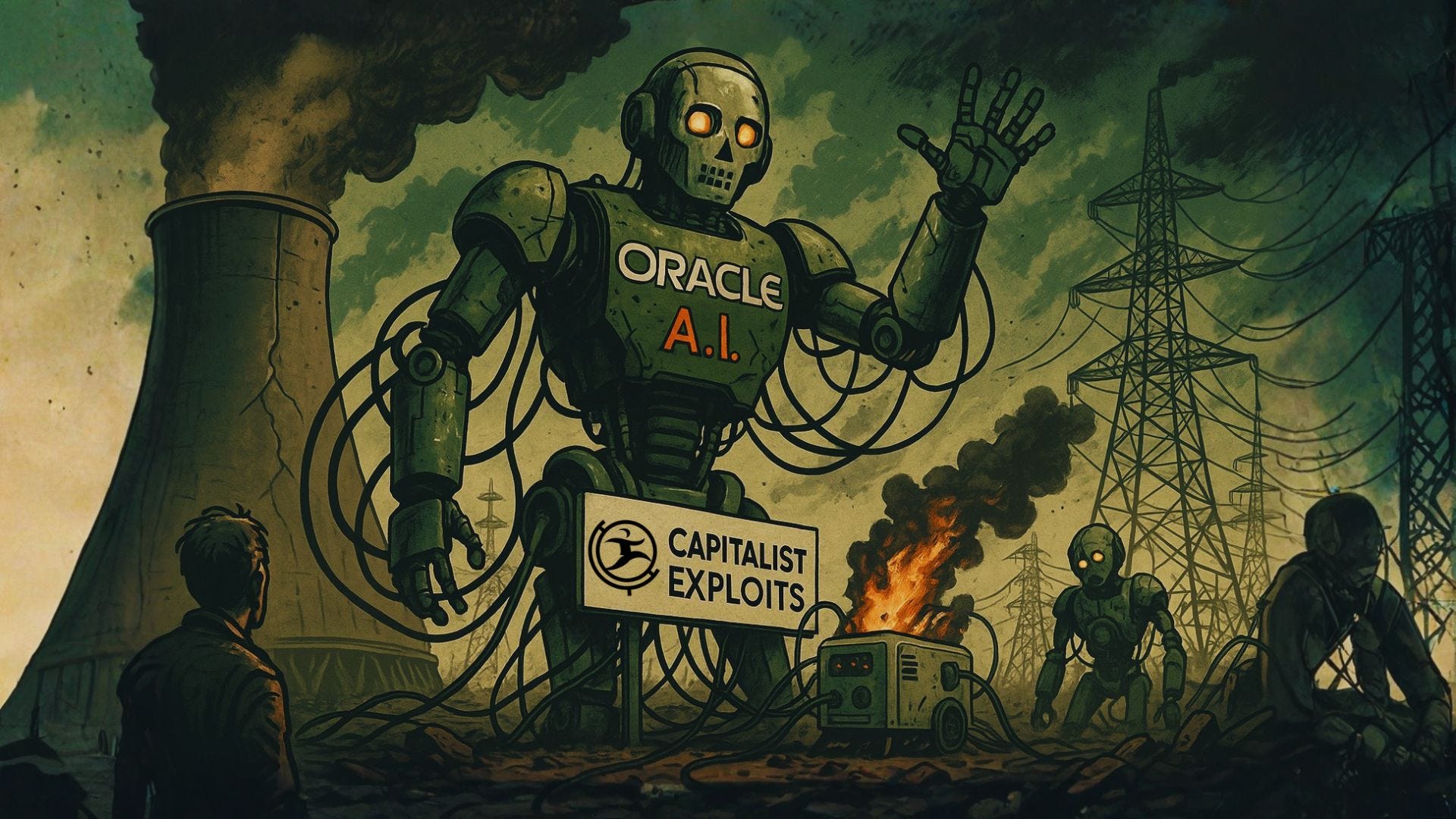

Look, deals like the Oracle-OpenAI one don’t just happen in a vacuum. They’re the kind of nonsense that pops up at the peak of a mania, where logic takes a back seat to greed and hype.
Oracle’s stock jumps 25% because OpenAI promises $60 billion a year for cloud services?
OpenAI doesn’t have that money, hasn’t earned it, and Oracle hasn’t even built the facilities to handle it.
They need 4.5 gigawatts of power...that’s like four nuclear plants or a couple of Hoover Dams.
And Oracle’s debt-to-equity is at 500%, while Amazon’s at 50% and Microsoft’s at 30%.
This isn’t a deal…it’s a fraud designed to pump stocks and make insiders rich. So what does it tell us about the bigger picture in tech?
The Fraud at the Heart of It All
This Oracle-OpenAI agreement is straight out of fantasy land. OpenAI says they’ll pay billions they don’t have for infrastructure Oracle hasn’t built.
It’s like me promising you a billion widgets and you promising me half a billion dollars...neither of us has it, but hey, our stocks go up.
Larry Ellison becomes the richest man overnight on this vaporware.
At the top of any bubble, you see these egregious frauds from otherwise legitimate companies, and even more from the outright scams. Why?
Because due diligence goes out the window.
FOMO takes over, social pressure builds, and emotions cloud judgment. People invest in crap they wouldn’t touch in sane times.
So, how does this tie into the flood of low-quality investors pouring in?
Quantity Over Quality: The Investor Trap
At these peaks, you get more investors, but they’re the bottom of the barrel...less knowledgeable, less diligent.
The average quality drops.
In this cycle, it’s worse because it’s systematized through passive flows.
Your average Joe works his job, some cash goes to his pension, and Fidelity or BlackRock dumps it into ETFs tracking the S&P or NASDAQ.
Those funds disproportionately weight the big AI names, so capital flows there automatically.
Ask someone on the street about Oracle or Nvidia, and they squint...but they’re invested anyway.
Institutions aggregate capital, not perform.
Most businesses run on performance; theirs on gathering assets. So what’s happening with the S&P now?
The S&P Illusion and Concentrated Risk
The S&P’s up 50-60% since 2022, but that’s thanks to AI stocks surging 200%.
Most stocks in the index have done nothing. It’s a basket of names pulling the whole thing up, with capital concentrating more every day.
Now the frauds are unfolding.
This is stored potential energy...like all your cash in one spot in your house.
If it burns, everything’s gone. Everyone’s exposed, so the ramifications will be widespread. But have we seen this before?
Lessons from History’s Busts
Go back to the 1990s Japanese banking crisis: Real estate lending concentrated across banks led to decades of stagnation that hit the world.
Then 1998’s Long-Term Capital Management...one hedge fund nearly takes down the system because everyone’s connected.
2008 was bigger.
Each bust has a broader footprint.
This one’s the biggest yet, based on capital allocation.
Consequences?
Lost money, sure, but regulators will react late, maybe restricting international flows like post-Asian crisis in Thailand, where they curbed foreign real estate to “fix” bubbles. So what about today’s global setup?
The Coming Clampdown on Capital
Post-crash, measures come in to “solve” problems, whether they work or not. This one’s cross-border, with CBDCs and digital IDs rolling out.
In Britain, you can’t work without a digital ID soon...sold as stopping illegal workers, but illegals ignore laws anyway.
It’s for control, turning capital on and off as elites decide.
Concentration of capital causes busts…now they’re concentrating intellect in a few hands, thinking they can fix everything. Communism never works. Central planners aren’t smarter than billions acting in self-interest. But who’s behind this push?
Factions Vying for Control
It’s like a cabal of criminals robbing a bank...they might start together, but backstab each other.
You’ve got the WEF crowd in the EU, the CCP in China with social credit, and Silicon Valley types like Palantir influencing the US.
Peter Thiel’s path shows it.
They’re competing for powerful tech, sold as safety and ease. Pay with your phone?
Convenient, but it’s the hook for control. Starmer in the UK flops on questions...it’s pathetic, but they’ll push it. People are asleep. But can the rich sidestep it?
No Escape, Even for the Wealthy
You think wealth buys you an exit ticket? Think again.
History is littered with examples of the rich discovering, far too late, that when the system turns predatory, money is just paper until the regime says otherwise.
Go back to Mao’s China in the late 1940s and 1950s.
The wealthy, the industrialists, the landlords...they all thought they could sidestep the revolution for a while.
Pay the right bribes, keep your head down, maybe even join the Party early and get a nice title. Didn’t work.
One by one they were rounded up, stripped of everything, and either killed or sent to “re-education” camps.
Even the ones who made it onto the new elite list discovered something brutal: by global standards they were still dirt poor.
A famous delegation of top Communist officials visited Europe in the late 1970s under Deng Xiaoping, looked around, and realised the average Western worker lived better than China’s richest cadres.
That’s when the penny dropped...even the “winners” lost.
Fast-forward to today, and the pattern repeats, only now with biometric handcuffs.
Nigel Farage...love him or hate him...got de-banked by Coutts simply for his political views. No crime, no fraud, just wrongthink.
It took two years of public fighting to get his money back.
Jack Ma, actual billionaire, opened his mouth once too often about China’s financial regulators in 2020 and...poof...disappeared from public view for nearly a year.
When he resurfaced, his empire had been gutted, his wealth slashed, and he’d clearly been through whatever Beijing calls “re-education.” This was pre-mass biometrics, pre-CBDCs, pre-everything we’re seeing rolled out now.
Imagine what happens when your face, your iris, your gait, your heartbeat are the keys to your bank account, your health records, your job, your ability to travel, even your ability to buy groceries.
One “transgression”...a tax dispute that the revenue service gets wrong (and they cock up all the time), a social-credit ding, a whistle-blower accusation, or just being associated with the wrong person...and everything freezes.
Your money isn’t confiscated; it simply ceases to be yours with the flick of a switch.
I’ve seen it already in small doses: a friend woke up one morning to find $600,000 in a business account reduced to zero because the bank flagged “unusual transactions.”
Took weeks and lawyers to unfreeze it...and that was just a glitch, not malice.
This is concentration of technological risk on steroids.
All the eggs...your wealth, your freedom, your very identity...are in one digital basket controlled by people who’ve never shown the slightest hesitation to weaponise tools against anyone who steps out of line.
The wealthy always assume they’ll be insulated by their money. They won’t. If anything, they’ll be the first high-profile examples to make everyone else comply.
So when someone tells you AI and digital systems are going to “manage” all this fairly and efficiently, ask yourself: who exactly do they think is programming the rules, and how long before those rules turn on you...rich or poor?
Because once that infrastructure is in place, there is no opt-out, no offshore haven, no private jet that flies you far enough away. The net is global, biometric, and absolute.
And that’s exactly why the coming bust isn’t just about losing money in markets. It’s about losing the last remnants of control over your own life. But if the elites are about to get this kind of power, what stops the whole thing from collapsing under its own contradictions first?
AI’s Limits Exposed
Look, these so-called large reasoning models...the next step up from your basic large language models...are hitting a wall, and it’s happening faster than the hype machine wants you to believe.
Recent studies, like one from MIT, show that no matter how much compute you throw at them, the returns are diminishing sharply.
They’re plateauing around what you’d call a 110-120 IQ level...smart enough for basic tasks, but when you pile on complexity, they just collapse under the weight.
Apple’s research backs this up too, revealing how even the fanciest models fail spectacularly on puzzles that require real step-by-step reasoning.
If the powers that be are betting the farm on AI to manage everything...from economies to personal lives...it’s a failing strategy.
Think about it: Back in 2022, without this AI bubble propping up the markets, where would we be today?
Tech stocks would have tanked harder, and the S&P might still be licking its wounds from the post-COVID hangover.
Progress in AI is slowing down, and here’s why: recursion.
That’s when AI starts feeding on its own output.
It began by scraping a massive vault of human-written text from history, but now the internet’s flooded with AI-generated slop.
A small bit of garbage gets pumped back in, and it snowballs...garbage in, garbage out.
So much of what’s online today is AI vomit being re-ingested, degrading the models over time. But is AI really the existential threat they’re selling us, or is it just another overhyped tool?
AI as a Tool, Not a God
AI’s basically a data aggregator...a fancy, supercharged library.
You give it a prompt, and it dives in, pulls together bits from everywhere, categorizes them, and spits it back out in a neat package.
It’s exceptional at that. It’s already changing the world in ways we can see, like speeding up research or automating grunt work. But sentient? Conscious? Able to truly think or create something novel?
No chance. It’ll never gain that spark.
If humans stopped all creative output today and handed the reins to AI, nothing new would ever happen. The library can’t dream up fresh ideas; it can only remix what’s already on the shelves, no matter how many forms it takes.
Take the motor car as an example...if AI existed before it was invented, we’d still be clopping around on horses and carriages. AI wouldn’t have conceived of it because it lacks imagination.
Now, this sentience narrative they’re pushing?
It’s straight out of the “trust the science” playbook we saw during COVID. Remember how you couldn’t question the official line without being labeled a heretic?
Science became the new god of the West, unquestionable.
Back in the day, the Catholic Church played the same game...priests interpreted the Bible for you, no reading allowed.
Then the printing press came along, people started thinking for themselves, and the power crumbled.
AI’s just the latest version: Sit down, peasant, don’t question the algorithm.
You can’t possibly be smarter than it. COVID exposed this control tactic, where debate was shut down.
Green energy? That scam collapsed under its own weight.
Vaccine passports? They got a foothold in spots but largely flopped globally.
AI’s the next iteration, sold as the all-knowing savior. So could relying on it actually hold us back as a species?
The Risk to Human Creativity
If we start subjugating ourselves to AI, buying into the idea that it’s superior to human ingenuity, we’re setting ourselves up to hamper real innovation in the long run.
Reports from college professors are alarming: Gen Z and even younger alphas are struggling to write basic papers without generative AI holding their hand.
They’ve lost that fundamental skill because why bother when you can prompt a bot to spit out an essay? Brain scans from studies show lower neural activity when people use AI for writing...it’s like outsourcing your thinking, and your mind gets lazy.
But here’s the thing: Tools, when used right, can amplify us without replacing us.
Think about spreadsheets...they revolutionized bookkeeping.
In the old days, you’d scribble everything in ledgers, add up columns by hand, double-check for errors. It took forever.
Then calculators sped it up, and spreadsheets made it instantaneous.
Did we declare spreadsheets would take over the world? No, they’re just tools.
AI’s the same...it needs human input to shine. We didn’t stop there with progress; we built on it.
Now, imagine a world overrun by AI in everyday life.
I saw a restaurant recently with robots zipping around...cleaning floors, taking orders via apps, delivering food.
Novel at first, sure, but I don’t want that every time.
We all crave the human touch: a waiter who chats, recommends the pad thai because they know it’s fresh today.
In a sea of automation, scarcity creates value. People will pay a premium for authentic interaction, just like how handmade crafts or live music stand out now.
Back in school, I learned calligraphy with those fancy pens...not everyone did, but it built a connection between hand and brain that’s better than typing.
Reading physical books feels different too, more engaging than screens. Some skills get lost in progress, but they become rarer and more prized.
So, how do we position ourselves in this shifting landscape?
Capital Rotation: The Smart Move
We’re smack in the middle of one of those historical cycles where everything unravels because of unsustainable debts.
Governments are going bankrupt, and in their desperation, they pull the craziest stunts...like the control grabs we’ve been talking about. What always happens next?
Capital rotation.
Money flees the sinking ships and heads for safer harbors. It’s already underway, and you can see it plain as day in the markets.
Gold’s been outperforming the S&P 500 for two solid years now...up about 39% compared to the S&P’s 42%, but wait, over the exact period, gold’s edged it out when you factor in total returns.
Silver and platinum are catching fire too, surging as investors wake up.
The gold miners, which sat idle for ages, are finally revving up as the cycle turns.
Energy’s another one...deeply depressed right now, but primed for a massive inflow as reality bites.
This is all about losing faith in paper money and government bonds, which are a terrible bet as currencies get devalued.
Hard assets are still at historical lows, making them the obvious play. Our approach?
Diversify globally across about 10 sectors...commodities, resources, unloved areas...while steering clear of any single jurisdiction’s risks.
Concentration got us into this mess; spreading out gets us out.
Avoid the tech tinderbox and focus on what’s real. So, with a bust likely coming, how do you actually protect your wealth?
Protecting Your Wealth in Chaos
The Oracle-OpenAI deal? That’s your smoking gun for peak mania...fraudulent hype at its finest, signaling the top.
Elites will seize on the inevitable bust to tighten their grip, rolling out more centralized controls like digital IDs and CBDCs.
But history shows these plans flop against the emergent power of billions of humans acting in their own interest...no cabal of planners can outsmart that.
A wise move? Rotate now into gold, energy, and diversified hard assets.
Question the AI hype...it’s a powerful tool, sure, but not the god they’re peddling.
This crash will be broader than ‘08 or the dot-com bust, rippling everywhere because everyone’s tied in.
Yet, in the rotation lies opportunity. Spot the shift early, position accordingly, or get burned holding the bag. The choice is clear: Act like the smart money, or join the herd over the cliff.
Was a newsletter subscription earlier. Still like the content, but I have a major challenge: Can't buy the recommendations here in EU. I have one broker partnering with Interactive Brokers, where I can buy some Nordic names, not all. E.g. Indonesia, Malaysia, forget it. Maybe only through a country ETF which is usually loaded with finance & tech rubbish.
Through accounts with regular banks, I can't even buy Norway single stocks. The funneling effect of this is crazy. And makes stock picking even more difficult to avoid the tech & AI crap. Frustrating.
Diversification in different countries seems like an idea until you remember that the covid regimes were pretty nearly universal...
AI masters I f the universe mostly don't believe their own hype,they know it is a tool for controlling narrative and surveillance....