![[Section Divider Image]](https://substackcdn.com/image/fetch/$s_!Uxj9!,f_auto,q_auto:good,fl_progressive:steep/https%3A%2F%2Fsubstack-post-media.s3.amazonaws.com%2Fpublic%2Fimages%2Faabef1b2-0db2-4ef4-b170-72e4d9fedf9d_1320x50.webp "[Section Divider Image]")
A man at Uber recently said the quiet part out loud, and almost nobody noticed.
Andrew Macdonald, Uber’s president and COO, told a podcast that he could no longer draw a straight line between what the company was spending on AI and what it was getting back. The phrase he used was the kind of thing finance people say when they’ve stopped pretending. “That link is not there yet.” Ninety-five percent of Uber’s engineers using the tools every month. Seventy percent of committed code now machine-written. And the man whose job is to justify the bill cannot tell you whether any of it produced a single feature a customer would notice.
This is not a man saying AI doesn’t work. Read it again. It’s a man saying he’s been handed an invoice and can’t find the thing he bought.
His own engineers had already blown through the entire 2026 budget for their AI coding tools four months into the year. Uber capped them. A company that spent $3.4 billion on research and development last year...a company that does not flinch at big numbers...looked at the meter and flinched.
And here’s the thing about a meter. It only feels free when someone else is paying.
The Token Trap
There’s a logic to how the smart money fell into this, and it’s worth understanding because it’s the same logic every time.
AI feels cheap when you’re one person experimenting on someone else’s subscription. It feels free, even. It only becomes expensive when the company sees the bill, and the bill, it turns out, can run higher than the salary of the person you fired to pay for it. Token costs for running these agents are now outpacing the headcount savings they were sold to deliver. And when the tokens run out, the thing simply stops. No workaround. No continuity. The employee you let go knew what to do when the system broke at two in the morning. The AI just sends you an invoice for the outage.
Uber isn’t an outlier. It’s the one that admitted it.
OpenAI is carrying a $60 billion annual cloud bill against something like $25 billion in actual revenue. Starbucks reportedly built an AI that can’t reliably count coffee cups... so perhaps Jose gets his job back after all. Microsoft, the company that has staked its entire valuation on this stuff, quietly pulled the plug on using one of these coding tools for its own internal engineering teams.
The pattern is consistent enough now that it deserves a name. Call it the gap between what AI costs and what AI does.
But the spending gap, as ugly as it is, isn’t the part that should keep you up at night. The spending gap is just bad business. What sits underneath it is something closer to alchemy, and it’s being run at industrial scale by the largest companies on earth.
The Mark-Up Mechanism
Here’s a number that should stop you cold.
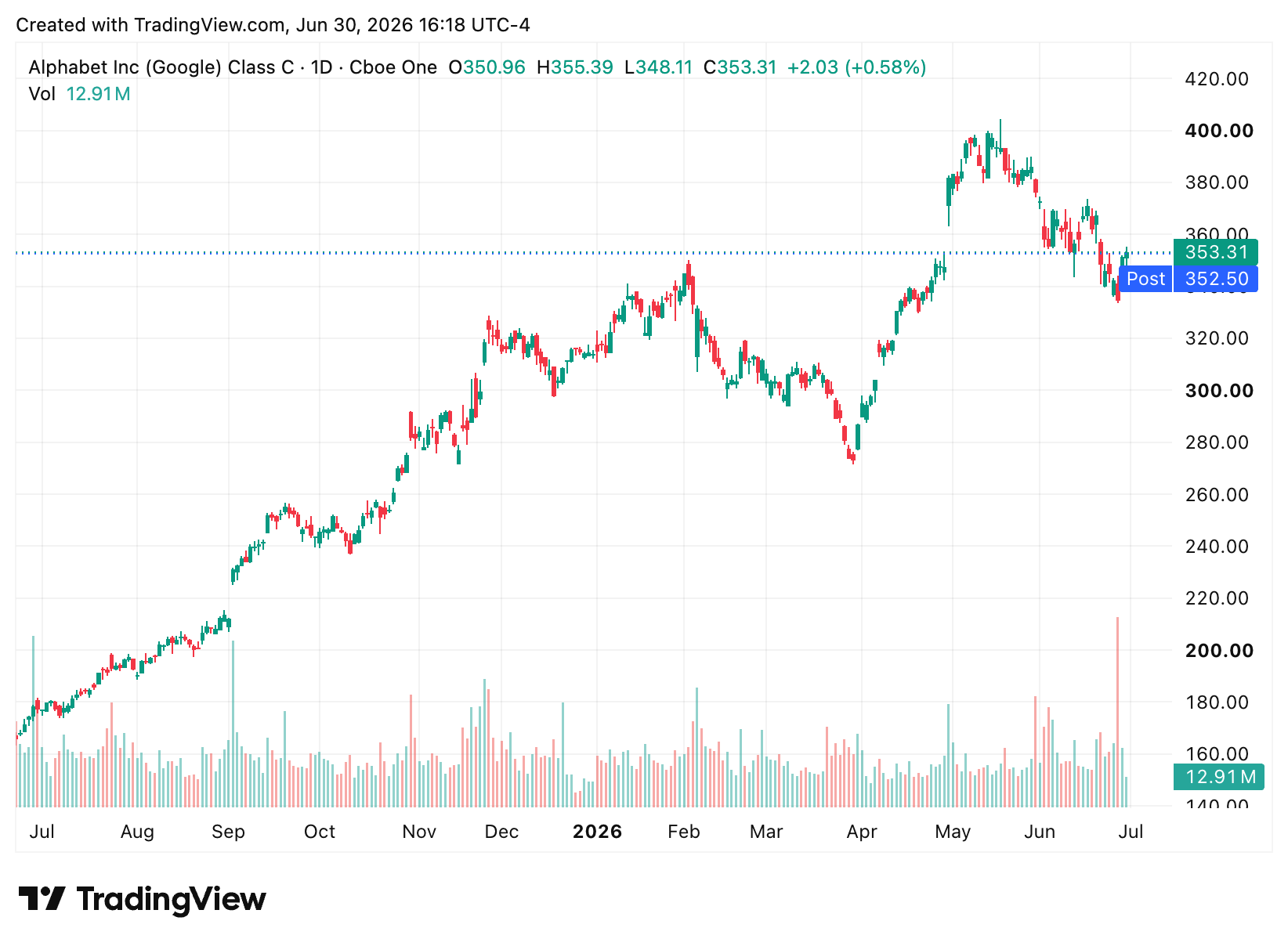
In the first quarter of 2026, Alphabet reported a record $62.6 billion in profit. Up 81% on the year. A blowout, the headlines said. A vindication of the AI bet.
Except nearly half of it, about $28.7 billion, didn’t come from search, or YouTube, or cloud, or Waymo, or anything Google actually sells. It came from Alphabet revaluing a stake it owns in a private company. On paper. Without selling a single share.
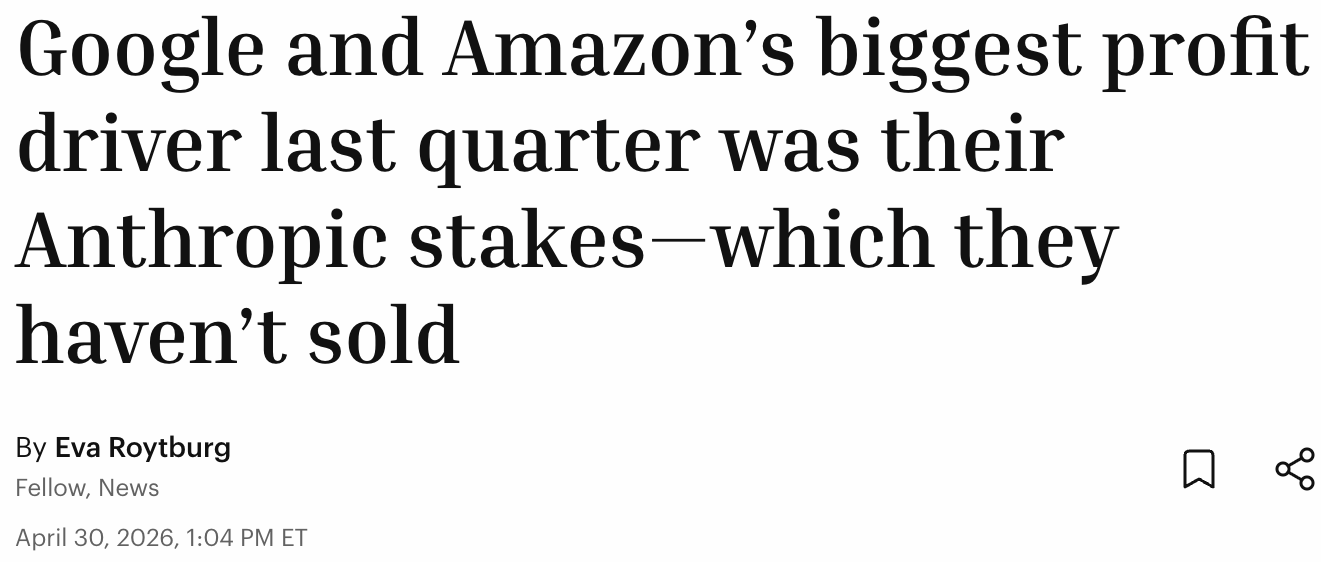
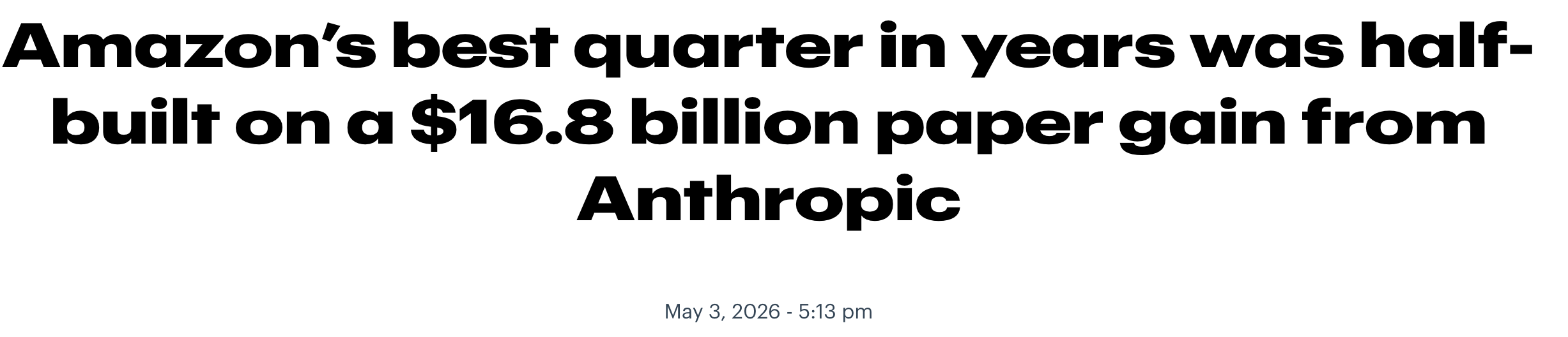
Amazon did the same thing the same quarter. Of its $30.3 billion in net income, $16.8 billion was a paper mark-up on the same private AI company. More than half its profit. Meanwhile, and hold this number next to the last one, Amazon’s actual free cash flow collapsed 95% to $1.2 billion, because $44.2 billion in real money walked out the door to build data centres it doesn’t yet have the power to run.
Real cash out. Paper profit in. Genius, isn’t it.
So how does a company book tens of billions in profit on an asset it hasn’t sold? You need to understand the mechanism, because the mechanism is the whole story.
When a private company raises a new round, even a tiny one, the share price set by that round becomes the benchmark used to re-value every existing share held by every existing investor. Own 10% of a company last valued at $100 billion, and some new investor drops a million dollars in at a valuation implying $300 billion? Your stake just went from $10 billion to $30 billion. Overnight. Whether or not the business changed in the slightest. And under the accounting rules, you don’t just get to record that...you’re required to. It flows straight onto your income statement as profit.
That’s normal private-equity accounting. What’s new is the scale, and who’s holding the pen.
Incestuous Circular Financing
Follow the money around the loop once, slowly. It’s worth it.
Google put early money into Anthropic, a few hundred million in 2023 for roughly a tenth of the company, building to around 14% by this year. In February, a new funding round re-rated that AI company from $183 billion to $380 billion. Google’s stake jumped from about $25.6 billion to $53.2 billion. A $27.6 billion paper gain, straight into the P&L, nearly doubling reported pre-tax income for the quarter.
Now here’s the part that should make your jaw tighten.
Google itself committed $10 billion to the round that drove that new valuation. But the cash didn’t actually move until April...the next quarter. So Google engineered the valuation uplift in Q1, deferred its own cheque to Q2, and booked the full mark-up gain in Q1.
In other words: the investment that created the profit hadn’t even been made yet when the profit was recognised.
And the gain is only half of it. The AI company then takes the capital it raised, including Google’s money, and spends it buying compute from Google Cloud. Google’s cloud revenue jumped 63% in the quarter, much of it AI infrastructure spend. A good chunk of that is the startup spending Google’s own money back with Google, at a fat margin. So Google books the paper gain, then collects the cash back as revenue, then earns another few billion in margin on top of the money it just got returned.
I think I’m going to call this ICF...incestuous circular financing. Though incestuous circular fraud might be the more honest label, if only it were illegal.
Because it isn’t. That’s the whole trick.
We’ve Seen This Movie. It Was Called Global Crossing.
None of this is against the rules. The accounting is permitted. The auditors sign off. And if that reassures you, you weren’t paying attention in 2001.
Back then, telecom carriers traded identical lumps of fibre-optic capacity with each other and booked each swap as a sale, manufacturing revenue out of thin air. Qwest sold capacity to Global Crossing; Global Crossing sold roughly the same capacity right back. Both pointed at the transaction and called it growth. A Qwest spokesman at the time called it “common practice” in the industry, which it was, right up until it wasn’t.
Qwest ended up restating roughly $950 million in phantom revenue. Global Crossing went bankrupt owing $12.4 billion, leaving thousands of miles of fibre dark and unused. Investors... ordinary American families... lost $54 billion. Nearly 10,000 people lost their jobs.

The difference between then and now? Those swaps were eventually ruled illegal. Today’s loop is fully compliant with every accounting standard on the books.
That is not reassuring. That is the warning. Legal doesn’t mean stable. It just means no regulator can stop it before it unwinds.
Strip out the equity mark-ups and the recycled cloud revenue, and Google’s underlying business is growing at a perfectly respectable 16%. Not 81%. A fine number for a company that size. The other 65 points are machinery. And the valuation of the private company at the centre of it all is set not by any open market, but by the same handful of giants who get richer every single time it ticks up. A closed loop, painting its own marks, printing its own profits.
And you already know who’s standing underneath when it comes down. Same as always. Joe Sixpack, whose 401(k) is run by some mindless desk drone in a suit who calls it “managing.”
The headlines say record profits, AI vindicated, the bet is paying off. The footnotes...the paper mark-ups, the deferred cheques, the circular cloud revenue, the 95% cash collapse...say the profits aren’t profits at all.
So what happens when the loop stops spinning, and more to the point, where do you want to be standing when it does?
Here is what waits on the other side of the paywall below. The four-stage hype curve that tells you exactly where in this cycle we are right now...not where the pitch decks claim, but where the engineers who’ve lived it say it actually breaks. Why the AI tools are real and worthless at the same time...the Camry-versus-Ferrari distinction that separates the work that gets cheaper from the work that can’t. And the specific corner of the market we are positioned in for exactly this...the cheap, unloved, physical thing the entire AI fever depends on and refuses to pay for...the trade that wins not when the chatbots get smarter, but when the crowd realises the profits were marks in a ledger all along.
If you have read this far you already feel the shape of it. The rest of this one is for paid subscribers...the part where the argument stops being interesting and starts being actionable.
Upgrade to the Insider Newsletter Level to keep reading →