

![[Section Divider Image]](https://substackcdn.com/image/fetch/$s_!40m4!,f_auto,q_auto:good,fl_progressive:steep/https%3A%2F%2Fsubstack-post-media.s3.amazonaws.com%2Fpublic%2Fimages%2F84498e75-c8fa-445a-af45-756d23859a00_1320x50.webp "[Section Divider Image]")
There is a particular kind of comfort that comes from a number nobody has tested. You see it on a brokerage statement, on a fund report, on the glossy annual letter from an endowment that has spent two decades being held up as the smartest money in the room. The number sits there, serene and unbothered. One times cost. One-point-two. Marked, audited, signed off.
And it is, in many cases, a complete fiction.
I want to talk about that fiction today, because it has just walked into the open at the one institution the entire pointy-shoe establishment spent twenty years trying to copy. Harvard. The endowment held up as the cathedral of sophisticated investing is now neck deep in the same private equity and private credit garbage we have been warning about for the better part of a year. And the dolts running the money are discovering, in slow motion, what happens when a fiction is asked to become a fact.
The trick only works while nobody asks for the money
Here is the mechanism, stripped of the jargon designed to keep you from understanding it.
Private equity funds report the value of their holdings themselves. They mark their portfolios to comparable public multiples, then apply a liquidity discount at the manager’s discretion. That phrase, “at the manager’s discretion,” is doing an enormous amount of work. It means the person whose bonus depends on the number is the person who gets to pick the number. Whowouldathunkit.

This works beautifully, right up until something trades.
For the last few years the exit door has been welded shut. No IPOs worth the name. No strategic buyers stepping up to pay 2021 prices. No secondary sales clearing at par. And as long as nothing trades, nothing prices. The valuations float along, untroubled by reality, because reality requires a transaction to assert itself and there have been no transactions. A portfolio marked at one times cost is worth one times cost in exactly the way a house is worth whatever Zillow says...until you actually try to sell it.
The denominator does the dirty work
So why is the spell breaking now?
Because Harvard needs cash. The endowment funds more than a third of the university’s operating budget, the federal money is under attack, and a tax increase on endowment income is bearing down. Roughly seventy percent of the portfolio sits in private equity and hedge funds. Four percent sits in bonds. That is not a balanced portfolio. That is a bet, dressed up as prudence, that the music would never stop.
When you need cash and your money is locked inside illiquid funds, you have two doors. You can sell your fund stakes on the secondary market, where buyers happily take them off your hands at a discount to the reported value. Or you can sell the liquid things you still own, which shrinks the whole portfolio and mechanically pushes the private equity percentage even higher, which trips your own allocation limits, which forces still more selling. Either door leads to the same room.
And the moment a single secondary stake changes hands at, say, sixty-five cents on the marked dollar, something irreversible happens. A price exists. A real one. Stakes have been changing hands at a discount to net asset value, and the auditors who waved through the self-reported marks now have a transaction to point at. They start asking why this fund says one dollar when a willing buyer just paid sixty-five cents for the same thing. The discretion evaporates. One trade contaminates every mark around it.
This is the part nobody at the cocktail parties wants to discuss. The marks were never wrong in a way you could prove. They were just untested. The selling is the test.
The credit piece is the real kicker
The equity fiction is bad. The debt underneath it is worse.
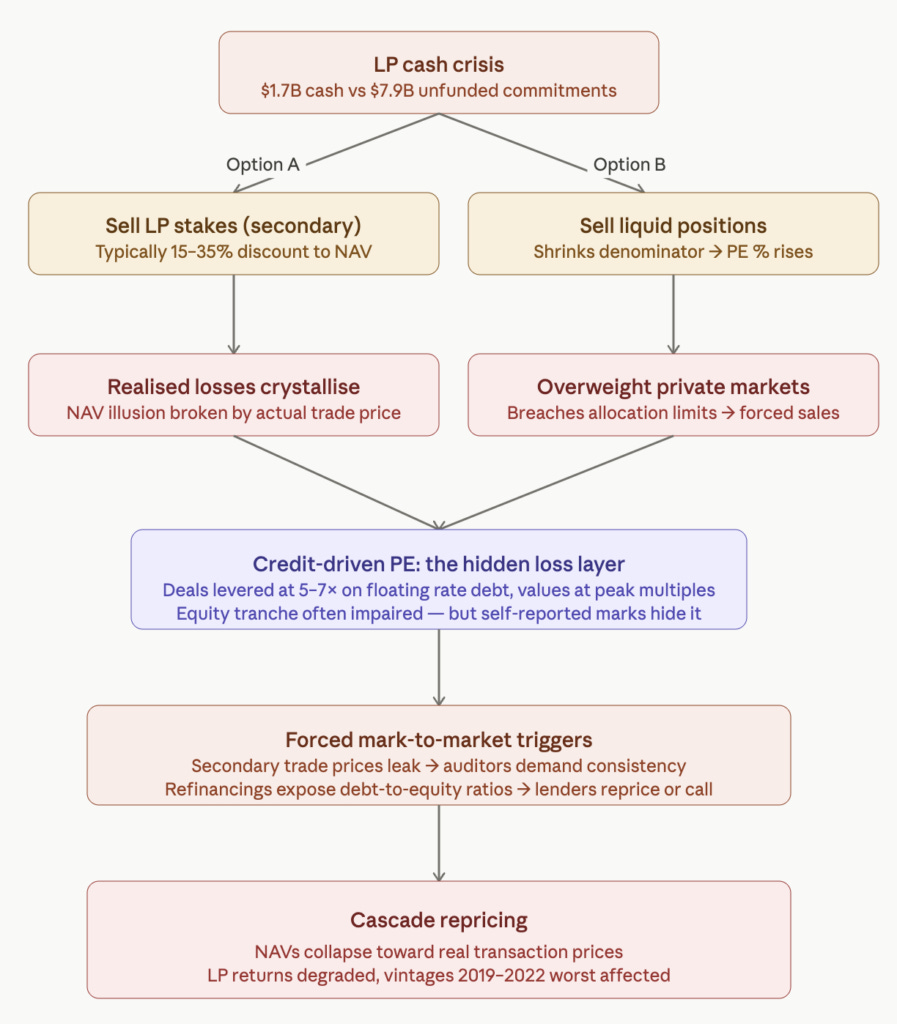
A vast slug of the deals stitched together between 2020 and 2022 were levered to the eyeballs on floating-rate debt, against businesses valued at peak multiples. Then rates normalised. The cost of capital went up and the multiples came down, squeezing the equity cushion from both ends at once. In plain economic terms a lot of that equity is underwater, and in some cases it is simply gone. But the self-reported mark doesn’t show that, because the self-reported mark doesn’t have to.
Until the debt matures.
A company bought at six or seven times leverage in 2021 eventually has to refinance. When it shuffles up to the window in 2025, 2026, 2027, it does so at rates two to three hundred basis points higher, against earnings that may have gone nowhere, into a lending market that has rediscovered the concept of risk. And the lender, unlike the fund manager, has no incentive to be polite. The refinancing process mechanically surfaces what the equity is actually worth. Often that number is somewhere between “very little” and “nothing.”
That is not a mark anyone chose. It is a covenant breach. It becomes public. And it is precisely why you have been watching fund after fund quietly gate its investors, slamming the redemption window shut and telling people who were promised liquidity that, terribly sorry, the money will come back to you eventually, through periodic distributions, at a pace of our choosing.
We have seen this movie. The PE world’s valuations were slow to move in 2008 too. They sat there looking calm while the world burned, and then the refinancing cycles arrived and the bank lenders stopped extending and the numbers moved all at once, violently. The difference this time is the sheer scale of the thing. When the most sophisticated institutional capital on earth is running forty percent and more of its book in private markets, you are not looking at a niche problem in a corner of finance. You are looking at a systemic concentration that has been marked to a story.
What this actually tells you
Step back from Harvard for a second, because Harvard is not the point. Harvard is the tell.
When the cleverest, best-resourced, most envied allocators on the planet start quietly building an armour of liquidity, issuing bonds and dumping fund stakes at a haircut rather than touching their marked-to-perfection private book, they are voting with their feet on what those marks are worth. They will not say it out loud. They will talk about portfolio optimisation and duration management and rebalancing into a generational opportunity. But the action underneath the words is unmistakable. They want out, and they want out before everyone else works out the same thing.
Between the private equity overhang, the private credit gating, and the small matter of the AI bubble inflating in the same sky, the odds of the next couple of years chugging along without a violent speed bump look slim. Sooner or later a concrete barrier gets hit. It always does.
Which brings us, as it always does, back to the only question that matters. What do you actually own, and what is it actually worth when somebody is forced to find out?
A barrel of oil is worth what a barrel of oil is worth, every single day, in a market that prints a real price every second the sun is up. An ounce of gold the same. A tonne of coal, a bushel of grain, an acre of dirt that grows food. These things have the inconvenient and deeply unfashionable property of being priced continuously, in daylight, by people actually transacting. There is no manager’s discretion. There is no liquidity discount applied at someone’s convenience. There is no number waiting to be exposed by the first honest trade, because every trade is honest and every trade is now.
For twenty years the clever money paid a premium to own things that never had to prove what they were worth. It is about to find out what that premium costs.
Before you go
What you have just read is the why. It is the part I am happy to put in front of the whole world, because the world ought to hear it and most of the people who should be saying it are too busy collecting fees on the marks I just described.
But the why doesn’t make you any money on its own. The money is on the other side of the trade...in the specific, named, continuously-priced assets that win when the fiction collapses and capital comes stampeding out of the dark and into things it can actually value. That part we keep for the people who want to do the work alongside us.
If that is you, here is where it lives.
Upgrade to the Insider Newsletter. It lands in your inbox roughly twice a month, and every issue carries The Big Five...five deep-value trade ideas, fully worked, the kind of macro intelligence most analysts won’t touch because it sits in energy, commodities, and geopolitics, the three corners of the market where the real asymmetry has been hiding while everyone crowded into the Bag 7. Full access to the Asymmetric Investing Course comes bolted on. Thirty-five dollars a month on the annual plan, which works out ten percent cheaper than paying month to month.
The free tier gets you roughly two market posts a week, and they are good ones…The Newsletter is simply where the why turns into the what.

Click Here to Upgrade to the Insider Newsletter →
As always, none of the above is financial advice. We are not telling you what to buy. We are telling you what we think. Do your own research, and size yourself so the speed bumps don’t end your race.