

![[Section Divider Image]](https://substackcdn.com/image/fetch/$s_!kFL9!,f_auto,q_auto:good,fl_progressive:steep/https%3A%2F%2Fsubstack-post-media.s3.amazonaws.com%2Fpublic%2Fimages%2Fd40c56f4-00ff-4901-8872-423325d80022_1320x50.webp "[Section Divider Image]")
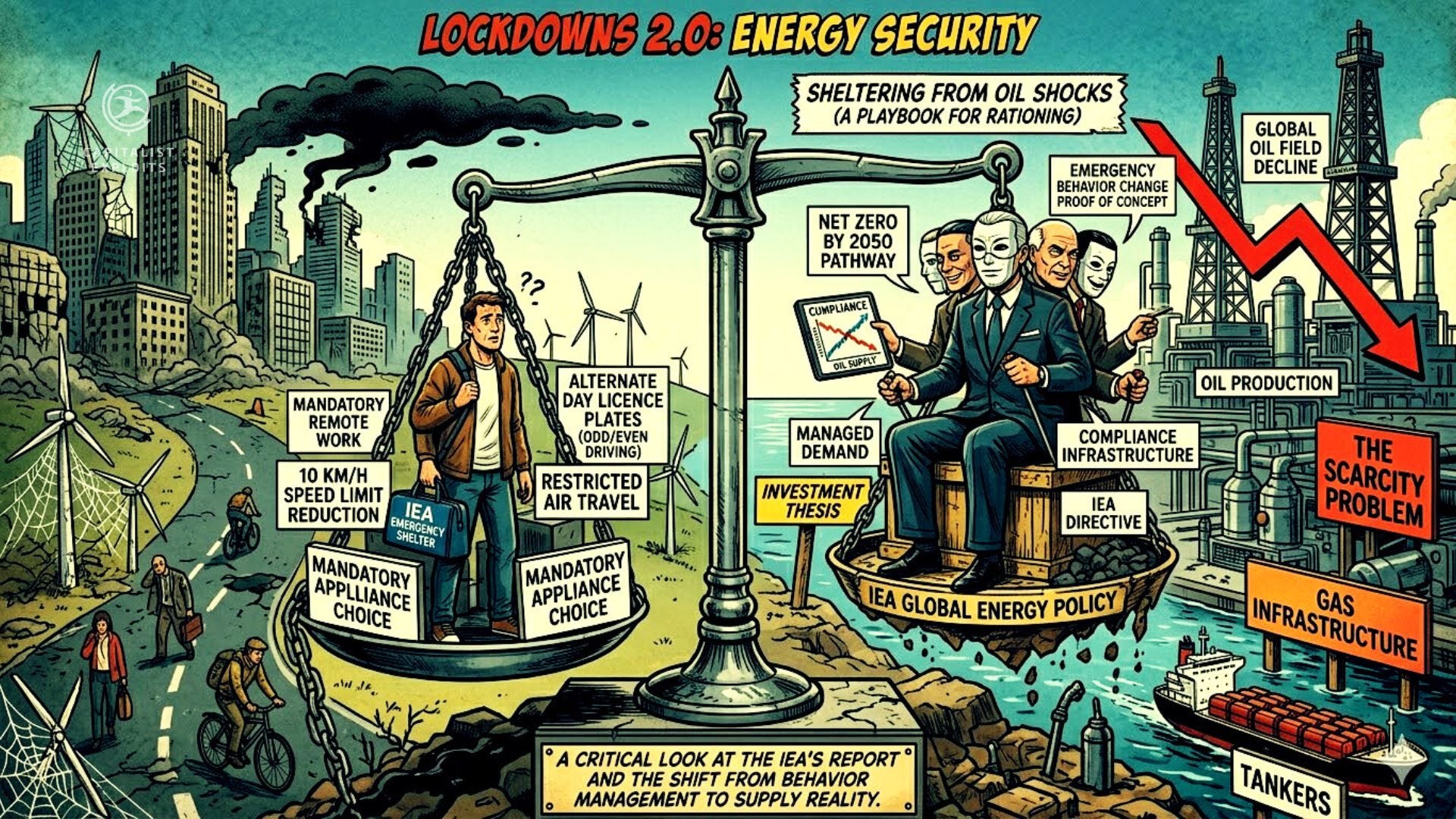
The International Energy Agency just published a report called Sheltering from Oil Shocks.
Read that title again. Sheltering. From oil shocks. As if the solution to an energy supply problem is to manage your behaviour rather than solve the supply problem.
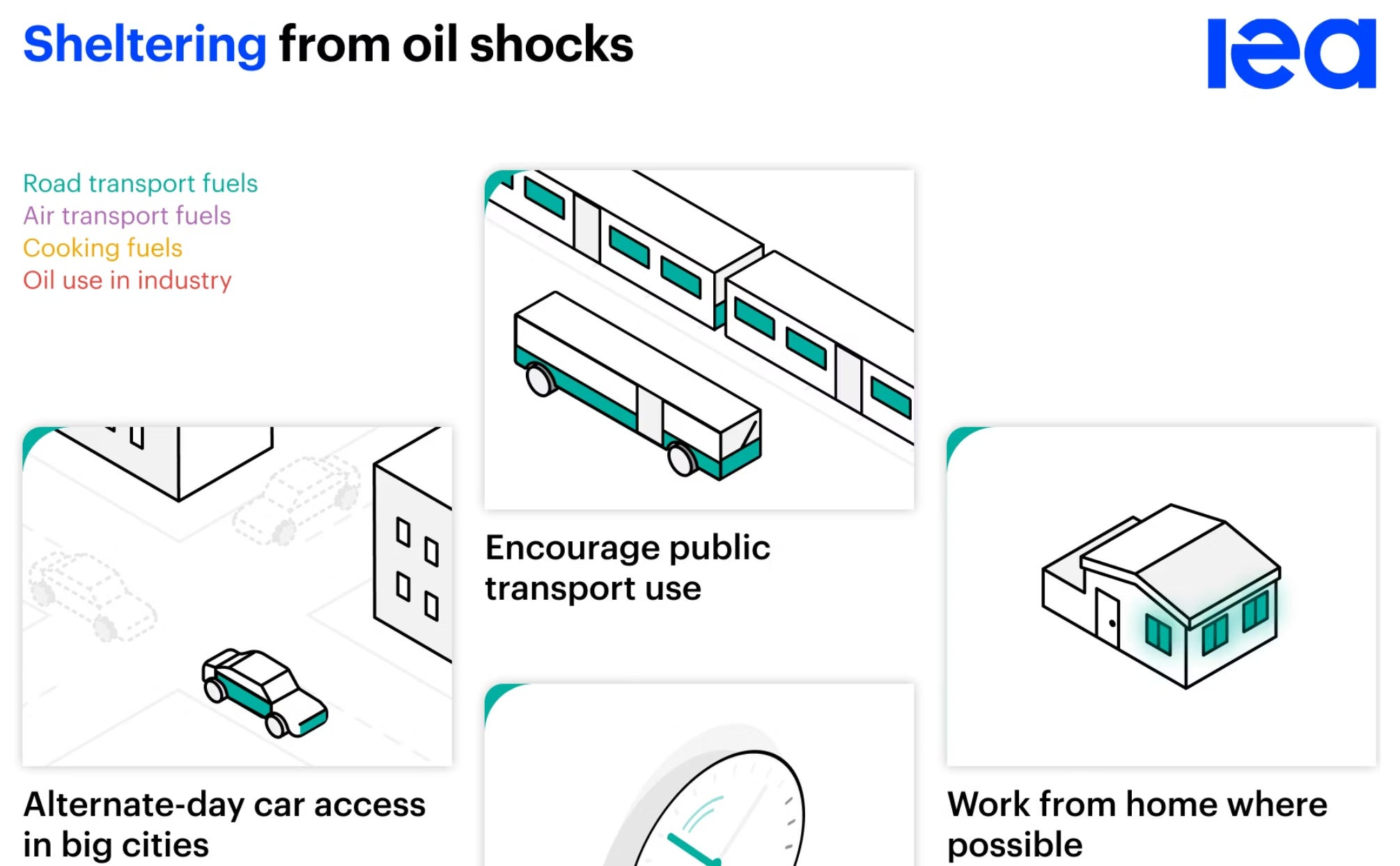
I read it. All of it. And I want to walk you through what it actually says, because the document is instructive...not for the reasons the IEA intends.
The Report
The context is real enough. The conflict in the Middle East has effectively shut the Strait of Hormuz. According to the IEA’s own figures, around 20% of global daily oil consumption previously transited that waterway. That flow has slowed to a trickle. Gulf producers have cut output by at least 10 million barrels per day. Brent is north of $100. The IEA has already authorised the largest emergency stockpile release in its history...400 million barrels from member country reserves.
So: real disruption, real price spike, real emergency response on the supply side. Fine. This is what the IEA exists to do.
But then comes the second half of the report. The demand side. The “10 options” for governments, businesses, and households to “shelter themselves” from the shock.
And this is where it gets interesting.
Option One. Governments should mandate or encourage working from home. The Philippines and Pakistan have already introduced four-day government workweeks. Sri Lanka has closed public offices on Wednesdays. The IEA estimates three additional remote days per week could cut personal car oil consumption by up to 20%.
Option Two. Reduce highway speed limits by at least 10 km/h. Pakistan has already done it. France did something similar in 1973 and again in 2022. A 10 km/h reduction can cut an individual driver’s fuel use by 5% to 10%.
Option Three. Alternate-day road access based on your licence plate number. Odd plates drive Monday. Even plates drive Tuesday. Korea is currently considering a five-day or ten-day vehicle rotation system. The IEA frames this as reducing congestion and “engine idling.” Which is technically true. It is also a permit system for movement.
Option Four. Avoid air travel “where alternatives exist.” The IEA doesn’t define what qualifies as an alternative. A twelve-hour train journey? A video call? The ambiguity is deliberate...it allows regulators to determine after the fact whether your trip was essential. Governments are encouraged to lead by example by restricting overseas travel for public officials. Thailand has already suspended government agency trips abroad.
Option Five. Switch from gas cooking to electric. The IEA is now recommending what appliance you use in your kitchen.
I want to stop there for a moment. Because taken individually, none of these is outrageous. In a genuine supply shock, people tighten their belts. Businesses adapt. Governments respond. That’s normal.
What’s not normal is the architecture underneath these recommendations.
Where We’ve Seen This Before
In 2020, governments around the world restricted movement, mandated behaviour, and closed businesses. The justification was public health. The template that emerged...the compliance infrastructure, the digital passes, the essential vs. non-essential designations...proved remarkably durable.
In 2022, the energy crisis that followed the Ukraine war produced its own round of behavioural mandates. The EU recommended thermostats capped at 19 degrees. Germany launched public campaigns asking citizens to take shorter showers. France ran information campaigns on eco-driving. The IEA published guidance on all of it.
And now here we are in 2026, and the IEA is publishing a 10-point demand management plan that includes licence plate rotation systems, government-enforced remote work, and restrictions on air travel based on criteria that regulators will define for you.
The excuse changed. The template is identical.
What makes this worth paying attention to is not that governments are doing these things in an emergency. It’s that the IEA’s own longer-term publications make very clear that emergency measures are viewed as a proof of concept for permanent structural change.
The IEA’s Net Zero by 2050 report is explicit on the point. The lesson the IEA drew from Covid-19 was not caution. It was that people will comply at scale when the pressure is sufficient. Mass behaviour change, achieved under emergency conditions, demonstrated what’s possible. The same report calls for ongoing personal behavioural changes as a core part of the Net Zero pathway...lower speed limits, reduced flying, dietary shifts. The emergency creates awareness. The awareness becomes the baseline. The baseline becomes the mandate.
This is not a conspiracy theory. It’s a stated policy framework from the agency that exists to manage global energy security.
The Investment Angle
Now. Here’s where I want to turn this, because this is what we actually do. We look at the world as it is, not as we wish it were, and we try to figure out where the money goes.
The IEA report is useful not as a policy blueprint but as a demand signal. When the world’s foremost energy security body publishes a crisis management document recommending demand rationing across transport, aviation, and industry...that tells you something about the supply situation.
The Strait of Hormuz carrying 20% of global oil consumption is not a new vulnerability. It has been the central structural fact of global oil markets for fifty years. What’s new is that the disruption has actually happened at scale. And the response...strategic reserve releases, demand mandates, national emergency protocols...confirms that the just-in-time global energy system has no margin left.
This is exactly the setup we have been talking about for the better part of two years. Global oil field decline rates are running at 8% annually, meaning the industry needs to replace roughly 8 million barrels per day of production every year just to stay flat. Capex into new production has been structurally inadequate since 2015. Shale growth in the US is decelerating. There is no cavalry coming.
And now a single geopolitical shock has knocked 10 million barrels per day offline and the IEA is telling people to carpool.
The gap between what the world needs and what the supply system can deliver is not closing. It is widening. And gaps like that, in commodity markets, have historically resolved in one direction.
We are positioned for this. We have been positioned for this. Energy, broadly...oil and gas producers, services companies, tankers, the infrastructure that moves molecules around a world that runs entirely on them. Not because we predicted this specific conflict. We didn’t. But because the underlying structure of supply and demand had already made some version of this outcome highly probable.
Geopolitical shocks are the match. The tinder has been building for years.
The governments implementing driving rotation systems and work-from-home mandates are not addressing the underlying problem. They are managing the symptoms. The underlying problem is that the world systematically underinvested in energy production for a decade while simultaneously pursuing a green transition that has not delivered reliable baseload power at scale. The IEA’s own demand management report is a tacit admission of that failure. You don’t publish a rationing playbook if the supply side is healthy.
None of this is advice. We own what we own and you should do your own research before touching anything. But the direction of travel here seems reasonably clear. Scarcity commands a premium. The producers and handlers of scarce physical commodities are not going away. And the political response to scarcity...whether it’s rationing, price caps, or licence plate rotation systems...has historically transferred wealth from paper assets to real ones.
That process is underway.
The Longer Game
In other words: the solution to being exposed to oil shocks is to reduce your dependence on oil. Which sounds reasonable until you spend thirty seconds thinking about it.
You cannot manufacture a solar panel, a wind turbine, an EV battery, or a heat pump without oil in the supply chain. The resins, the lubricants, the transport, the mining equipment that pulls the copper and lithium and cobalt out of the ground...it all runs on oil. The green energy supply chain is not separate from the fossil fuel supply chain. It is downstream of it. So when oil gets constrained, green energy device production gets constrained too. The IEA is essentially recommending you cure a headache by hitting yourself somewhere else.
Then there’s the reliability problem. When the power goes out...and in a genuine energy crisis, it will...you cannot cook. You cannot heat your home. You cannot take a hot shower. The family that transitioned off gas to a fully electric kitchen and an electric heat pump has no fallback. Gas gives you something to cook on when the grid goes dark. Electricity gives you a very expensive paperweight.
And even when the grid is running, most of the electricity flowing into your all-electric home is generated by fossil fuels. Natural gas. Coal. In many countries, oil. Electrifying your appliances and calling it clean energy is, in most cases, just burning fossil fuels with extra steps...extra infrastructure, extra transmission losses, extra points of failure.
None of this is an argument against managing energy use intelligently. It is an argument against pretending the transition has already happened, or that it can be accelerated by rationing petrol and mandating induction stoves while the Strait of Hormuz is closed.
The commodity thesis runs right through the middle of all of it. Oil to run the world as it exists today. Critical minerals to build the world the planners say is coming. And the monetary debasement required to fund the gap between those two realities...the emergency reserves, the consumer subsidies, the $900 billion spent between 2022 and 2023 just cushioning households from the last crisis...is a hard asset story however you cut it.
The playbook keeps pointing in the same direction.
Yes, oil will never disappear.
"Let’s not forget—it's ENERGY that powers the world, not currency (fiat). So why cling to a depreciating currency when energy prices are rising faster than the returns offered by holding that currency? The logic is simple: purchasing power rooted in energy is more resilient than trust in paper.
And modern wars rarely erupt in random places. They tend to ignite in regions rich in energy (or OIL) resources—or against nations that control them. Libya, Iraq, Russia—each a case study in how oil shapes foreign policy and military intervention." - https://divistockchronicles.substack.com/p/the-multipolar-currency-era
The “war” is a fictional hoax. Both geopolitical “sides” are controlled by the same puppet masters.
The only answer to any request and imposition of “energy rationing” would be the massive use of the only thing we should stockpile: weapons and related bullets to use against all polticians (Bankers’s butlers), journalist (Bankers’s sex workers) and environmental activist (neo-Malthusian, anti-human terrorists).