

We left you at the open bar.
Fifteen hundred people in a Houston convention hall, neon nametags, a go-kart track and an open bar, quitting their jobs to trade a market that had only ever gone up. We said Mr Market always turns up to those parties in the end, and that the crowd is never the one who sees him walk in.
Which rather raises a question. Fine... but what, specifically, is that crowd being sold?
Let us introduce you to Firmus.
Firmus is an Australian artificial-intelligence company, the kind the financial pages have spent a year describing in superlatives. Nvidia is a shareholder. OpenAI was signed up as the anchor tenant for two facilities in Malaysia. Meta was on the customer list. It had secured access to a hundred and seventy thousand of Nvidia’s chips. Every box on the AI bingo card, ticked.
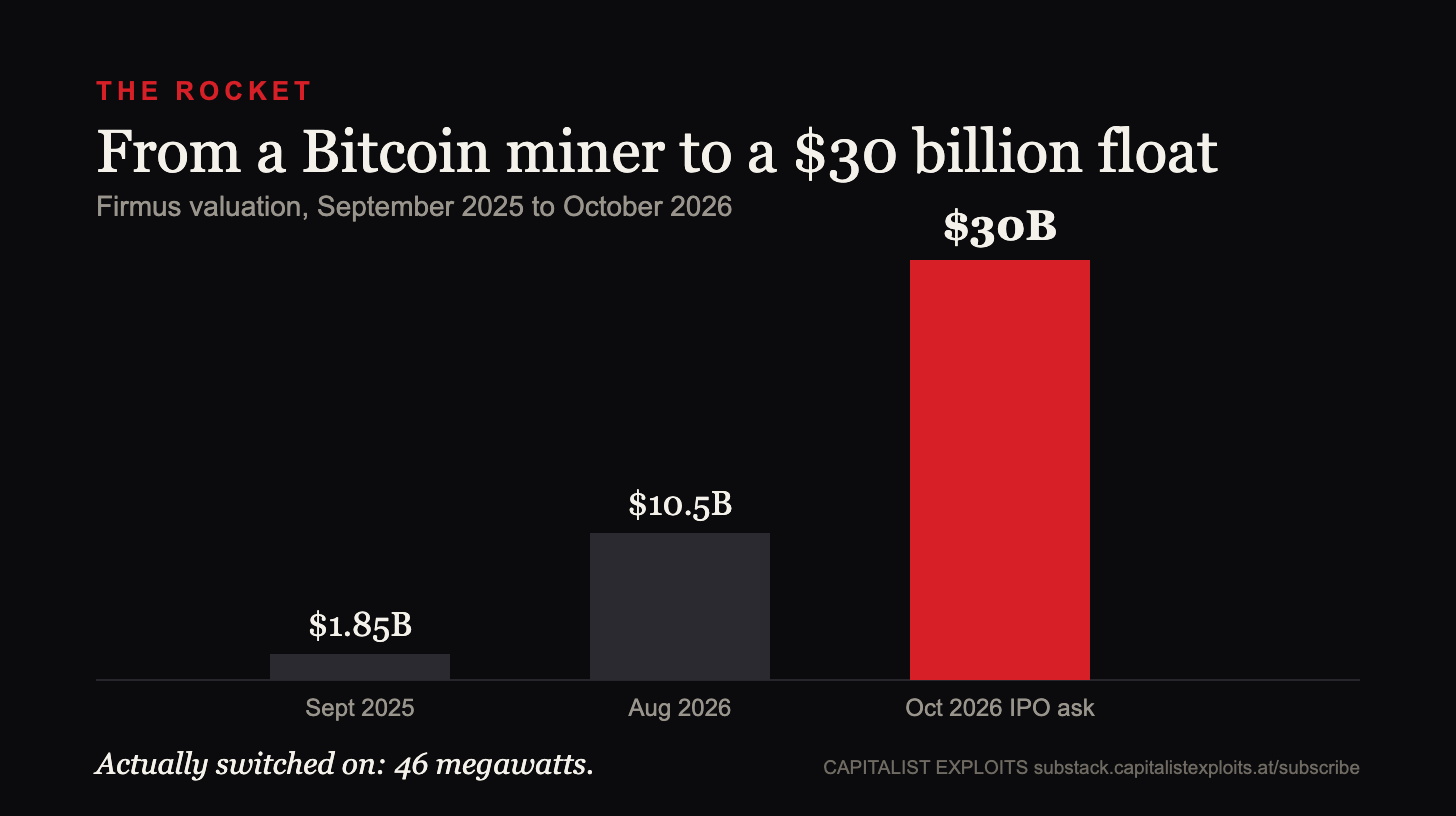
In 2019 it was a Bitcoin miner. By this October it was trying to list on the Australian Securities Exchange at a market value of around thirty billion dollars, raising five billion in the float. The valuation had travelled from 1.85 billion a little over a year ago, to 10.5 billion in August, to thirty billion by October. Up, and up, and up. You have seen that shape before. It was on the chart we showed you last time.
Now here is the number nobody at the party wanted to look at.
Against that thirty-billion-dollar valuation, Firmus had forty-six megawatts of data centre actually switched on. Forty-six. It had another 865 megawatts “under development,” and a further 3.2 gigawatts it described as “planned capacity and growth rights,” which is a marvellous phrase that means land, ambition and a slideshow. Its contracted revenue, the company confirmed, runs into the billions... but it only starts collecting a cent of that once the facilities are actually built and running.
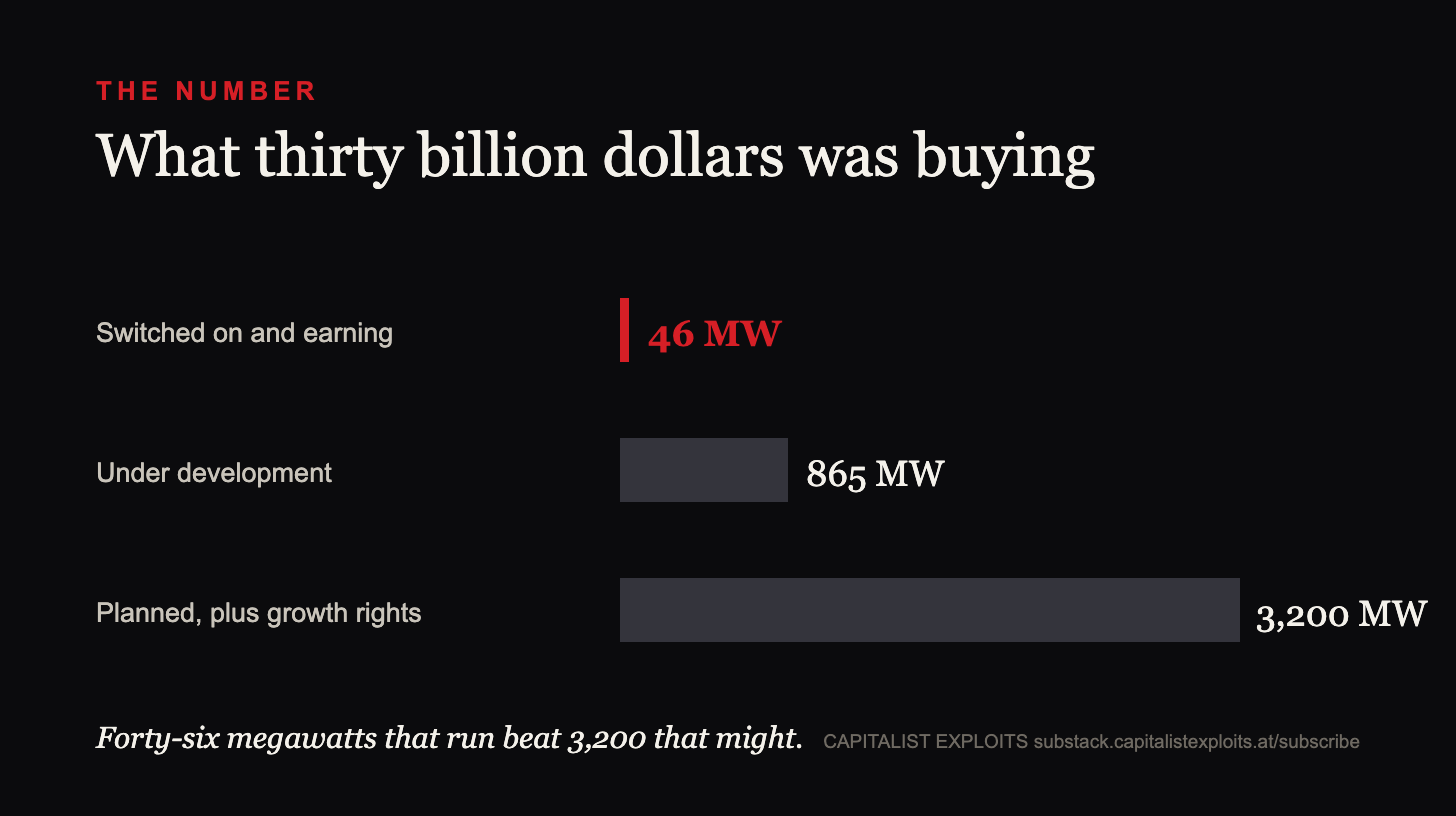
So strip away the logos and the chip allocations, and what you were being asked to buy, at thirty billion dollars, was forty-six megawatts of operating business and an enormous quantity of drawing board. One analyst put it more gently than we would. Investors, he said, “weren’t prepared to pay a sky-high price up front for capacity that’s still largely on the drawing board.”
And then there is the man who built it.
Firmus was co-founded by Oliver Curtis, its largest individual shareholder. In 2016 Mr Curtis was convicted of insider trading and sentenced to two years, of which he served one. The scheme, back in 2007 and 2008, turned on about 1.4 million dollars and relied on precisely the thing a public market is supposed to forbid: trading on information the person across the table does not have.
We raise it not to kick a man who has served his time. We raise it because there is a certain poetry in a market euphoric enough to hand thirty billion dollars to a float built by someone who once went to prison for understanding, better than most, exactly how asymmetric information works. The papers called it a journey “from jail to AI billionaire.” We would only note that the billionaire part needed the float to close.
It did not close.
The book opened on the Tuesday. By Friday morning, days before the shares were due to start trading, Firmus pulled the whole thing. The board said proceeding “was not in the best interests of the Company and its shareholders” and pointed at market volatility, which is what every board points at. The fund manager quoted in the papers was blunter. “Confidence evaporated.” The reporting had the institutions balking at the valuation, the financing needs, the thin operating history and the construction risk. In other words, somebody finally opened the spreadsheet.
Here is the part worth sitting with. The money that said no was not the retail crowd. It was the institutions, the ones who get the deck, the data room and the forecast models the rest of us never see. The float collapsed precisely because the professionals would not pay the price being asked. The crowd never even got its turn.
This is the other half of the story we told you at the open bar, and it is the half that decides what happens next.
A mania has a supply side. For every giddy buyer quitting his job to day-trade, there is someone on the far side of the table building inventory to sell into the excitement. The IPO window is where that trade happens at scale. It is the machinery by which a private story gets marked up and handed to the public at the top... a Bitcoin miner becomes an AI champion becomes a thirty-billion-dollar float, and the entire apparatus exists to move the thing from the people who own it cheap to the people who will buy it dear.
So watch the window. When the hottest names in the hottest sector start getting pulled days before they trade, it is not because anyone has stopped believing in artificial intelligence. It is because the first buyer actually made to pay up front has started doing arithmetic. That is how these things always turn. Not with a crash and a siren. With a withdrawn prospectus and a sentence about market volatility.
We are not short Firmus. We do not buy the drawing board, long or short. What we own, as we say roughly once a month until you are thoroughly sick of hearing it, is the unglamorous opposite: things that are cheap because nobody is excited about them, and that already throw off the cash the exciting names are still only promising. Forty-six megawatts that actually run beat 3.2 gigawatts that might, every single time the music stops.
A company can be a real business and a ruinous investment at the very same moment. The crowd has never once managed to tell the two apart in time.
If you like our reporting, then you’ll definitely like our Insider newsletter.
The Insider Newsletter is not a hot-tip service. It is the research we use to build our own picture of the world, every issue, handed over so you can argue with it, keep the sixty percent you agree with, and sharpen your own model. While the headlines were still calling Firmus a thirty-billion-dollar AI champion, the issue this article came from was already counting the megawatts. That is the whole job: we read the spreadsheet, not the story.
Thirty-nine dollars a month, or four hundred and twenty for the year. If a single issue keeps you out of one drawing-board float dressed up as a sure thing, it has paid for itself many times over. And if it is not for you, Substack will refund any subscription inside seven days of payment. No retention call, no exit survey.