

![[Section Divider Image]](https://substackcdn.com/image/fetch/$s_!gUhJ!,w_1456,c_limit,f_webp,q_auto:good,fl_progressive:steep/https%3A%2F%2Fsubstack-post-media.s3.amazonaws.com%2Fpublic%2Fimages%2F78c4622f-f98f-4d13-9f1b-0bac9e584c74_1320x50.webp "[Section Divider Image]")
There is one question we keep hearing. From clients, from readers, from anyone paying attention right now.
When does this end?
It is the wrong question.
The right question is: who has an incentive to end it? Run that analysis. Go actor by actor. And something uncomfortable becomes very clear.
Russia
Russia is fighting Ukraine. But Ukraine isn’t really the opponent.
Ukraine is the battlefield. The opponent is the collective West...specifically the American military-industrial complex that has funded, armed, and sustained this war from the beginning.
Given that framing, what does Russia want? Its real opponent weakened, distracted, and fighting on as many fronts as possible. Every dollar flowing into Middle East operations is a dollar not flowing to Kyiv. Every political fracture in Washington over Israel-Iran is political capital Russia doesn’t have to spend.
Russia benefits from the war continuing. It is that simple.
China
China has watched the Western strategic playbook carefully. The sequence is not subtle: weaken Russia, control their resources, surround China with compliant client states, and then dictate terms to Beijing.
Energy is China’s structural vulnerability. Russia and Iran represent the two feedstocks of energy that sit outside Western orbit. A Western victory in the Middle East doesn’t just hurt Iran. It tightens a noose around Chinese energy security that Beijing cannot afford to ignore.
So China watches. It waits. And it has every incentive to see the West bleed resources, credibility, and political will in a theatre that isn’t Beijing’s problem to solve.
Iran
For Iran, this is existential. Not metaphorically. Literally.
Even if the bombs stopped tomorrow, Iran’s leadership understands something the Western commentariat won’t say aloud: they’ll be back. Maybe in five years. Maybe ten. Because the strategic objective...control of the region, control of the energy flows...hasn’t changed. It never changes.
Iran has studied Vietnam. The lesson is not complicated: you cannot win a conventional war against a militarily superior force. But you can bleed them. Slowly. Over years. Until the domestic political will to continue collapses under its own weight.
That is Iran’s strategy. A sustained war of attrition. And they are prepared to prosecute it indefinitely.
The Political Class
And what of the political and managerial class in the West? The ones whose influence expands in proportion to the scale of the crisis?
For them, a prolonged conflict is an opportunity. Emergency powers, accelerated procurement, tightened surveillance infrastructure, expanded mandates. As Randolph Bourne wrote in 1918, War is the health of the State. These are not people with a strong personal interest in resolution.
The Gulf States
Here is the actor I find most interesting. And most trapped.
The Gulf states tied their destiny to the Western military-industrial complex decades ago. The arrangement seemed sensible enough at the time: recycle petrodollars into US Treasuries and US equity markets, and receive American military protection in return. The petrodollar recycling arrangement that has anchored demand for US Treasuries for fifty years traces directly to a 1974 deal between Kissinger and the Saudis. Mutually beneficial. Durable. Or so it seemed.
Now they are discovering the problem with that deal.
The protection is conditional. The alliances are transactional. Step away from the arrangement and you invite colour revolutions, economic pressure, or worse. Step toward it and you bankroll a military project that is increasingly visibly failing.
There is no clean exit. The Gulf states are not a winner here. They are a hostage to a bargain they can’t renegotiate and can’t walk away from.
But here is what matters for us: they know it. Gulf Arab leaders are reconsidering their military alliances. The petrodollar recycling arrangement is now under structural pressure that the current conflict has accelerated into something that can no longer be ignored. Turkey, for its part, has already refused to let Israel and the US use its bases to launch attacks on Iran. That is not a small signal.
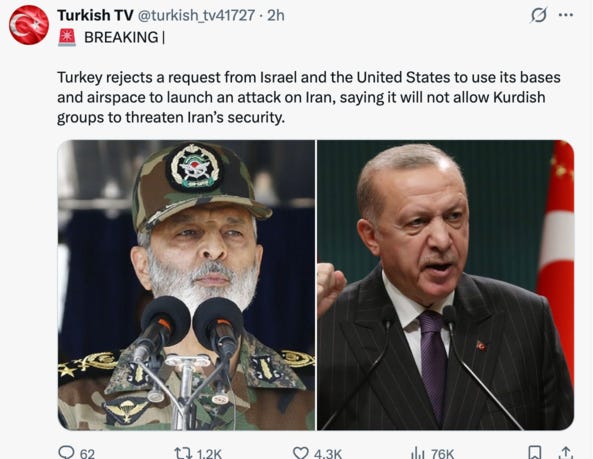
These are not reversible decisions. Once you've publicly refused a request from Washington, the relationship has changed permanently.
What the Market Hasn’t Priced
Markets are treating this conflict as a spike. A disruption. A line on a chart that eventually reverts to baseline.
The incentive structure says otherwise.
Consider what the world has now learned. US stealth aircraft can be targeted. US defence equipment, purchased by allies at enormous expense, has performed below expectations in a real shooting war. The invincibility myth that underpinned decades of American deterrence has taken damage that cannot be repaired with a press conference.
Africa is gone to the West. India cannot be relied upon. European nations are discovering their military capacity is considerably thinner than the briefing papers suggested. Alliance quality matters enormously for projecting power, and the quality of the Western alliance has just been publicly tested.
And then there is this...the conclusion that matters most for anyone who manages capital:
Natural resource ownership is now equivalent to superpower status.
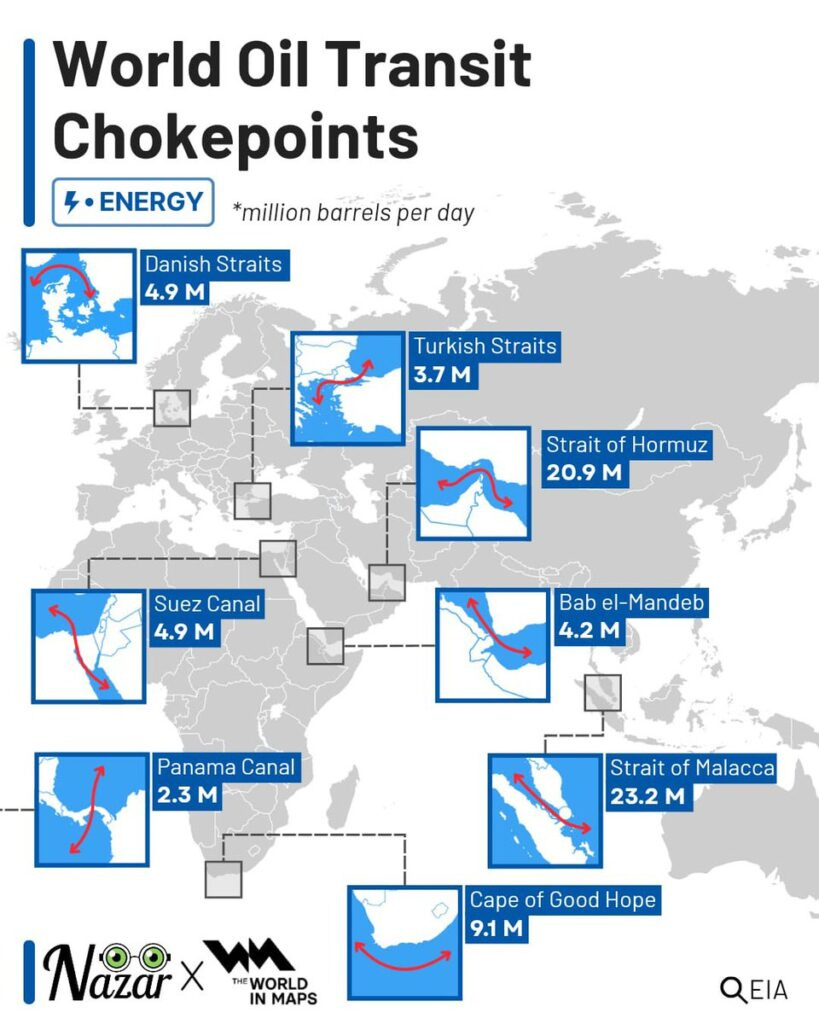
The Strait of Hormuz carries roughly 20 million barrels of oil per day. The Strait of Malacca another 23 million. These are not lines on a map. They are the circulatory system of global industrial civilisation. Every nation that depends on these flows is reassessing its exposure. Every nation that controls or sits adjacent to these flows has discovered it holds leverage it never fully understood it had.
We are entering a period when all of these chokepoints get contested...not necessarily by military force alone, but commercially, diplomatically, and geopolitically. The old assumption that military supremacy decouples from resource control died somewhere in the fog of this war.
This Is Our Shtick
We have been positioned for this for years. Hard assets. Energy. Emerging markets in resource-rich geographies. These are not trades. They are structural allocations for a world where the foundational assumptions of the last thirty years are being dismantled in real time.
The investors who are already positioned in the assets that win in that environment will do well. Those waiting for clarity will eventually get it. But clarity, in our experience, arrives late and expensive.
If you want to know exactly how we’re positioned...which specific names we hold across energy, hard assets, and EM...that is all inside the Insider Service at capitalistexploits.at. The analysis above is the why. The what is behind the paywall.
Do your own research, as always.
Know someone who thinks like you do?
Capitalist Exploits has a referral program. If you share your personal referral link and someone subscribes…free or paid…it counts toward a reward. Three referrals earns you a free month. Five gets you three months. Twenty-five gets you six.
Your referral link is in your account settings under “Refer a friend.” Takes 30 seconds to find and share. The people you send it to get access to the research. You get compensated for growing a community of investors who actually pay attention.
That’s the deal.
yes russia and china are 2 beneficiarries , also usa oli is beneficiary , but overall this is what happens when people voting for narcistic psychopats like trump, they have tendency to leave scorched earth afterwards