

![[Section Divider Image]](https://substackcdn.com/image/fetch/$s_!9Cth!,f_auto,q_auto:good,fl_progressive:steep/https%3A%2F%2Fsubstack-post-media.s3.amazonaws.com%2Fpublic%2Fimages%2F7e896fc2-f04b-4280-ba1e-9f193579a076_1320x50.webp "[Section Divider Image]")
Greetings, friends!
Let me ask you a question, and I want you to sit with it for a second before you answer.
Why would the most capital-hungry companies in the history of capitalism...the ones that have never made a dime...suddenly be in such a tearing hurry to sell you a piece of themselves?
In June, SpaceX came public at $1.77 trillion. The largest IPO ever floated. By the close it was worth about $2.1 trillion. And now Anthropic...a company that spent two dollars and seventy-five cents for every single dollar of revenue it booked last year...is lining up to list at north of $2 trillion of its own.
You are meant to read that as strength. The future, arriving. Get in before the bell.
It is the opposite. And once you see why, you will not be able to unsee it.
The end of the line
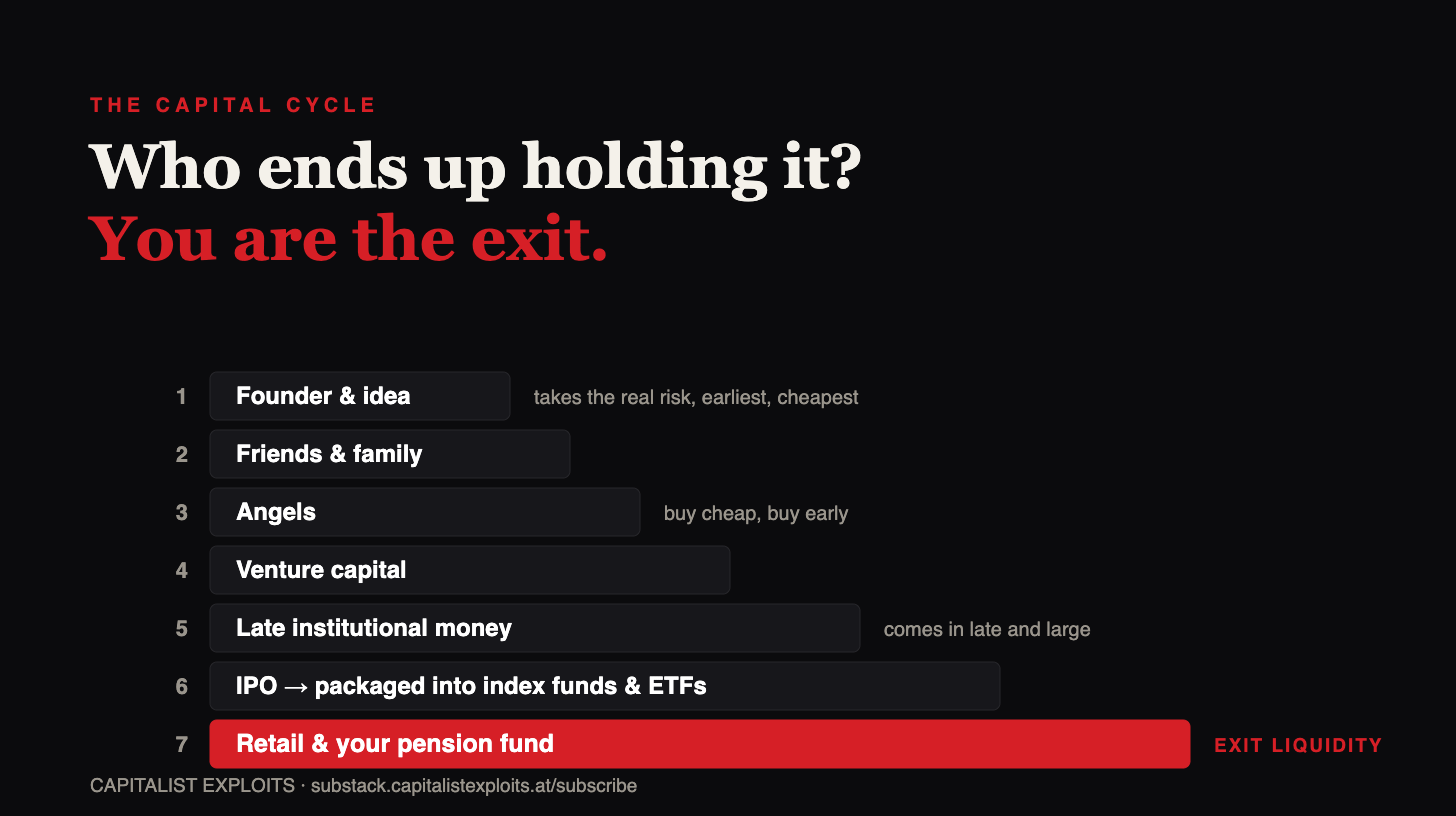
Every company that ever listed travelled the same road. It starts with a founder and an idea. Then friends and family. Then angels, who buy cheap and early because they are the ones taking the real risk. Then venture capital. Then the big institutional money that comes in late and large. And then, at the very end of that chain, when there is nobody cleverer or richer left to sell to...it gets packaged up, wrapped in a ticker, and sold to the public. To retail. To your pension fund.
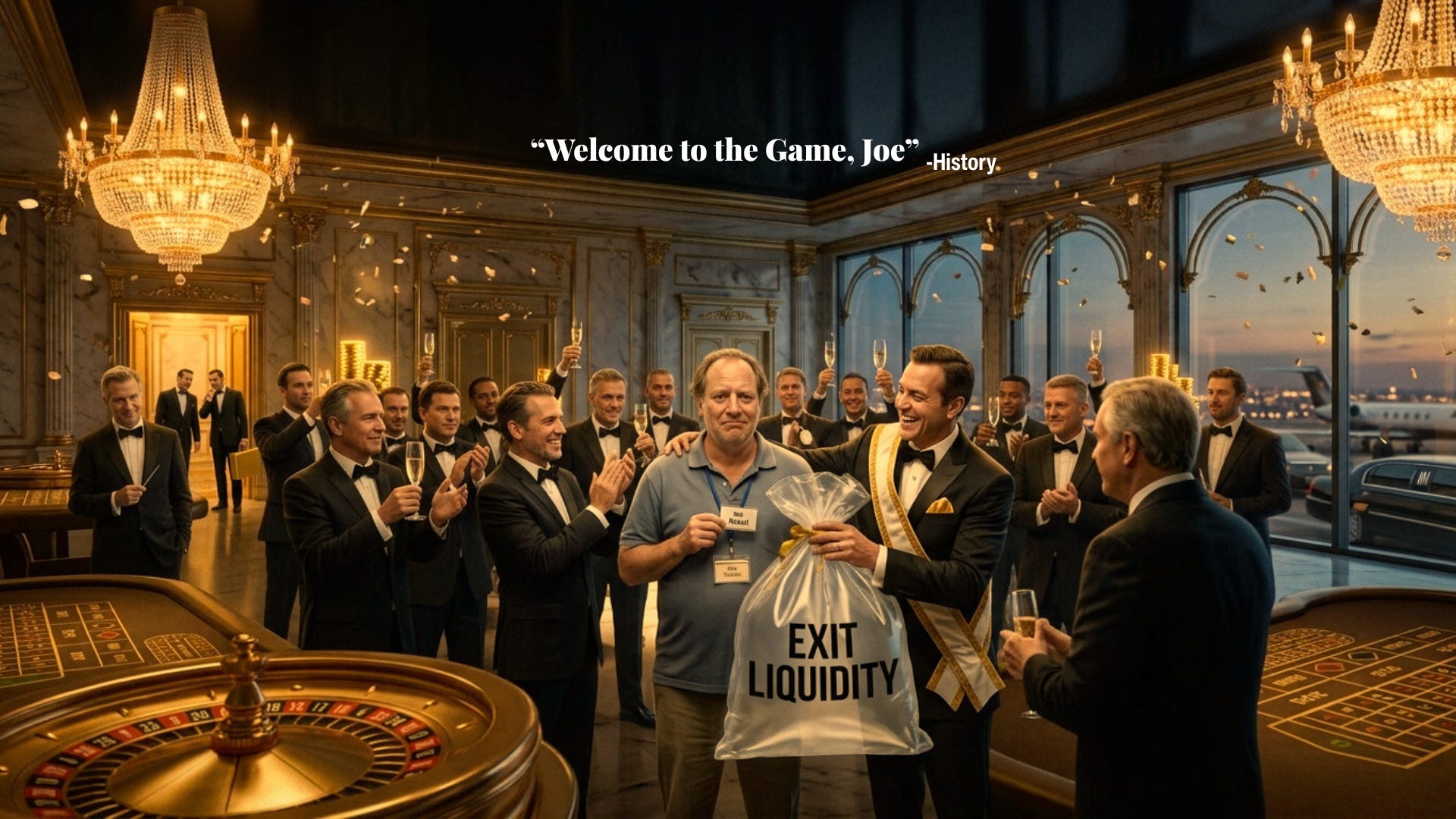
In the trade this has a name. Exit liquidity. You are the exit.
That is not a slur. It is the mechanism. The early money does not get paid until the late money shows up to take the shares off its hands. And the latest money of all, the money of last resort, is the fellow with a 401(k) who never chose any of this and the pension trustee who is mandated to track an index.
So when the private well runs dry...when a company has raised at valuations so eye-watering that even the late-stage institutions have had their fill...there is exactly one pool of capital deep enough to cash everyone out. Ours.
The tell is in the prospectus
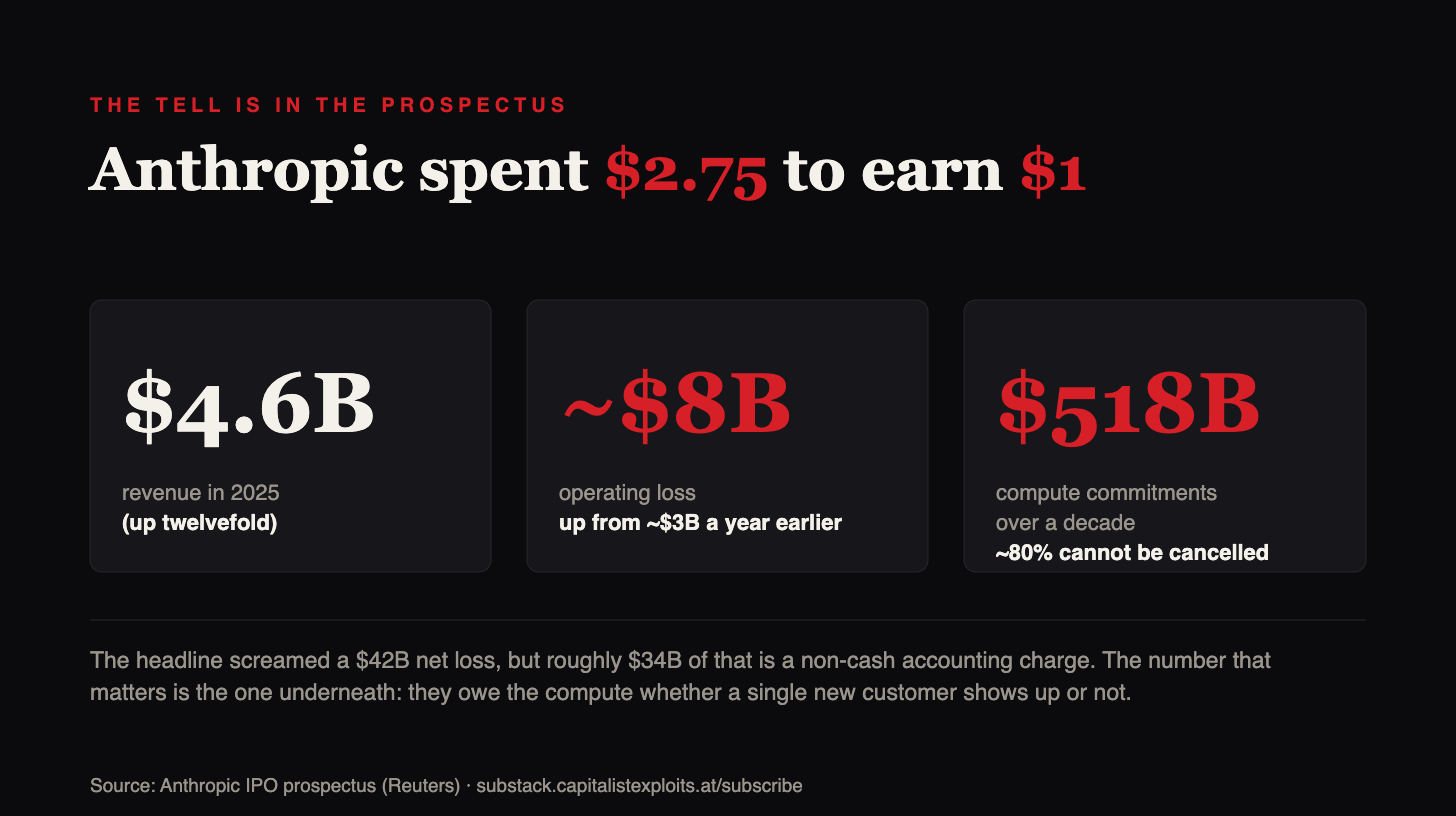
Anthropic’s own filing tells the story, if you can stomach the numbers. Revenue of $4.6 billion last year, growing twelvefold, which sounds marvellous until you notice the company spent roughly $2.75 for every $1 of that revenue, with compute alone eating $1.59 of each dollar. The operating loss ran to around $8 billion, up from $3 billion the year before.
The headline screamed $42 billion. Most of that...some $34 billion...is a non-cash accounting charge: the paper value of earlier financing that can convert into shares simply went up. So no, they did not set fire to $42 billion in a single year. But do not let the accountants comfort you either. Sitting underneath it all is $518 billion of compute commitments stretching out over the next decade, roughly 80% of which cannot be cancelled. They owe that whether a single new customer ever shows up or not.
Something that pays you is an asset. Something that reaches into your back pocket, year after year, whether you use it or not...that is a liability.
The only question that matters is who ends up holding the liability. And that is where this stops being a story about artificial intelligence and becomes a story about your retirement.
Built for the handoff
Look at how the SpaceX float was actually put together, because the architecture gives the game away. Seventy percent of the deal went to institutions, thirty to retail. Only about 5% of the whole company was floated at all...so little that it needed a regulatory waiver to get done. Raise the cash, hand the late crowd a thin slice, keep the control. Textbook.
But here is the part that should make the hair on the back of your neck stand up. You do not have to have bought a single share for this to be your problem.
Because almost nobody actually chooses anymore. The market is no longer a place where people weigh a company and make a decision. It is a machine. Money flows into index funds and ETFs...into your workplace pension, your target-date fund...and the machine buys whatever is biggest, because it is weighted by size. The bigger a thing gets, the more the machine is forced to buy, which makes it bigger, which means it buys still more. Nobody is making a decision. The system feeds on itself.
So the moment these companies list and ride into the index, you own them. Not because you believed. Because you were indexed. In other words, the exit liquidity is being collected from you automatically, by direct debit, while you sleep.
They play the flows game, not the valuation game. And the flows game can run a very long way past sense. But it ends. It always ends.
“We have to beat China”
So why am I so sure the bill lands on us and not on them?
Because of the story they are already telling. You have heard it. AI is dangerous. AI is a matter of national security. We must win the race against China. We need guardrails, oversight, a seat for the government at the table.
Call us old-fashioned, but we have seen this film. Strip away the Skynet dressing and the thing they are describing is...a very good, very fast library. A database that writes nicely. A remarkable tool, genuinely. It is not about to wake up. The fear is not a property of the technology. It is manufactured, the same way fear was manufactured not so long ago, and it does two jobs at once.
First, it builds a moat. Regulate a thing in the name of safety and you pull the ladder up behind the incumbents. The small competitor who might have built it cheaper...the next bunch of nerds in a garage...can no longer get funded or licensed. What gets sold to you as oversight is an oligopoly with a permission slip.
Second, and this is the one that matters for your money, it writes the script for the rescue. When something is declared “too important to fail,” the failure is never allowed to stay the shareholders’ problem. It becomes everyone’s. And through all of it nobody has stopped to answer the only question worth asking. We have to win the AI race...to win what, exactly?
Cyprus-ish
Here is how it goes, and you can mark the page.
The listings go through. The public and the pensions take the shares at the top. Then the cycle turns, as cycles always do, and these cash-incineration machines meet an interest-rate environment that no longer forgives companies with no earnings. The thing wobbles. And at precisely that moment...not a day before...the word “safety” arrives. It is for your protection. We cannot allow a disorderly collapse. We are stepping in.
And when the state steps in to backstop a mess this size, somebody pays for it. It does not arrive as a letter saying we are taking your money. It arrives as a mandate. A new rule about what your pension is now required to hold. A quiet conversion. A haircut dressed up as a rescue, and you wake up with cents on the dollar.
If that sounds far-fetched, it is only because you were not in Cyprus in 2013. One weekend the banks simply did not open, and depositors with more than one hundred thousand euros at the Bank of Cyprus watched 47.5% of it converted into equity in a bank nobody wanted. Overnight. By decree. Framed, naturally, as a rescue.
That is the template. Not confiscation at gunpoint. A mandate, for your safety, that quietly puts your capital in the ship they need you sitting in.
Where the clever money actually is
Now set all that noise beside what the people who move real money are quietly doing.
They are not queuing for the shiny new listings. Look at where capital is actually flooding: into US Treasury bills, the very front end of the curve, at the fastest pace on record...Cayman-based hedge funds loading up on short paper as though it is going out of fashion. Not Nvidia. Not thirty-year bonds. Bills. Liquid, short, boring, and ready to move the instant the picture clears.
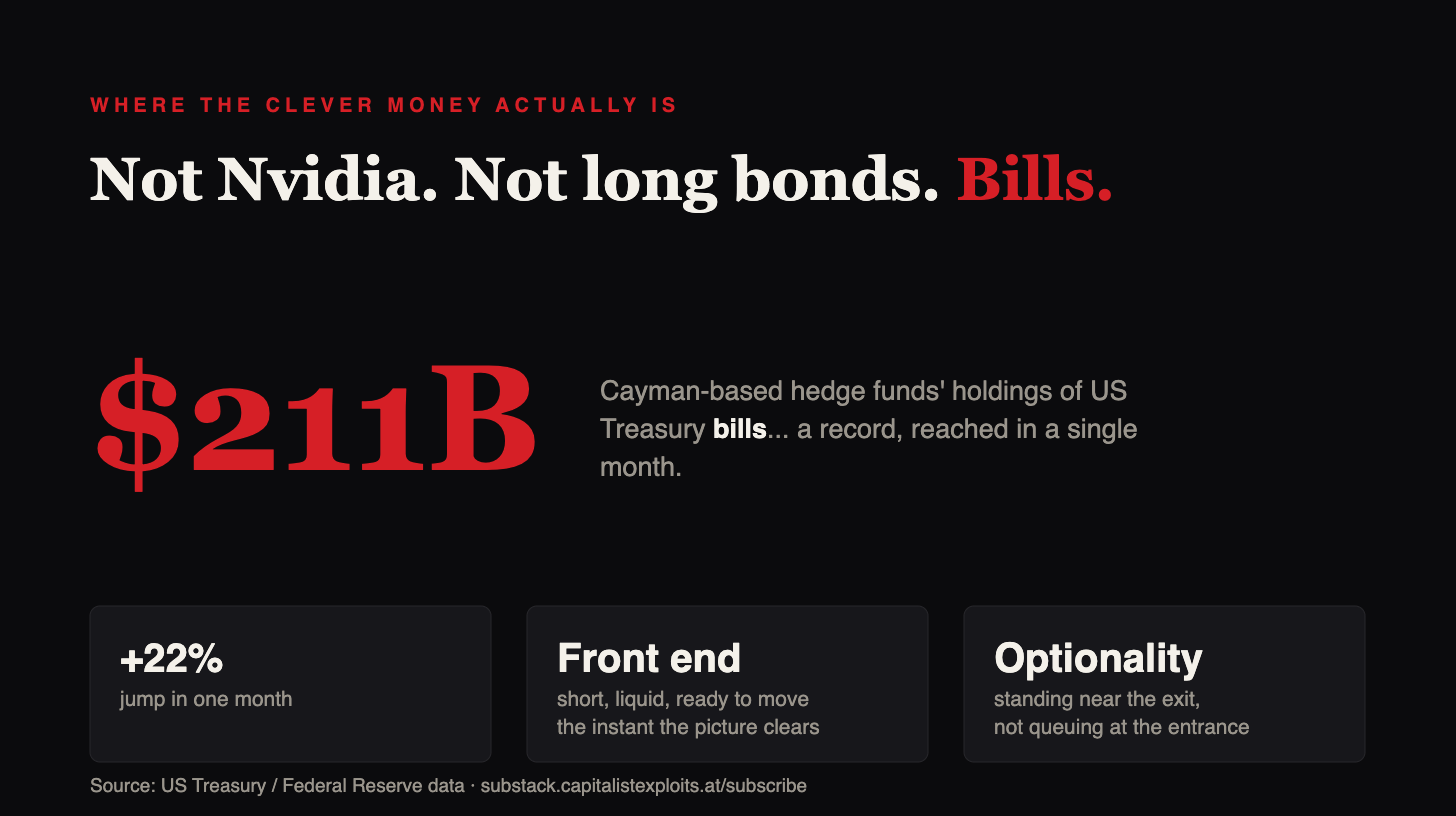
That is what conviction looks like once you strip the story away. The smart money wants to be liquid and it wants optionality. It is standing near the exit, not queuing at the entrance.
So there are two trades laid out in front of you, side by side. One is being marketed to you with trillion-dollar fanfare and a countdown clock. The other is being done quietly, in size, by people who do this for a living. Make up your mind which table you would rather sit at.
What we would actually do
We are not short a story here, and we are not telling you to go and sell everything by Tuesday. We do not do timing...anyone who tells you they can pick the day is selling you something.
What we would do is simpler, and duller, which is usually the clue that it is right. Go and look at what you actually own. Properly. Line by line. Because the odds are the index has already handed you a seat at this table without ever asking your permission. Then ask yourself a plain question: would you rather own the thing the whole world is being herded into, or the things nobody is bidding for...the stuff that pays you, the stuff that cannot be conjured into existence with an accounting entry, the hard assets sitting in the ground while the crowd stares at its screens?
The asymmetry, as ever, is on the unloved side of the room. It always is.
What you have just read is the shape of the argument. The names actually being bought and held against it...the sizing, the rotation, the live portfolios we run with real money behind them...sit inside the full Insider Service. If you want to stop being the exit and start being early, that is where the work lives.
Nothing in this article constitutes investment advice. Do your own research. All investments carry risk. This is what we think...it may not be suitable for you.